

4 December 2012
Super Typhoon Bopha (Pablo) makes landfall in the Philippines
Unfortunately, Typhoon Bopha (known as Pablo in the Philippines) rapidly intensified in the few hours before making landfall,managing to achieve Super Typhoon (Category 5) status. Landfalling super typhoons have the potential to be very damaging. This storm is exceptional in many ways, as Jeff Masters outlined in his blog yesterday. In a year of extreme events worldwide I suppose another should not be a surprise.
As forecast, the storm made landfall on the Mindanao in the Philippines, and is now tracking west-northwest across the island:
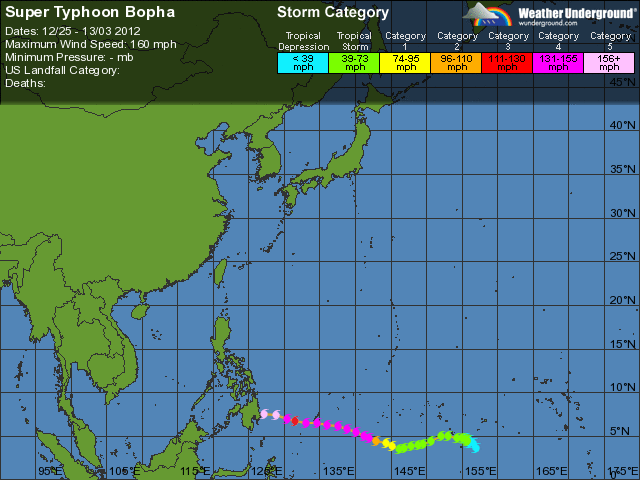
In so doing it is bringing both very damaging winds and very intense rainfall. Landslides and floods are inevitable, although at this stage it is difficult to forecast how bad these will be. It will range somewhere between bad (but manageable) and catastrophic. There are too many uncertainties to know which will apply, but the precedent from the much weaker Tropical Storm Washi a year ago is not promising. The only positive sides to this story are that there has been at least some element of preparedness and that the storm is moving fast, which may reduce the rainfall. This is the most intense typhoon to strike Mindanao in recorded history though, so the outcome could be very serious.
Three sources of useful information as the storm tracks across the island:
PAGASA – the national meteorological organisation in the Philippines
NDRRMC – the national disaster management organisation in the Philippines (who are very proactive i their use of the web)
TRMM – satellite monitoring of tropical rainfall
2 December 2012
An update on Typhoon Bopha as it heads towards the Philippines
A quick update on Typhoon Bopha (Pablo) as it churns its way towards the Philippines. The most recent forecasts suggest that it will make landfall in the southern part of the Philippines on Tuesday as a category 3 storm, and then will rapidly weaken as it loses its energy source:
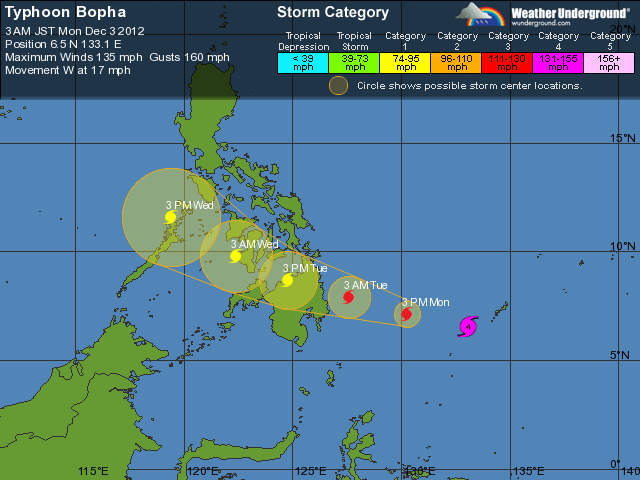 This remains a very grave danger to Mindanao and associated areas. As I have noted before, even though meteorologists focus on wind speeds, most of the harm caused by tropical cyclones comes from water – i.e. storm surge, floods and rainfall triggered landslides. Efforts are being made to prepare for the storm, but this has the potential to be very serious.
Typhoon Bopha – a very real landslide threat for the Philippines
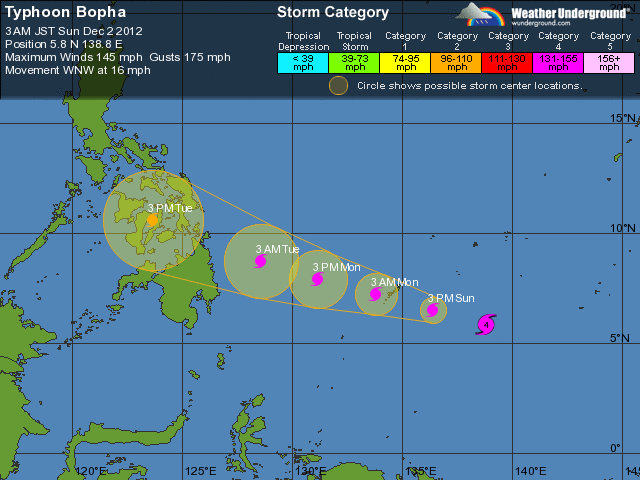
Over the last few days Typhoon Bopha (which is known as Typhoon Pablo in the Philippines) has intensified very rapidly as it tracks westwards. This is an unusual typhoon, in particular in terms of its starting point, which was at about 4 degrees North. Land-falling typhoons in December are also quite unusual (there have only been three since 1978). Usually typhoons start further from the equator than this, because they need a stronger Coriolis force to allow rotation to develop. The typhoon will pass over Palau in the next 24 hours, and then is forecast to track west-northwest to cross the southern part of the Philippines on Tuesday (map from Weather Underground):
.
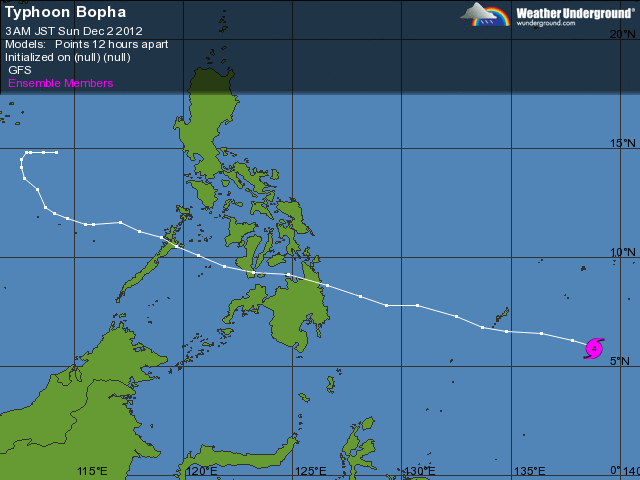
This is will make landfall in the Philippines as a category 3 storm. This is very strong, but not exceptional (the scale goes up to five). However, it is also likely to bring very heavy rainfall, which of course is the potential trigger for landslides, and the Philippines has a long history of devastating landslides from typhoons. The only positive sign is that it does seem to be moving reasonably fast, which typically reduces the rainfall impacts (the biggest problems often arise when the typhoon stalls – i.e. stops moving – which concentrates the rainfall in a smaller area). However, the longer term forecast does seem to show the storm slowing and then stalling to the west of the Philippines, which must be a cause for concern:
.
Last year Tropical Storm Sendong (known locally as Washi) crossed a similar area, also in December, bringing devastation as a result of very serious landslides and floods. Sendong was not as intense as is Bopha, being just a tropical storm as it crossed Mindanao. Whilst there is no way to know what might happen this time, the dangers are very real. There is a very real need to ensure that there is adequate preparation along the potential typhoon track. T
1 December 2012
Further landslide movement in Dorset, England
In my post yesterday I noted that:
” …deep groundwater levels will now be rising, so don’t be at all surprised if there are reports of larger landslide movements over the next few months. Places such as Dorset and the Isle of Wight, where there are large coastal landslide systems, will be particularly vulnerable.”
And sure enough, the BBC website today has an article that starts:
“A section of coastline in Dorset has been cordoned off after a crack was seen in a cliff. Coastguards called to Charmouth on Wednesday put up warning signs and Dorset County Council is considering if further action is needed.”
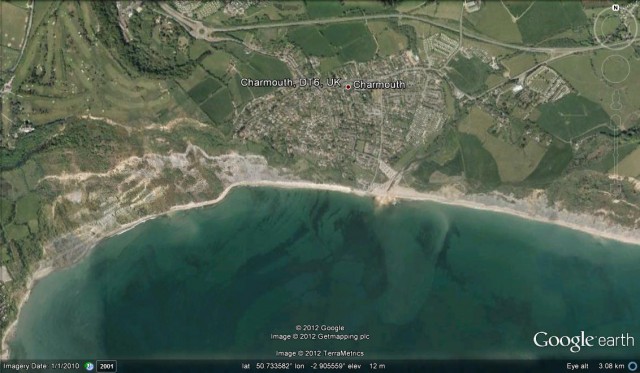
Don’t be too impressed – that deeper landslide systems will become more active was inevitable, so this was an easy call to make. Charmouth is a well-known landslide hotspot, as the Google Earth image below shows. Indeed, it is one of the places that all landslide scientists should visit:
 . . .65 ..
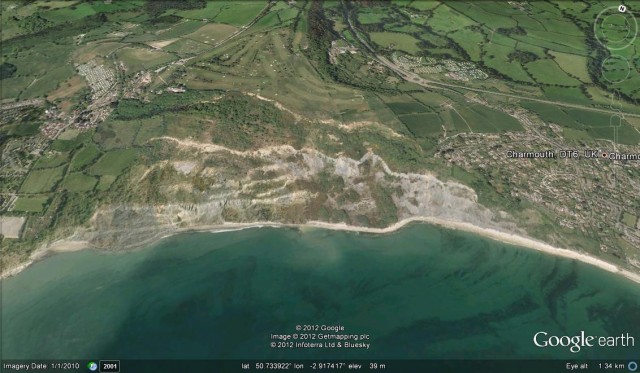
. To the west of the town is the famous Black Ven landslide complex:
.
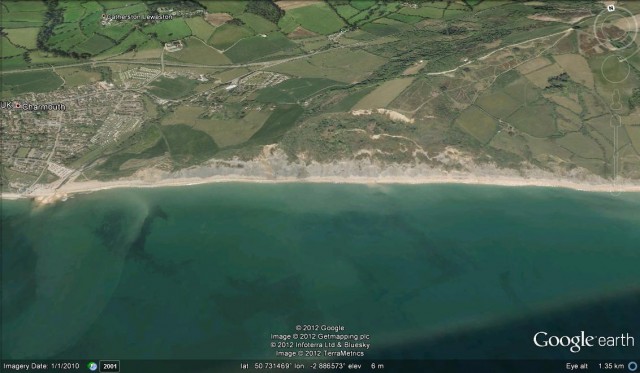
To the east is the Stonebarrow landslide:
 .
.
.
At the moment it is not at all clear where the recently reported movement has occurred, or indeed the nature of the crack that has opened up. I suspect we’ll see more such reports in the next few months.
30 November 2012
Multiple landslides in the UK in the last week
The exceptional rainfall event in the UK (there is a fantastic gallery of images of the floods at the bottom of this page) about which I blogged yesterday has been responsible for triggering landslides across the country. Indeed, I have never known so many landslides to occur in the UK – it is a very unusual period. The highest profile event occurred at Whitby, as covered in my post yesterday, and the news today is that the demolition of the houses has started.
I thought it would be interesting to pull togather a selection of other newsworthy landslides. There are many more in addition to this set:
1. Landslides on the main railway line in Teignmouth, Devon
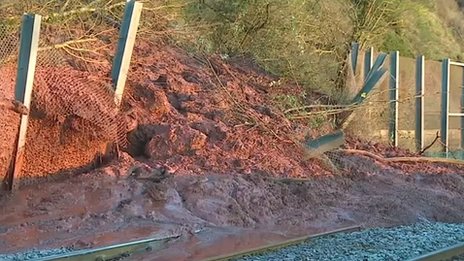
The main railway line from London to Cornwall has been repeatedly disrupted by landslides. This is the same section of line that I featured in my landslides in art series a few weeks ago. The most recent landslide occurred yesterday, and is shown below. The BBC News website reports that movement has continued and that the site is now being examined by an roped-access team. The line is not likely to reopen until Saturday.
http://www.bbc.co.uk/news/uk-england-devon-20538711
2. A rockfall in Shropshire
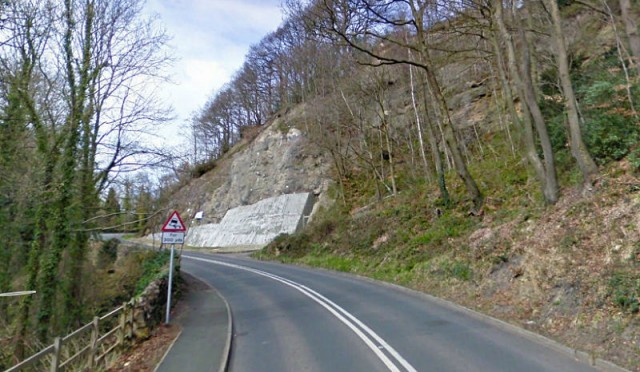
Meanwhile, over in Shropshire the key road into the World Heritage site at Ironbridge has been blocked by a rockfall at Jiggers Bank. This stretch of road has had repeated rockfall problems and has been subject to a number of remediation exercises, as the image below shows. The reports suggest that the most recent event was on a section of the slope that had not been engineered. The road is still closed.
http://www.shropshirelive.com/2012/11/29/jiggers-bank-to-remain-closed-following-rockfall/
3. Another railway line landslide, this time in West Sussex
Meanwhile, an important commuter railway line suffered a small embankment failure between Holmwood and Dorking, near to Horsham in West Sussex. Although not large, the landslide shifted ballast from under the sleepers, leaving the track unusable. This has caused considerable disruption:

http://www.streathamguardian.co.uk/news/10079114.Commuters_delayed_amid_emergency_timetable_teething_problems/
4. And yet another railway landslide, this time in Gloucestershire
A very similar landslide to that described above occurred at Westerleigh junction in Gloucestershire, closing one of the two tracks between Bristol and Swindon. This landslide appears to be larger than the one at Horsham, but has not retrogressed to the point at which the track is undermined. The article notes that Network Rail, who are responsible for track maintenance, have estimated that the repair will need 4000 tonnes of ballast.

http://www.thisisbristol.co.uk/Continued-delays-rail-landslip-Bristol-Swindon/story-17454430-detail/story.html
5. A coastal landslide in North Devon
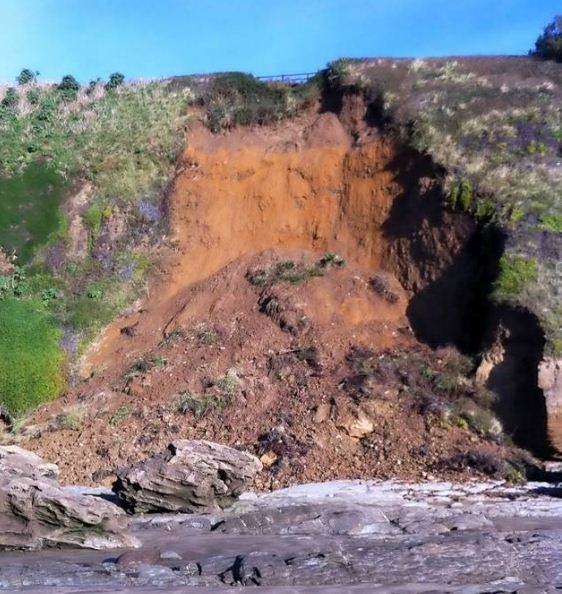
Over in North Devon, a coastal landslide at Saunton occurred on Wednesday night. This image, captured by Bob Braunton and featured on the North Devon Gazette web site shows the landslide:
http://www.northdevongazette.co.uk/news/landslide_on_saunton_beach_1_1716116
So what next?
The heavy rainfall has now moved away, to be replaced by cold weather, so the immediate threat should start to subside. However, for some slopes the groundwater level will still be rising as the rainfall percolates through, so more landslides are possible. It is notable though that all of the above landslides are shallow – so far there is not much sign of the deep-seated landslide systems reactivating. This is almost certainly because groundwater levels were so low after the prolonged drought that ended in the early summer. These deep groundwater levels will now be rising, so don’t be at all surprised if there are reports of larger landslide movements over the next few months. Places such as Dorset and the Isle of Wight, where there are large coastal landslide systems, will be particularly vulnerable. Such landslides represent a comparatively low level of risk to life, but can cause extensive property damage. It will be an interesting winter.
28 November 2012
A damaging landslide in Whitby, England triggered by recent heavy rainfall
An exceptional period of rainfall, triggered by a pair of low pressures systems crossing a country with soils that were already saturated, caused considerable disruption across the UK over the weekend. The effects have been so significant that the Environment Agency has activated the Disaster Charter, which facilitates the collection and initial analysis of remotely sensed imagery after a disaster. Activations in the UK are very rare. In North Yorkshire, the historic fishing port of Whitby suffered a landslide that was not particularly large but has been quite damaging. Whitby is located around the mouth of the River Esk, which has cut a steep valley into the local rocks. The result is a large number of steep slopes upon which most of the old part of the town is built. I have featured the landslides and rockfalls in Whitby before, although most of the the mass movements are associated with coastal erosion of one type or another.
My group has been studying coastal landslides and rockfalls at Whitby for a long time, and we have a number of long-term monitoring sites in the area. Separately I can recommend a very nice cottage to rent in the old part of the town near the sea if you would like to pay a visit to Whitby 😉
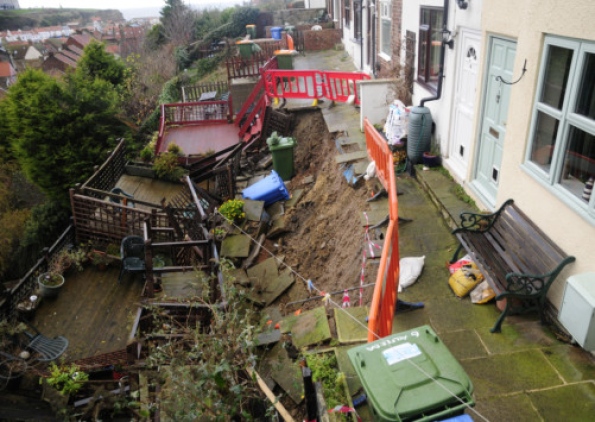
During the heavy rainfall a landslide occurred on the east side of the river valley, affecting the gardens of a row of Victorian (19th Century) cottages. The Whitby Gazette has the story, with a good image of the site:
.
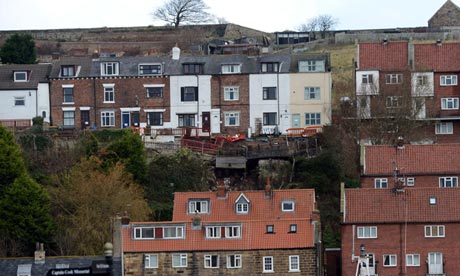
Whilst the Guardian has a good image from the other side of the river:
Photograph: John Giles/PA
.
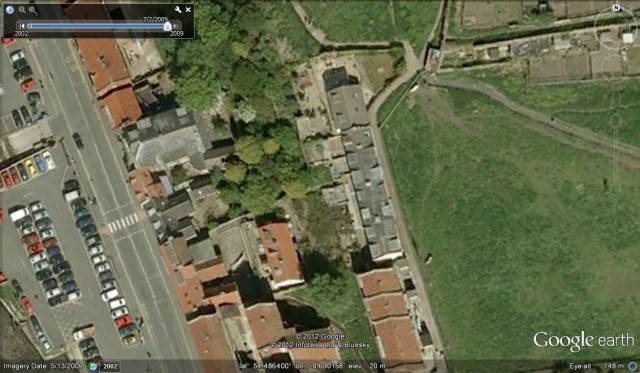
The row of houses, called Aelfleda Terrace, has been condemned by the local council and will need to be demolished. The problem is not that the houses are damaged – indeed the Whitby Gazette report suggests that they are unaffected by the landslide, but that there is the potential for further movement. Collapse of the properties would put at risk the houses downslope of the terrace.
Of course this is heart-breaking for the owners of the houses (although according to the Whitby Gazette article they seem confident that the property loss will be covered by their insurance). According to the article, local people are blaming instability in the area on apparently flawed drainage works, with suggestions of a more global issue associated with the placement of fill during construction of a car park. It is impossible to say without a more detailed evaluation whether either of these issues is a factor. The BBC News website indicates that the private water company Yorkshire Water have been in discussions with the house owners prior to this event.
For info the image below shows the Google Earth imagery for this area, collected in 2009. The resolution of the imagery is not good enough to see whether the slope in question was showing signs of distress at this time:
 .
.
According to Rightmove, one of these properties sold in 2007 for about £200,000, suggesting that about £1 million worth of property has been destroyed.
26 November 2012
Rockfall risk assessment reports for the Port Hills, Christchurch, New Zealand
 .
.
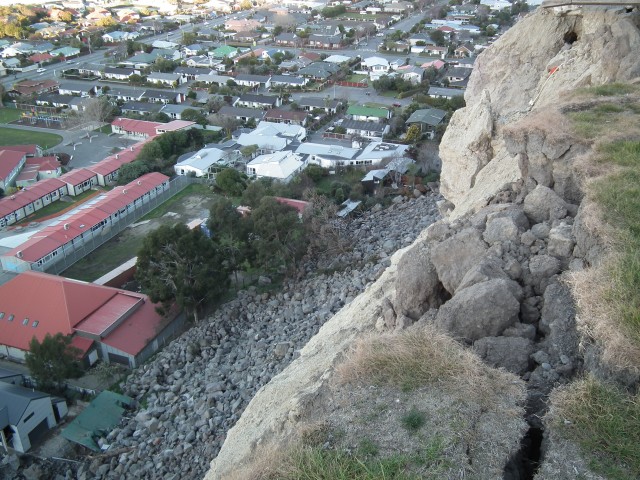
One of the legacies of the Christchurch earthquake sequence in New Zealand has been both increased levels of rockfall hazard and increased awareness of the level of hazard that predated the seismic events. The most seriously affected area is the Port Hills area to the southeast of the city, where large numbers of houses were affected by rockfalls during the earthquakes, and may more were left at risk in the aftermath. To assess the level of hazard properly, Christchurch City Council commissioned GNS Science to undertake a quantitative life risk assessment for the affected areas. This has been a huge piece of work, undertaken in the public spotlight on a very short timescale. The aim has been to generate the best possible assessment of the risk to life; this assessment can then be used as the basis for decisions on the viability of individual properties.
Christchurch City Council have now released the full set of reports of the rockfall life risk assessment, such that they area available for download. A total of seven reports are available as PDFs as follows:
- Canterbury Earthquakes 2010/2011 Port Hills Slope Stability: Geomorphology mapping for rockfall risk assessment
- Canterbury Earthquakes 2010/11 Port Hills Slope Stability: Principles and criteria for the assessment of risk from slope instability in the Port Hills, Christchurch
- Canterbury Earthquakes 2010/11 Port Hills Slope Stability: Pilot study for assessing life-safety risk from cliff collapse
- Canterbury Earthquakes 2010/11 Port Hills Slope Stability: Life-safety risk from cliff collapse in the Port Hills
- Canterbury Earthquakes 2010/11 Port Hills Slope Stability: Additional assessment of the life-safety risk from rockfalls (boulder rolls)
- Canterbury Earthquakes 2010/11 Port Hills Slope Stability: Pilot study for assessing life-safety risk from rockfalls (boulder roll)
- Canterbury Earthquakes 2010/11 Port Hills Slope Stability: Life-safety risk from rockfalls (boulder roll) in the Port Hills
- Separate maps associated with the reports
The analysis presented in these reports is really fascinating – they are the most comprehensive, carefully-considered and thorough rockfall risk assessments that I have ever seen. I strongly commend in particular the “principles and criteria” report (number 2) and the Life safety risk reports (numbers 4 and 7).
Inevitably the political situation with regard to implementing the outcome of these analyses is very complex, but at least there is a credible scientific analysis from which to start.
24 November 2012
Download the Powerpoint file of my talk “Plate Tectonics & associated hazards: Christchurch, New Zealand”
On Tuesday I gave a talk at a Teachers First conference on Plate Tectonic hazards held in London. These events are the most enjoyable presentations that I give – school teachers are wonderfully knowledgeable, engaged and interesting. I promised the group that I’d make my talk available online via this site, so as usual it can be downloaded from Authorstream. The talk aims to provide some background on the plate tectonic setting of New Zealand (which is complex), and then to talk about the very surprising hazards that the Christchurch earthquake sequence has generated. You should be able to see the talk below (unless you are unlucky enough to be using something manufactured by Apple – my sympathy if so), or alternatively you can view it here.
[authorSTREAM id= 1600665_634892645118877500 pl= player by= Nubiagroup]
23 November 2012
Boulders!
In the last few days there have been several interesting incidents involving boulders on various scales:
1. A small boulder movement in Bath, England
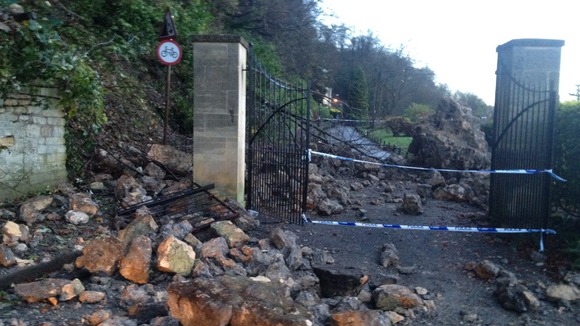
The spell of exceptionally wet weather in the Uk over the last few months continued yesterday (and there is more due tomorrow) with a very intense low pressure system bringing very heavy precipitation. In the beautiful city of Bath, a boulder was dislodged and rolled about 20 m downhill overnight. This was quite small, but still had an estimated mass of about 3 tonnes:
http://www.itv.com/news/west/update/2012-11-23/landslip-in-bath-releases-huge-boulder/
.
The boulder has a rather strange shape, so I’d be interested to hear what it is made from.
On a slightly larger scale, James Glover, a PhD student here at Durham, drew two really ice examples from Europe last week to my attention:
2. A large boulder fall in Switzerland
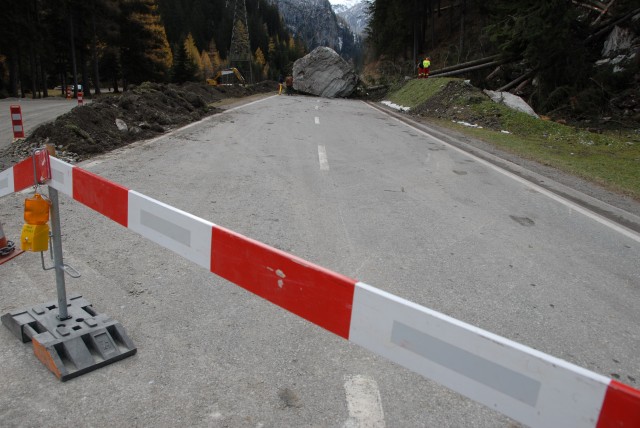
In Switzerland last week an 80 cubic metre boulder fell onto Julierstrasse between Rona and Mulegns. James passed on to photos that Maja Bless took of the boulder and its source / track:

.  .
.
3. A very large boulder fall on the Gotthard Tunnel rail line.
(And many thanks to a few other people for highlighting this one too). Last Wednesday a huge boulder fell onto the Gotthard Tunnel railway line in Switzerland. This Swiss article provides the details in German, but in a nutshell about 70 cubic metres of rock came down and landed on the track, which was blocked until last Monday. This is a screen grab from that article – I suspect that the designers of the rock catch fence didn’t quite anticipate that their design would be tested to this extent:
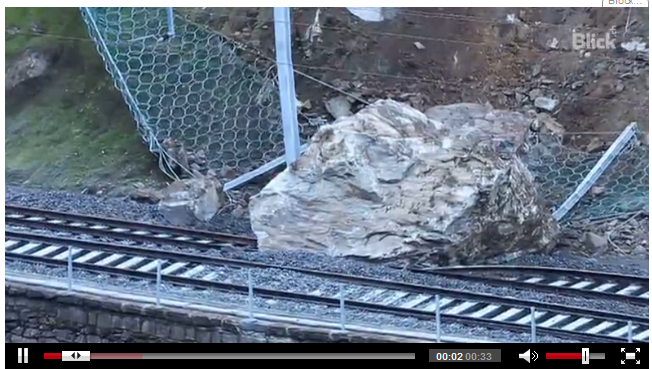
.
This site has suffered repeatedly from landslides this year, but it may well have been that the geologists found it very difficult to assess the stability of a block this large.
20 November 2012
Landslide sessions at EGU 2013
The EGU General Assembly, held each year in Vienna, is the greatest annual meeting of landslide scientists and practitioners. The 2013 meeting will be held from 7th to 12th April and promises to be an amazing event as usual. Having given the meeting a miss last year (I had attended the previous six years) I am raring to go in 2013, especially as I will miss the AGU Fall Meeting in San Francisco in a fortnight. There is a wide variety of sessions to which abstracts can be submitted – it is likely that some of these will be merged in due course, making the event a little easier to navigate. This is the full session list:
NH3.1: Mechanisms and processes of landslides induced by water
Convener: Hiroshi Fukuoka | Co-Conveners: Thom Bogaard , Roberto Greco , Giovanni Crosta , Paolo Frattini , Jean-Philippe Malet
NH3.2 Landslide mechanisms and processes in seismically or volcanically active environments
Convener: Randall W. Jibson | Co-Conveners: Janusz Wasowski , Hiroshi Fukuoka , Chyi-Tyi Lee , Vincenzo Del Gaudio
NH3.3 Rockfalls, rockslides and rock avalanches
Conveners: Michael Krautblatter , Jeffrey Moore | Co-Conveners: Federico Agliardi , Giovanni Crosta , Axel Volkwein , Luuk Dorren
NH3.5 Advanced methods in landslides research I: Characterizing and monitoring landslide processes using remote sensing and geophysics
Convener: Michel Jaboyedoff | Co-Conveners: Vincenzo Del Gaudio , Janusz Wasowski , Gilles Grandjean
NH3.6 Advanced methods in landslides research II: modelling
Convener: Giulio G.R. Iovine | Co-Convener: Denis Cohen
NH3.7 Large slope instabilities: characterisation, dating, triggering, monitoring and modelling
Convener: Giovanni Crosta | Co-Conveners: Michel Jaboyedoff , Federico Agliardi , John Clague , Lars Blikra , Oliver Korup
NH3.8 Prediction and forecasting of landslides
Convener: Filippo Catani | Co-Convener: Fausto Guzzetti
NH3.9 SafeLand Project and other research on effects of global change on spatial and temporal patterns of landslide risk
Convener: Farrokh Nadim | Co-Conveners: Jordi Corominas , H. Modaressi , Joanne Bayer , Luciano Picarelli , Leonardo Cascini , N. Casagli
NH3.10 Documentation and monitoring of landslides and debris flows for mathematical modelling and design of mitigation measures
Convener: Luca Franzi | Co-Conveners: Massimo Arattano , Muneyuki Arai
NH3.11 Landslide hazard and risk assessment, and landslide management
Convener: Paola Reichenbach | Co-Conveners: Fausto Guzzetti , Andreas Günther
NH3.12 Erosion/deposition in geophysical granular flows
Convener: Anne Mangeney
NH3.13 Numerical modeling for the analysis of failure processes in geomaterials and geostructures
Convener: Riccardo Castellanza | Co-Conveners: Jose Antonio Fernandez Merodo , Piernicola Lollino , S. Utili
GM6.1/NH3.14 Rockfalls, rockslides and rock avalanches (co-organized)
Convener: Michael Krautblatter
GM9.2/HS9.8/NH3.15 Geomorphic and hydrological processes in proglacial areas under conditions of (rapid) deglaciation (co-organized)
Convener: Tobias Heckmann | Co-Conveners: Andrew Kos , Christian Briese , Reynald Delaloye , Volkmar Mair , Samuel McColl , David Morche , Philip Owens , Tim Stott
Full details are available here; abstracts (there is no need to write a full paper for this meeting) are due on 9th January 2013. There is usually no possibility of an extension to this deadline.
 Dave Petley is the Vice-Chancellor of the University of Hull in the United Kingdom. His blog provides commentary and analysis of landslide events occurring worldwide, including the landslides themselves, latest research, and conferences and meetings.
Recent Comments