

16 November 2012
Losses from landslides in Colombia
Colombia is a country with a serious landslide problem. The combination of mountainous terrain, active tectonics, occasional earthquakes, deep weathering and intense rainfall means that the level of hazard is high. Add to this a vulnerable population and rapid expansion of the infrastructure, and the results are inevitably that losses from landslides are high. In recent years I seem to have blogged about landslide events in Colombia on numerous occasions (for example here, here and here), and there have been some spectacular events caught on video.
This graph shows the cumulative level of landslide losses in Colombia since the start of 2004, based upon my fatal landslide database (a paper explaining and analysing the data from the database can be found here):
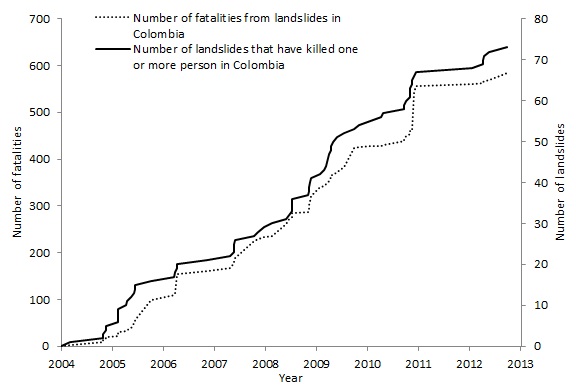 The seasonal nature of losses from landslides is quite clear, as is the high rate of losses in the period 2007-2011. Note that rainfall patterns in Colombia are heavily affected by the El Niño – La Nina (ENSO) cycle, with the heaviest precipitation being associated with El Niño conditions. Current conditions are neutral in terms of ENSO at present, but the effects of the recent La Nina conditions are clear in the graph above when the previously steep trend flattened out.
The impact of landslides across Colombia compared with the rest of South America can be seen in the map below, which shows fatal landslides from 2004 to 2011. Each dot is a single landslide that killed one or more people; the background is a digital elevation model. The concentration in Colombia (in the northwest of the map) is clear:
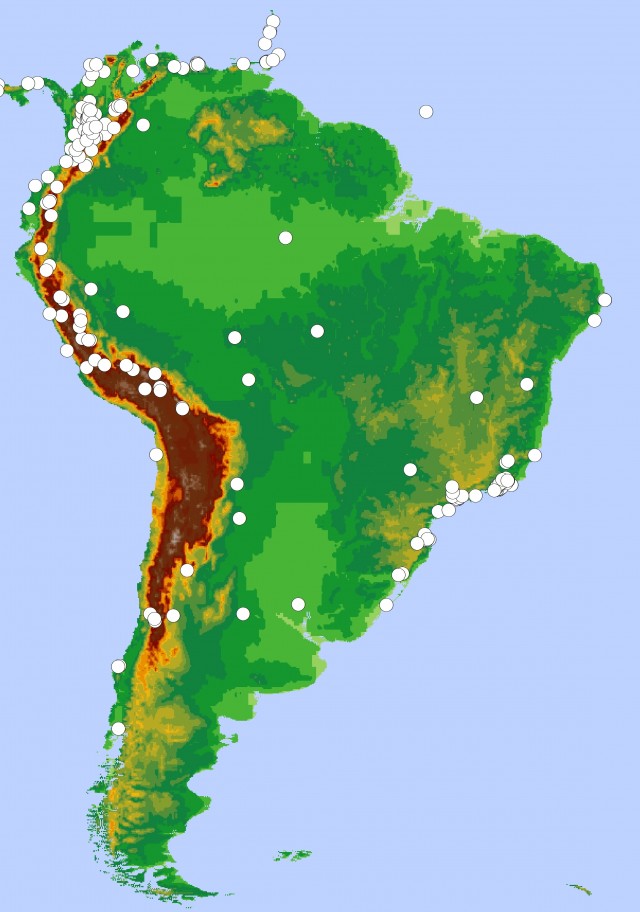 If we are to reduce the impact of landslides across South America then Colombia needs to be a priority country. Note also that western Colombia has high levels of seismic hazard – a large earthquake in this area would probably cause landsliding on a very large scale.
15 November 2012
Durham University undergraduate work on communities affected by landslides in Nepal
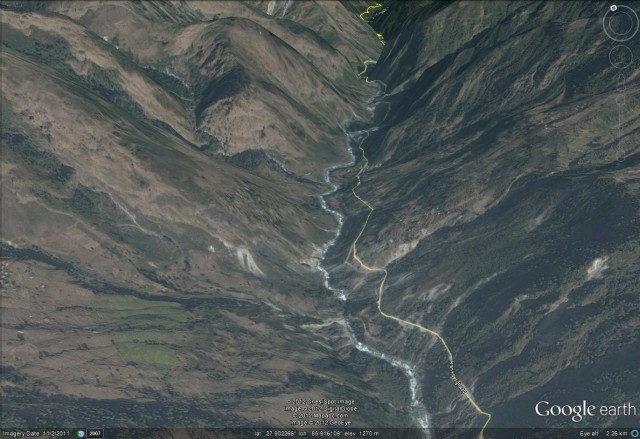
Each year, undergraduates from my department (Geography) at here at Durham undertake a field trip to the Bhote Kosi area of northern Nepal. This is a stunning environment that is also affected by multiple landslide hazards. The impacts are serious, for example frequently disrupting the strategically-important Arniko Highway, which links Kathmandu and Tibet. Inevitably though the greatest burden of the landslides falls upon the people living in the area, who are in general both very poor and very vulnerable to the affects of these hazards. Although not of the highest resolution, the Google Earth perspective view gives a pretty clear view of how serious the landslide problem is in the area:
 During the field trip, the students worked on a variety of physical and social projects in the area, spending time living in local communities. One of the projects focused on the impacts of a large, deep-seated landslide on local communities, with data being collected through both detailed mapping and interviews with the indigenous population. One of the students, Amy Wright, has written-up the work as a post on the IHRR blog. I thoroughly recommend that you take a look – this for example is a quote from her post:
“although not directly related to our study of changing landslide behaviour in relation to precipitation variations, the chronic risk that the local community faces due to the location of the settlement became apparent through our discussions with residents affected by the landslide. This was exemplified by the fact that local resident Kahika Bahadurshrestha’s father and brother had been tragically killed in 1990 by a boulder 2m in diameter demolishing part of their house, which was already partially destroyed twice this year.
“Despite the inherent risk posed by the landslide, the opportunity of living by the road being greater than the risk posed permeated the conversations; Kahika was able to earn a yearly salary that was above the national average through transferring goods from a vehicle on one side of the landslide to the other when the road had been blocked by slope movements.”
There are far too few studies on the social impacts of landslides, especially in less developed countries, so this is important. That it is being undertaken by undergraduates as part of their course is all the more remarkable.
14 November 2012
A interesting rockslide in Moab, Utah
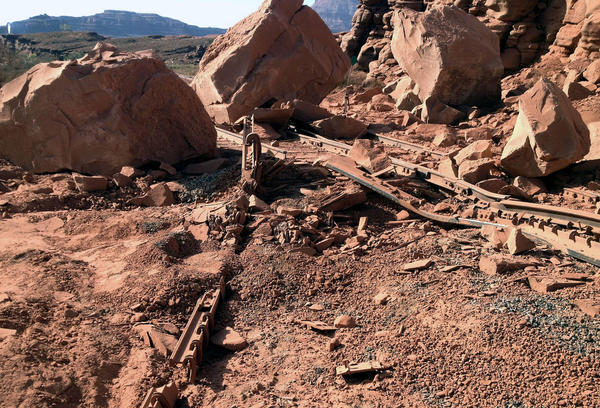
Hat tip to Bill Scarber for bringing this one to my attention. On 5th November a rockslide occurred about 15 km west of Moab in the Utah desert, damaging a railway line that is used to transport potash from a mine to market. The rockslide destroyed about 100 m of the line and also punched a large crater into a local road, Route 279. KSL has a rather nice video that shows images of the site, which may or may not embed below:
Alternatively, the images can be seen here. These two images show the damage to the line and to the highway:
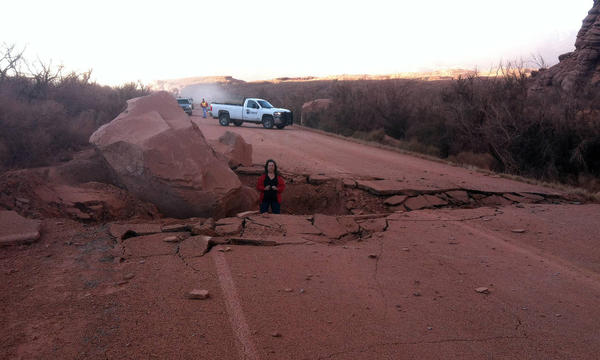 The railway line was reopened today.
12 November 2012
Lateral spread failures from earthquakes in Burma
NB: this is a corrected post – it is now clear that the lateral spreading images are from the 2011 Burma earthquake, not the November 2012 event.
There is comparatively little news emerging from Burma (Myanmar) following the earthquake yesterday, but current estimates put the loss of life at about 13 people, although communications with remote communities seem to be rather challenging. The most eye-catching event was the collapse of an under-construction bridge across the Irrawaddy River near Sint Ku, killing four construction workers:
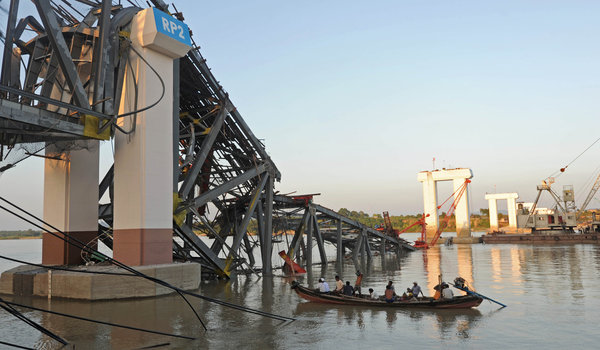
http://www.nytimes.com/2012/11/12/world/asia/deadly-myanmar-quake-destroys-bridge-and-mine.html?_r=0
There is at least some evidence of lateral spread failures during the earthquake. This image, from here, appears to show such a failure:
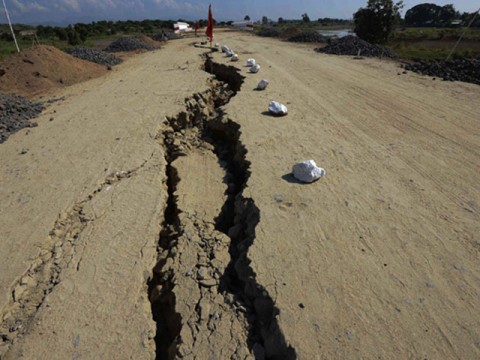
Previous earthquakes in Burma have shown impressive lateral spreading. This image for example, from an excellent gallery of images available here from the 24th March 2011 event, probably shows a lateral spread failure:
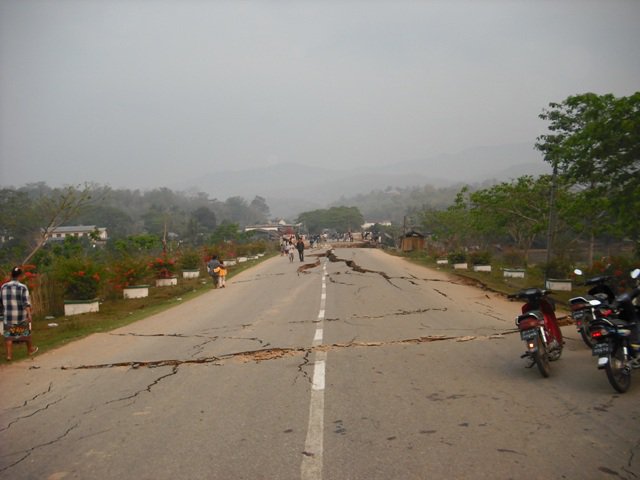 .
.
Note the displacement of the white lines, which indicates that the area delineated by the tension crack has displaced laterally to the left. There is another nice example, from a different location, although note that there may also be an element of settlement in the fill under the road here as well:
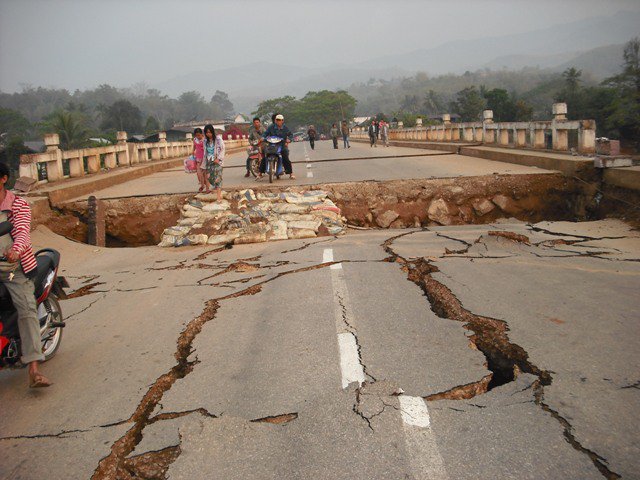 .
.
The behaviour of these lateral spread failures during aftershocks is highly complex, not least because retrogression of the spread can cause existing tension cracks to close. For this reason, it is fair to say that this is not an officially-recommended approach to demonstrating the size of a tension crack:
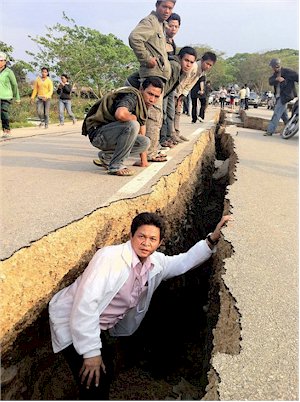
http://earthquake-report.com/2011/03/27/pictures-of-the-devastation-after-the-deadly-earthquake-in-tachileik-myanmar/
11 November 2012
First news of the Burma earthquake and an update on landslides from the Guatemala earthquake
1. The Burma earthquake
The M = 6.8 earthquake in Burma (I refuse to use the term Myanmar) this morning occurred at a depth of less than 10 km according the USGS, which should suggest that the impact has not been insignificant. The PAGER system calculates a 32% likelihood on 1 to 100 fatalities and a 32% likelihood of 100 to 1000 fatalities. However, initial reports suggest losses at the bottom end of the scale, although it is early days. The location of the epicentre, shown below, suggests that landslides might be an issue in at least a part of the area:
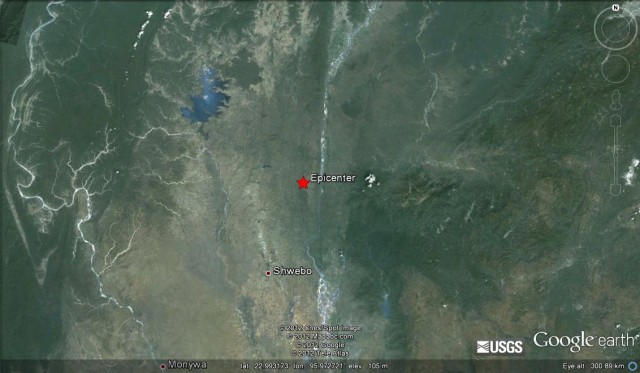
2. The Guatemala earthquake
Overnight more information has emerged about the impact of the Guatemala earthquake. Interestingly, this has seen the total number of lives lost adjusted downward to 42, with just two people reported missing. However, the loss of life from landslides has now risen to 28 with news that the largest single fatality event in the earthquake, the loss of ten lives from a single family, was due to a landslide in a quarry at San Cristóbal Cucho. The family consisted of the parents plus six children aged 14 and under. One additional member of the family, aged 19, survived because he was not in the quarry at the time.
This new information means that landslides are now known to have claimed 28 out of 44 likely deaths, i.e about 62%. Of these, 25 deaths appear to have occurred in three quarry collapses.
9 November 2012
More news of landslides from the Guatemala earthquake and first reports of a landslide dam break flood in Indonesia
A little more detail is emerging of landslides triggered by Wednesday’s M = 7.4 earthquake in Guatemala. Conred is reporting that 52 people lost their lives, with a further 22 reported missing.
From a landslide perspective perhaps most interesting is the image below, taken by Prensa Libre and posted on Twitter, of a landslide in Concepción Chiquirichapa. The commentary suggests that eight people were buried. This news report (in Spanish) confirms that all eight victims were killed in the quarry.
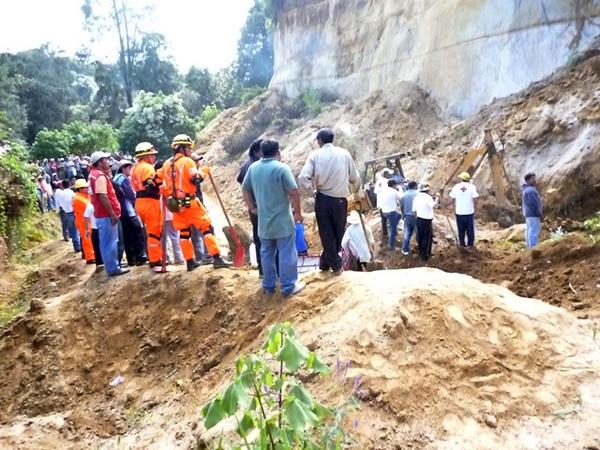 .
.
Meanwhile, this news report suggests that two people, including a nine-year old girl, were killed in a landslide at Zunil whilst collecting garbage, and that one person was killed on Mount La Muela in a rockfall. From what I can work out, this is in addition to the quarry landslide that I reported yesterday in San Marcos (see this report for example), which seems to have killed seven people.
If so, this would generate a tally of 18 landslide-related deaths out of a total 52 known fatalities. The typical ratio for landslide related deaths during an earthquake in a mountainous area is about 30% of the total – for this earthquake it appears to be in the range 24 to 35%, i.e. it is quite typical.
Meanwhile, from Indonesia there are some very early reports of a landslide dam collapse and resulting flood at Batanguru village in Mamasa district, Sulawesi. Reports vary somewhat as to the losses, but the most detailed report so far indicates 11 fatalities and seven people missing. More details of this should emerge during the day.
8 November 2012
First news and images of landslides from the M=7.4 earthquake in Guatemala yesterday
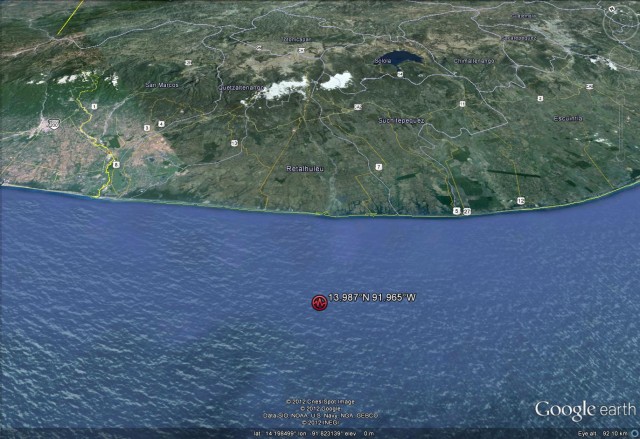
The M=7.4 that struck just offshore western Guatemala yesterday is now believed to have killed at least 48 people, with more people thought to still be buried in the rubble. The location of the epicenter of the earthquake, as measured by the USGS, indicates that there is high ground within the area that might be expected to have suffered high peak ground accelerations (as the Google Earth perspective view below shows), indicating that landslides are likely:
 .
.
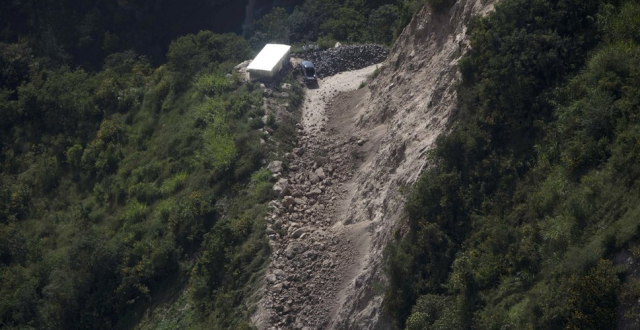
Inevitably, the area affected by landslides is both remote and inaccessible in the aftermath of the earthquake, so a proper understanding of the landslides will take some time. In the meantime, there is some evidence that landslides have been a significant problem. The BBC has two images that show landslides. The first appears to be a simple rockslope failure:
http://www.bbc.co.uk/news/world-latin-america-20247046
.
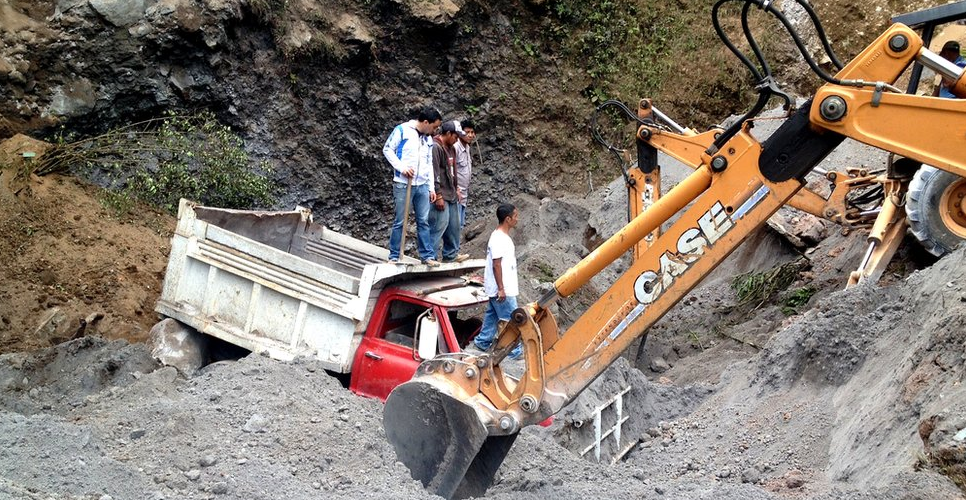
Whilst the second is a slope failure in an aggregate quarry that is reported to have claimed seven lives:
http://www.bbc.co.uk/news/world-latin-america-20247046
.
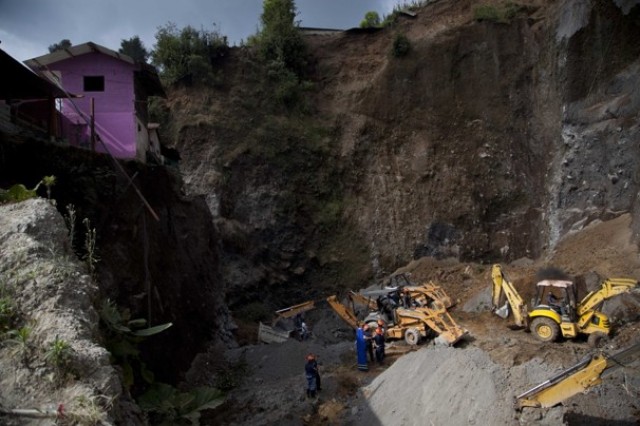
The Washington Post has another picture of what I assume is the same site:
http://www.washingtonpost.com/world/the_americas/powerful-earthquake-strikes-guatemala-border-area-near-mexico-killing-at-least-39-people/2012/11/07/90306926-2939-11e2-aaa5-ac786110c486_story.html
.
More images of the landslides will probably emerge in the next day or so.
7 November 2012
The National Slope Masterplan in Malaysia
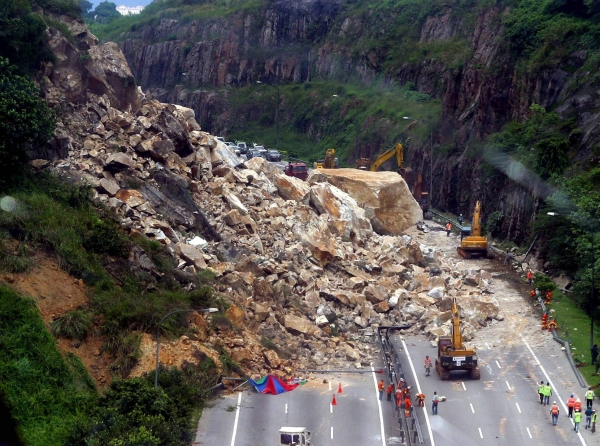
In 2004 Malaysia suffered the latest in a series of landslide incidents when a large rockslope failed and collapsed onto the New Klang Valley Expressway (NKVE) on the edge of Kuala Lumpur at Bukit Lanjan. This remarkable landslide, pictured below, closed the motorway for many months,inducing huge costs, although fortunately no-one was killed:
http://allmalaysia.info/wp-content/uploads/2012/03/perfectshots20.jpg
.
In response, the Malaysian Government formed the dedicated Slope Engineering Department within the Public Works Department, in order to manage slopes and to reduce the loss of life associated with landslides. One of the key actions of the Slope Engineering Department was to commission the development of a comprehensive plan for the management of slopes across Malaysia for the period 2009 to 2023. I was fortunate to have the opportunity to participate in this project in a small way as an expert reviewer – it was one of the most enjoyable tasks that I have undertaken in my professional career. The resulting document is large and very comprehensive, covering everything from hazard assessment through loss estimation, training, regulation and emergency response. In my view it is one of the most comprehensive national plans for slope management available anywhere in the world.
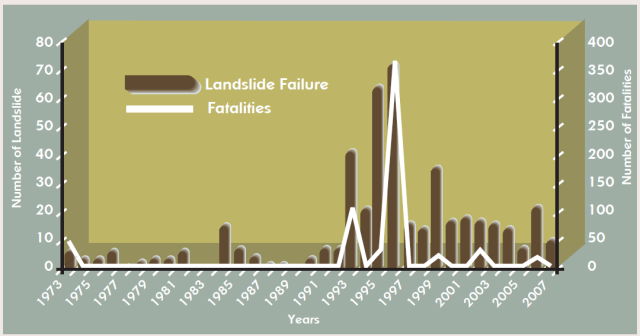
The document is now available online here (and there is a media report about it here). It is well worth a read, and deserves greater attention as a model for the ways that other countries might tackle their slope problems. There is a huge amount of detail in the report. For example, the document provides an assessment of landslide losses in Malaysia in the years leading up to the study:
 .
.
And in Appendix B (NB PDF) it even provides an inventory of significant landslide loss events across the nation.
6 November 2012
The most beautiful landslide on Earth? The Quiraing landslide on the Isle of Skye, Scotland
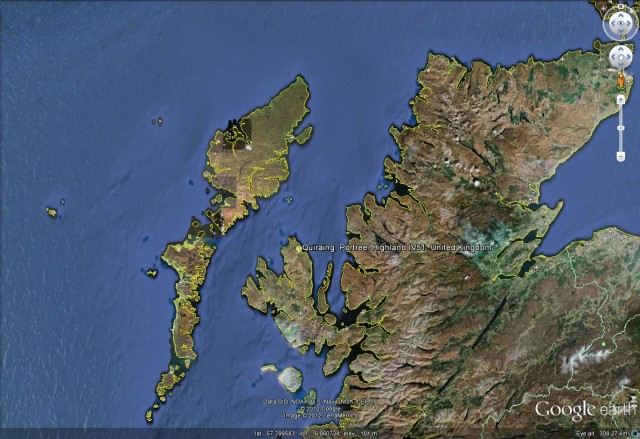
One of the most picturesque landslides on the earth is located at Quiraing (sometimes spelt Quirang) on the Isle of Skye in north-west Scotland. This is a very large, complex landslide complex on the Trotternish Range on the northern side of the Isle of Skye:
.
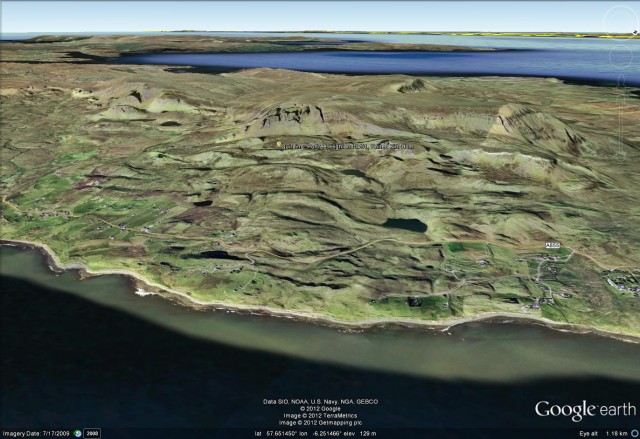
The landslide complex itself is both very large and very complex, as the Google Earth imagery shows:
 .
.
These are the largest landslides in the UK, covering an area of at least 8.5 square kilometres. This is a classic geologically-controlled landslide system, consisting of thick basalt layers overlying weak Jurassic sediments. The weight of the basaltic rocks is driving failure in the Jurassic sediments, allowing landslides to develop on a very large-scale. Movements continue today, albeit at a fairly low rate.
Where this landslide comes into its own in terms of majestic beauty – indeed, I would suggest that this is perhaps the most beautiful landslide system on Earth. I can’t reproduce it here, but take a look at this Flickr photo of the landslide – see what I mean? Or take a look at this Flickr archive of images from the landslide complex. These two aren’t bad either:
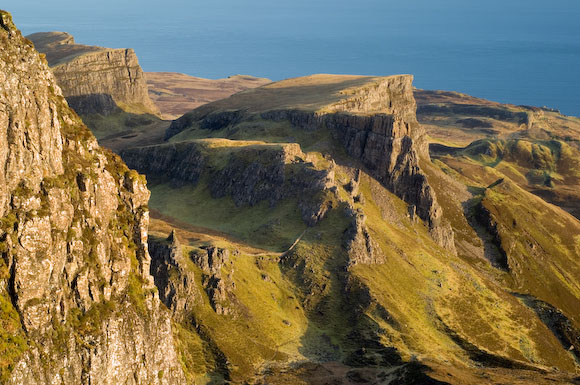
http://www.duncanshawimages.com/photo_1860784.html
And Lukas Spieker:
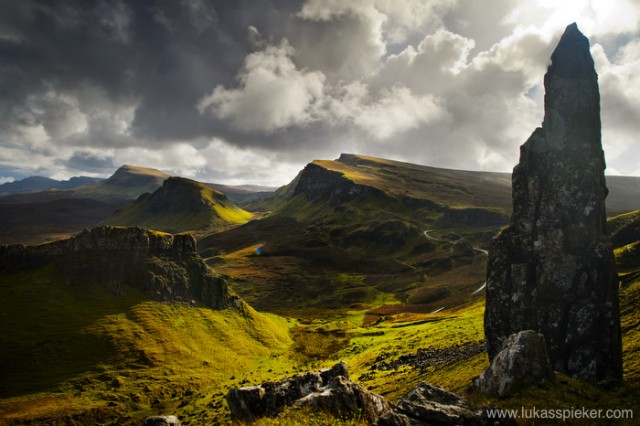
http://www.lukasspieker.com/blog/4954/isle-of-skye/
.
It is well worth a visit if you are ever in Scotland – Walk Highlands has a walking tour of the landslide complex.
3 November 2012
Fatal landslides in Nepal in 2012
Regular readers will know that I have long had an interest in landslides in Nepal, and indeed that I wrote a paper (Petley et al. 2007) a few years ago that explored in detail trends in landslide occurrence there. Nepal is particularly interesting as the combination of topography and climate mean that it is very landslide prone, and the impacts are exacerbated by the vulnerability of the population. As an aside, I am genuinely delighted that I’ll be working there again on the Earthquakes Without Frontiers project over the next few years.
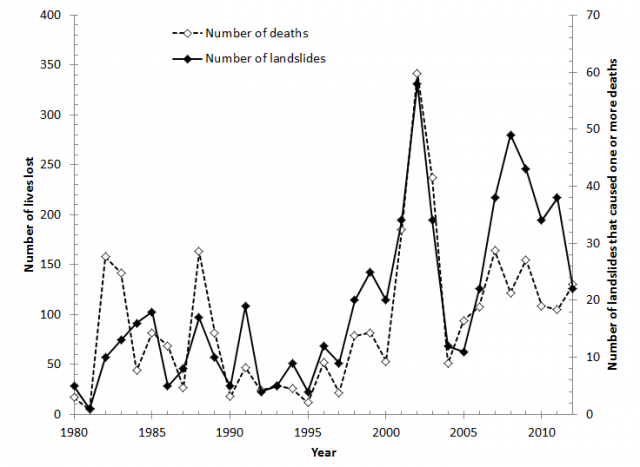
In Nepal the end of October marks the end of the landslide season as the monsoon retreats, to be replaced by cold but dry conditions. Hence, this is a good time to review the impact of landslides this year using my database of fatality-inducing failures. The provisional headline figures are that I have recorded 22 landslide events that caused one or more fatality in Nepal in 2012 to date, with a total of 130 deaths. The latter figure is dominated by the Seti River event back in May, which was responsible for 72 deaths. The graph below shows the number of people killed by landslides and the number of fatality-inducing landslide events per year in Nepal from 1980 to the present. It shows that 2012 was a low impact year in comparison with recent years:
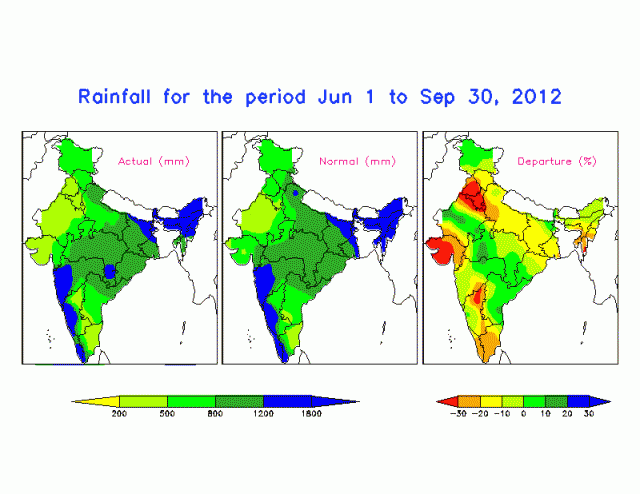
 The reason is almost certainly that rainfall associated with the SW Monsoon this year was well below average. This is the latest set of monsoon maps from India from Monsoon Online, showing that across India the monsoon was about :
 Unfortunately, whilst this low-level of rainfall is good for landslides and floods, it is bad news in terms of irrigation of crops. The harvest is thought to have been about 10% below expectations this year. As a result, Nepal is facing severe food price inflation, which will lead to high levels of hardship for those living in poverty there.
Landslide losses in Nepal are very variable, dominated from year to year by the patterns of the SW monsoon. In periods when the monsoon is intense the number of landslides increases dramatically. Unfortunately, the lower level of losses this year are very unlikely to indicate that landslide hazards are diminishing, but rather that the forcing mechanisms are operating at a lower level. It is likely that losses will become high again when the monsoon intensity is high.
Reference
Petley, D.N., Hearn, G.J., Hart, A., Rosser, N.J., Dunning, S.A., Oven, K. & Mitchell, W.A. Trends in landslide occurence in Nepal. Natural Hazards. 2007;43:23-44.
 Dave Petley is the Vice-Chancellor of the University of Hull in the United Kingdom. His blog provides commentary and analysis of landslide events occurring worldwide, including the landslides themselves, latest research, and conferences and meetings.
Recent Comments