

29 June 2012
Railway landslides in the UK yesterday
Yesterday afternoon a set of unusually intense thunderstorms passed across the north of England and Scotland, bringing short duration but very intense rainfall across a wide area. The result was localised flooding across a wide area and considerable disruption. Perhaps the greatest impact came on the railways, where a series of landslides has blocked lines. The impact of these events is best understood with reference to a map of the rail network in northern England and Scotland:
 You will see that there are only two main lines north from England to Scotland – the East Coast line from Newcastle-upon-Tyne north through Berwick to Edinburgh and the West Coast line through Carlisle. Both of these lines have old alignments – much more than a century old (the East Coast line was completed in 1850 for example) – although clearly the tracks themselves and associated services are much more modern. However, it does mean that the lines have a legacy of old earthworks, which in turn means that despite very considerable investment by the track operator Network Rail they are sometimes vulnerable to small-scale failures during heavy rainfall. Unfortunately the intense rainfall events passed across both lines, and was sufficient to trigger landslides that closed both tracks.
On the West Coast mainline there were a number of landslides on the line between Carlisle and Oxenholme – Network Rail tweeted two images of the problems:
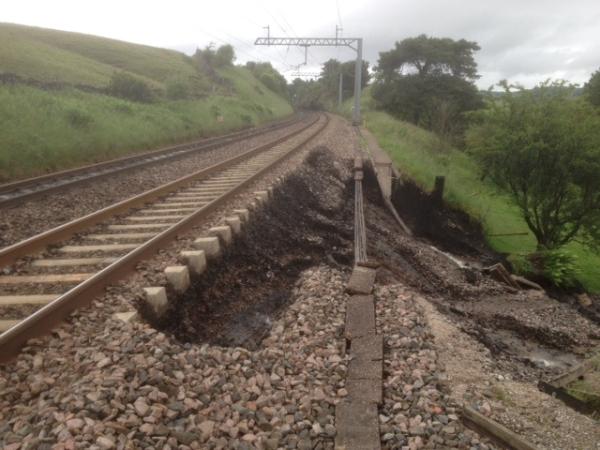
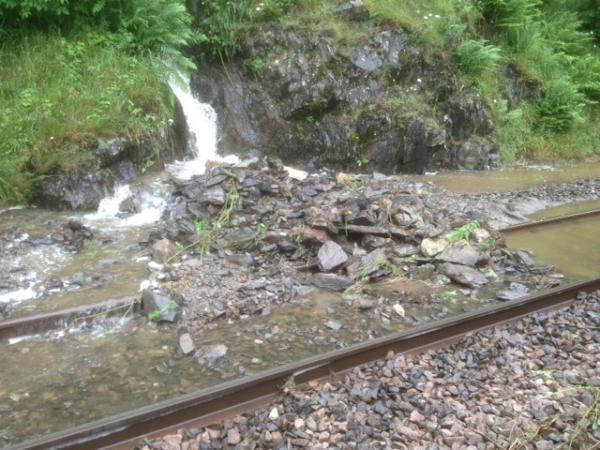 On the East Coast line, a landslide occurred near to Berwick-Upon-Tweed – again Network Rail tweeted two images of the landslide:
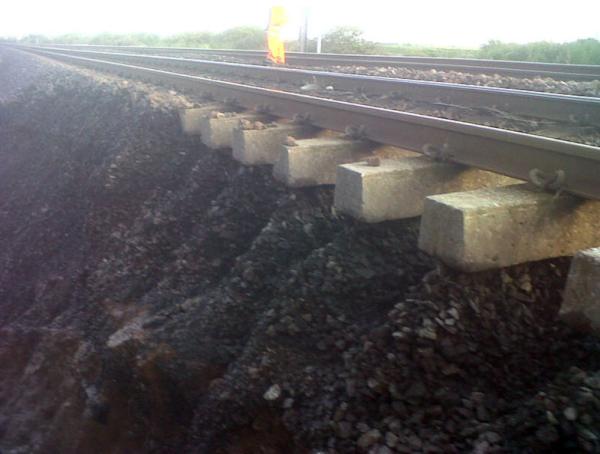
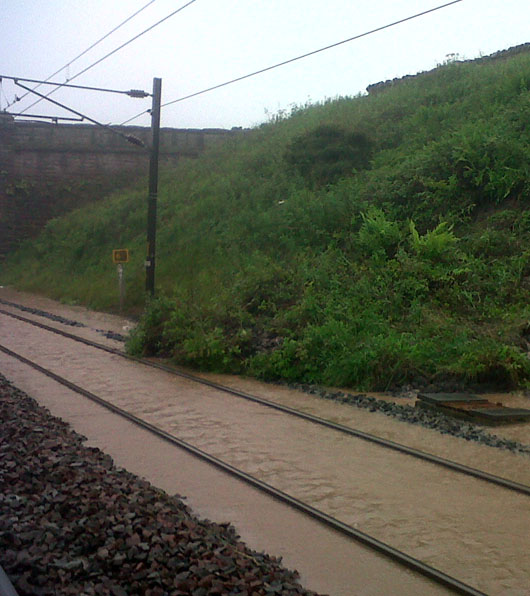 This morning the West Coast line is open, but the East Coast line remains closed for repairs until tomorrow.
In addition, there were landslides in a number of places on lines in Scotland. The most serious incident appears to have been at Tulloch on the West Highland Line, where a 24 coach train derailed by another landslide. Fortunately the driver was not injured. Network Rail have yet to release any images of that event, which presumably will be investigated by the Rail Accident Investigation Board.
27 June 2012
Multiple landslide impacts worldwide in the last few days
Over the last few days there have been major landslide events in many countries. As reported yesterday, a large landslide occurred in Uganda a couple of days ago on the flanks of Mount Elgon. Although the loss of life remains unclear, the likely total is around about 40 people. The BBC have an excellent image of the landslide on their website:
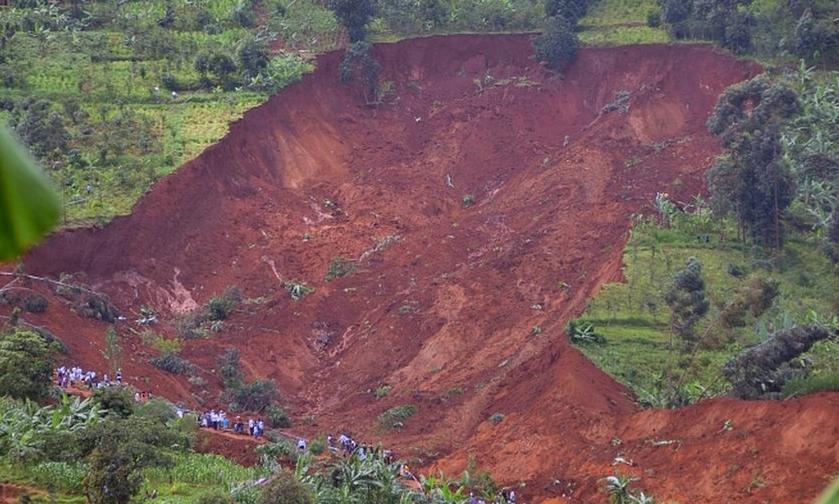
http://www.bbc.co.uk/news/world-africa-18595913
The death toll of this event was lower than it could have been due to the timing of the failure, which happened during the day when children were out at school and adults were at the market or working elsewhere.
This was not the case in Bangladesh, where very heavy rainfall overnight triggered a series of landslides that have killed at least 91 people in multiple locations in Chittagong, Cox’s Bazaar and Bardaban.
Meanwhile, in Guwahati in Assam, India heavy rainfall has triggered a series of landslides over several days, with at least 8 deaths.
Finally, in British Colombia in Canada there has been a series of debris flows and landslides triggered by heavy rainfall during the snowmelt season. Thanks to Andrew Giles for pointing out this image of one of the slides from Tran BC:
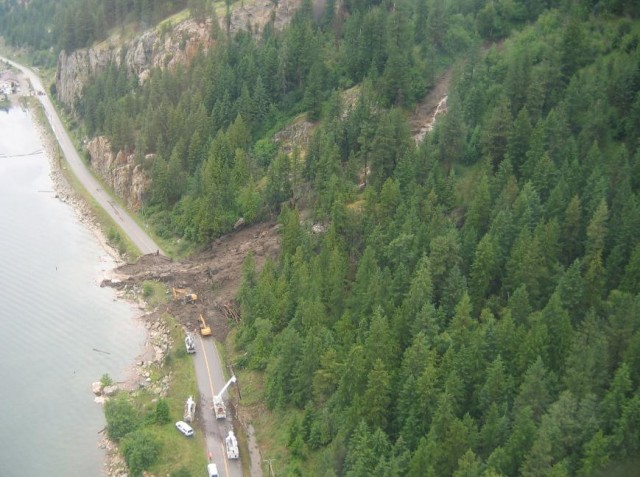 A good impression of the magnitude of the rainfall that caused this event can be gained from this Youtube video from Sicamous, also in BC:
http://www.youtube.com/watch?v=rKdJ72a_kjQ
26 June 2012
First images of the landslide in Uganda yesterday
New Vision Uganda has published online a first set of the images of the landslide on the flanks of Mount Elgon yesterday, which is believed to have killed at least 18, with 72 people reported missing (some reports suggest a much higher toll, but this is would be surprisingly high). The most informative image is this one:
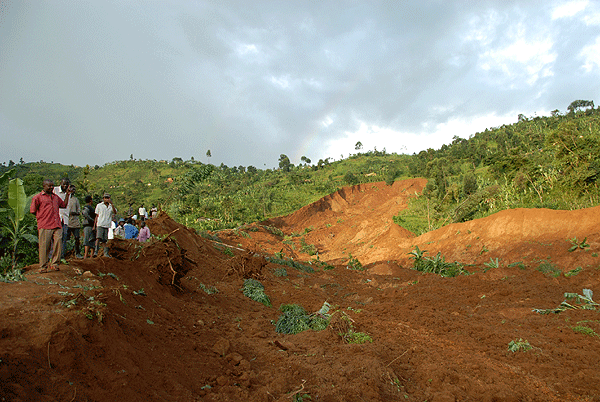
http://www.newvision.co.ug/news/632346-dozens-still-missing-army-joins-bududa-rescue-effort.html
The landslide appears to be a quite mobile flow in deeply weathered residual soil. The length of the runout is unclear. Unfortunately, given the likely nature of the reported 20 houses that were buried, the prognosis for those not recovered to date is not good.
Landslides in Art part 13: Janice Wright
It is a long time since I last posted to my occasional series on Landslides in Art. In this edition I have decided to feature three pieces by the Canadian landscape artist Janice Wright, who has produced the following three abstract pieces that depict landslides. Janice has a blog that explains some of her work.
The three pieces (all sadly but unsurprisingly sold) are described by the artist (referring to the first painting) as follows:
“This is one in a series of three paintings completed on hot press watercolour paper using a palette knife. Although I generally like to use reference photos when painting, this series I created without my usual ‘road map’.”
I like them in particular because of the sense of movement that they project. The colours suggest a cold landscape, so in my mind’s eye they are reminiscent of the recent Siachen ice / rock avalanche in Pakistan:

http://www.janicewrightart.com/large-single-view/Abstraction/1615051-7-23006/Painting/Acrylic/Abstract.html#.T-lnQ5GxlEN

http://www.janicewrightart.com/large-single-view/Abstraction/1615371-8-23006/Painting/Acrylic/Abstract.html#.T-lnYZGxlEM

http://www.janicewrightart.com/large-single-view/Abstraction/1615501-9-23006/Painting/Acrylic/Abstract.html#.T-lnkZGxlEM
The artist has many other paintings that depict landscapes in a range of styles. Some can be interpreted as depicting incipient rockslope failures.
25 June 2012
First news of another landslide accident in Uganda
Reuters Africa are reporting that there was a landslide on the flanks of Mt Elgon in Uganda this morning. The reports suggest that heavy rainfall triggered a landslide in Bumwalukani parish on the slopes of the extinct volcano. Three villages were buried. The reported death toll is currently 10 people, with early reports suggesting that up to 100 may have been buried. However, note that the reports are currently very sketchy about this incident, so these numbers may change substantially.
Mount Elgon has been the location of a number of landslides in recent years. The worst event occurred in 2010, when heavy rainfall triggered a landslide that killed over 300 people. This area has been subject to high levels of deforestation in recent years, with large areas being turned over to coffee production. Unfortunately, landslides are proving to be a major hazard as a result.
Two neat debris flow videos from France
On 4th June 2012 a series of debris flows were caught on video within the Rif Blanc watershed in the department of Hautes-Alpes in France. The debris flows are now on Youtube:
The location of the landslide is at Lat: 45.0424, Long: 6.4265. The Google Earth perspective view shows the location of the video and the catchment well:
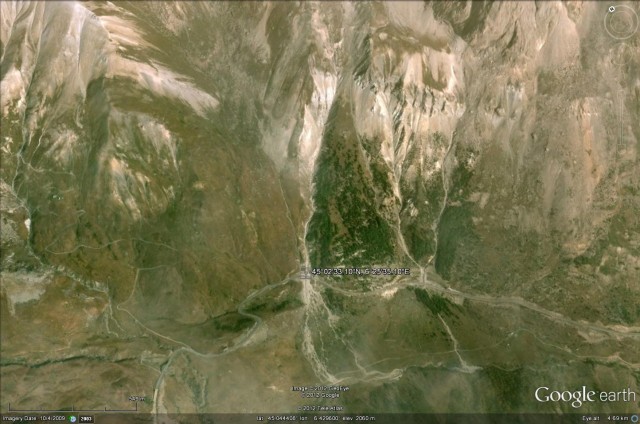 Thanks to Alexandre Mathieu for highlighting these videos and for providing more details.
20 June 2012
Did you see a landslide?
For the last few years seismologists have had considerable success in getting spatial information about earthquakes through web-based initiatives in which users can indicate the magnitude of shaking that they experienced during an event. The two best known examples are the USGS Did you Feel It? and the Geonet (New Zealand) Report an Earthquake initiatives. In landslides there has been some discussion about whether this model could be replicated to start to collect much better information about the spatial distribution of events. It is good to see that the USGS, so often the pioneer in such work, has taken the plunge with the Did You See It? site, in which users can fill in a short form to report a landslide event:
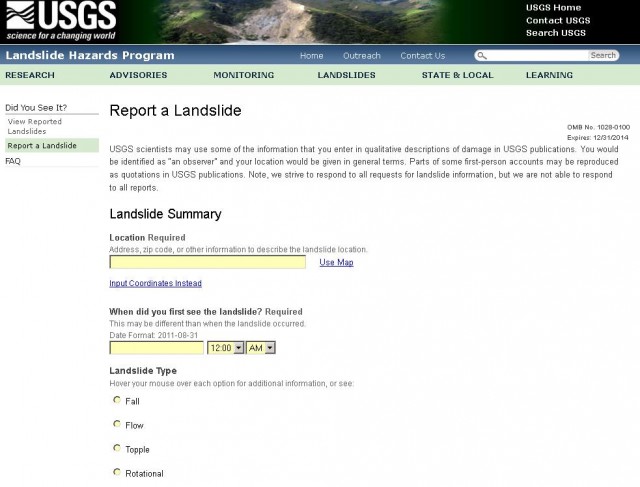 Inevitably this will take some time to gain momentum, but it is a really great initiative that we should all support if possible.
18 June 2012
48 deaths resulting from a leaking pipe?
In November 2011 a landslide occurred in the city of Manizales in Colombia, resulting in the loss of 48 people in a poor suburb. Pictures from the site showed the catastrophic impact of this landslide on this densely inhabited urban area:
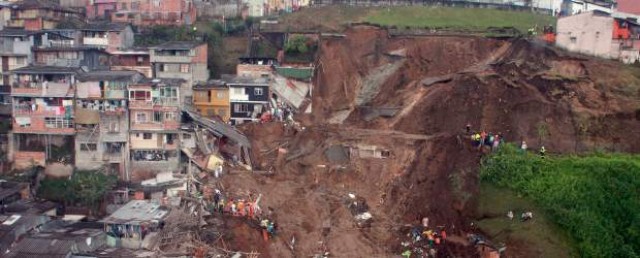
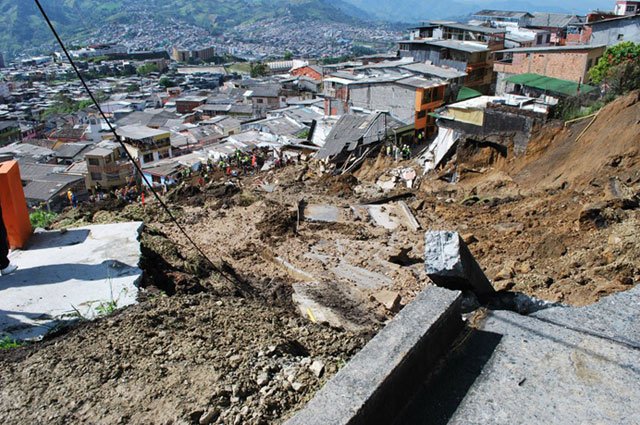 Over the weekend Colombia Reports posted an article that reported the provided the outcome of an investigation of the causes of the landslide, undertaken by the Colombian engineering firm Acuaservicios Engineering Solutions. I have no way of being able to assess the quality or validity of this work, but the report notes that the landslide was probably caused by a leaking pipe that saturated the mountainside.
Investigators have discovered that a leaking pipe caused a landslide that killed 48 people in the city of Manizales in central Colombia in November 2011, local media reported Thursday. Interestingly the report also notes that local people sought help before the disaster because they were aware of the presence of more water than usual, but they were apparently ignored.
Leaking pipes are commonly the cause of large landslides, especially where weak materials are present.
15 June 2012
Halema’uma’u volcanic vent rockfall video
With thanks to Lynn Highland of the USGS, this video of the west rim of the Halema’uma’u vent collapsing is rather cool:
14 June 2012
Another very large landslide – this time on the Canada / Alaska border – can you help?
In the last few weeks I have highlighted two large landslides, one in Nepal and one in Alaska, that Colin Stark and Goran Ekstrom detected remotely using seismic instruments (there is a great summary of the Nepal work on the Earth Institute blog). On 11th June they detected another, this time in the area of the border between Alaska and Canada. This is the seismic event that was almost certainly a landslide – but note that for an event like this the location is not likely to be very precise, meaning that it occurred in either Alaska or in Canada. The event occurred at 22:23 UT, which was 14:23 local time, on 11th June 2012. The map below shows the approximate location of this large event:
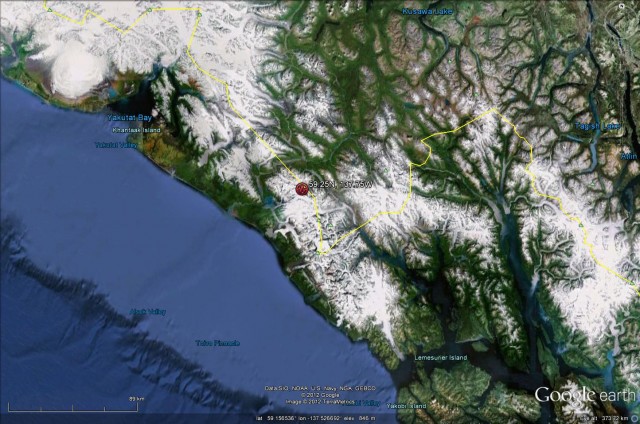 It would be really good to try to identify the location of this landslide. So, can anyone help to find it? This is quite a remote area, but at this time of year people will be travelling through, so if anyone has any contacts that might help us to find it then please drop me a line.
 Dave Petley is the Vice-Chancellor of the University of Hull in the United Kingdom. His blog provides commentary and analysis of landslide events occurring worldwide, including the landslides themselves, latest research, and conferences and meetings.
Recent Comments