

17 July 2012
Breaking news – a fatal landslide at Beaminster in Dorset, UK
Fatal landslides are quite rare in the UK, so news today that a landslide has killed two people in the south of the country is quite surprising. An even greater surprise is that the landslide occurred on 7th July in a populated area, and that the victims were reported missing shortly thereafter, but the bodies were only discovered last night. The landslide was triggered by the exceptionally heavy rainfall that crossed the southern part of the UK on 7th July. On that day two landslides occurred, one at each end of a tunnel in the town of Beaminster. The road was blocked and the road closed. Unfortunately, it appears that the car containing the two victims was buried beneath the debris, killing the driver and passenger. Unfortunately, this trapped vehicle was not identified at that time.
This image, from the New Civil Engineer, appears to show the debris:
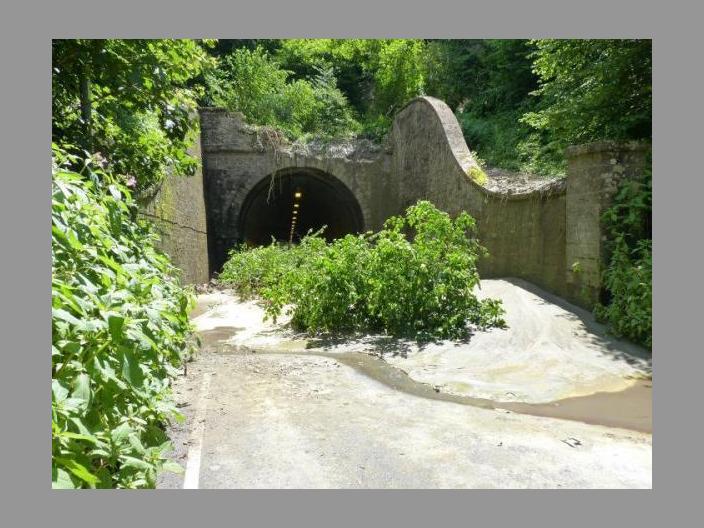 Clearly many questions will be asked about why the victims were not found for so long. However, it is important to bear in mind that survival times for victims buried in landslides is usually very short as the debris has such high density; that the site itself would have been (and indeed may still be) dangerous to those sent to the site, such that it may well have been the case that responding officers feared for their safety; that the car might have been totally covered in a debris pile that did not look large enough to contain a vehicle; and that there were many other incidents occurring at the time in this area. Thus, it would be unwise to be critical of the response until more information is available at least.
A landslide closes a famous hotel in India
The city of Shimla is a hillside settlement in Himachal Pradesh in northern India. Located at an elevation of 2,205 metres above sea level. it is a historic city which is also a major tourist destination. One of the oldest and most famous hotels in the Oberoi Clarkes , constructed in 1898 in a colonial style. The hotel has 34 rooms and employs 61 people.
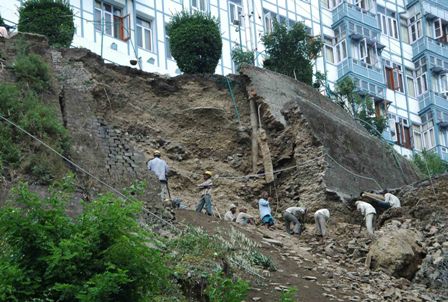
Yesterday the hotel was closed indefinitely in response to an acute landslide problem. According to news reports, the issue has been the result of the construction of a new high court building and associated roads in the vicinity of the hotel, which caused the failure of a retaining wall in May. Hill Post has this image of the site from June this year – the hotel is the building in the background:
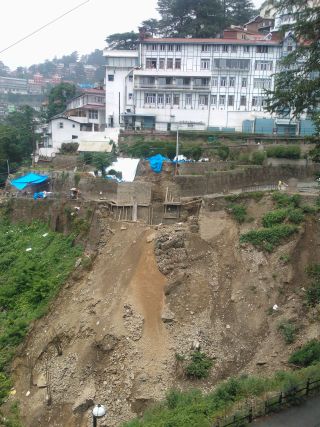
 It appears that attempts were made to rebuild the wall, but these has proven unsuccessful. The landslide has now reportedly retrogressed to within two metres of the hotel building, driven in part by monsoon conditions, and thus threatening the hotel, as this more recent image from The Hill Post shows:
16 July 2012
Stunning images of four recent landslides
Over the weekend some stunning imagery emerged of three recent landslides:
1. The Mount Lituya landslide in Glacier Bay National Park, Alaska
Over the last few days this landslide , which of course I reported first on this blog, has received a fair amount of media coverage (and some rather peculiar hype about its size). However, National Parks Traveler highlighted a video of the landslide shot by a local pilot who has flown up and down the landslide. It is stunning, but you might want to turn off your computer’s sound system:
2. The 21st May Hubbard Glacier fjord landslide
This is another landslide that was first reported on this blog. An aerial image of this landslide has now been posted on Facebook by the staff of Wrangell-St. Elias National Park & Preserve:
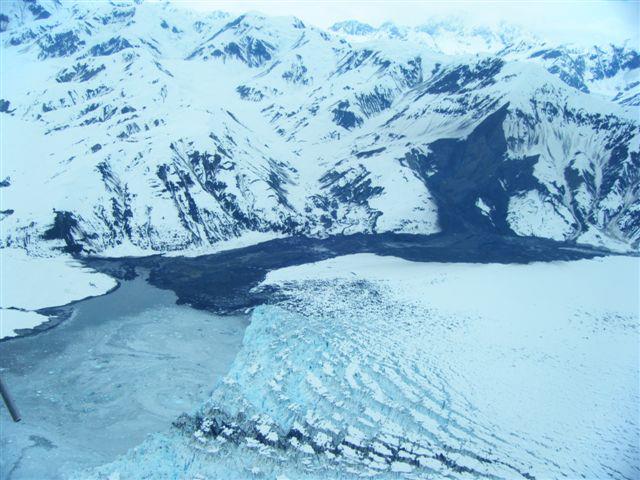 This is a really fascinating, and really unusual, landslide in terms of its flow dynamics. Why did it turn right rather than flowing straight on?
3. The Johnsons Landing landslide in Canada
I have covered this a couple of times over the last few days. This really remarkable image of the area in which the buried houses are located was released by Emergency Info BC this weekend:
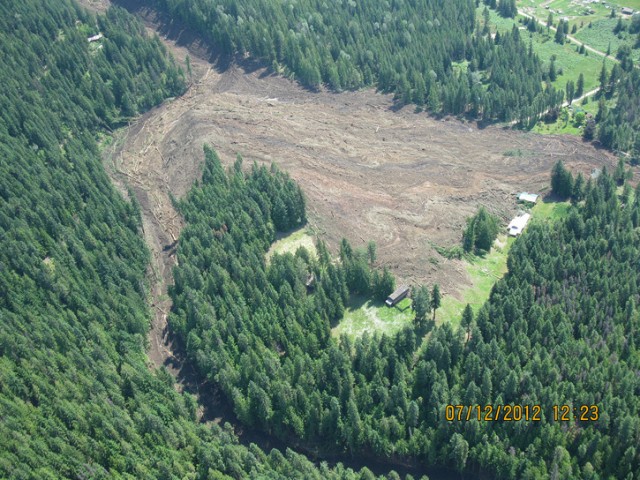 There are some really interesting flow structures that indicate quite well what happened at this location I think. There are other very interesting images on their Flickr page, including this one of the source area and track:
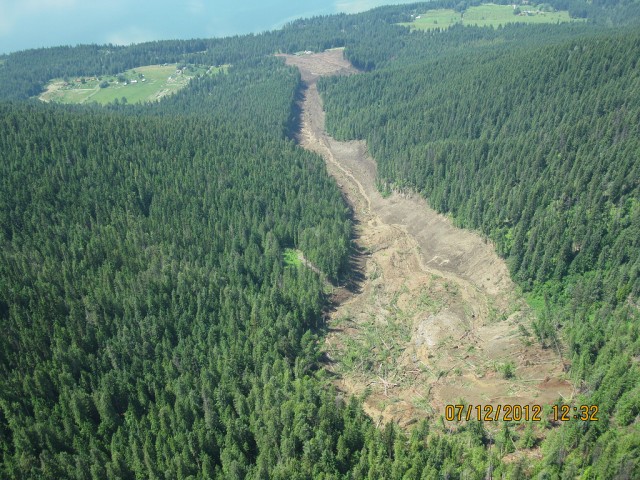 The trim line on the right side if the image on this image suggests that a very high wave of material must have traveled down this valley, which would also fit with the way that the landslide left the main channel in the area of the houses. I wonder what the mechanism was for such a dramatic failure event.
4. A landslide at Minamiaso in Japan
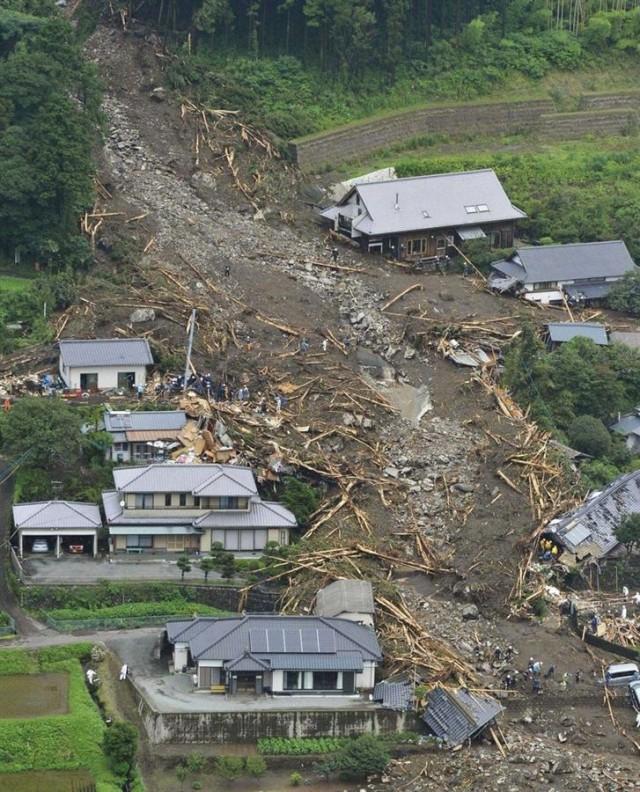
Finally, late last week and into the early part of the weekend southern Japan suffered record breaking rainfall that triggered landslides across a large area. Kyodo via Reuters have this remarkable image of one of the landslides:
http://hungeree.com/tag/minamiaso/
A dramatic video of a secondary failure of the Johnsons Landing landslide in Canada
This is a very narrow escape:
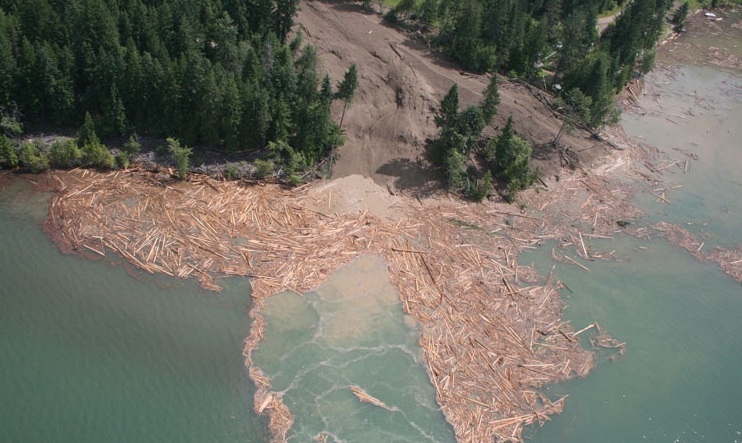
This is a secondary landslide a day after the main event, which killed four people.
This appears to be the aftermath (source):
http://www.ctvnews.ca/canada/search-to-resume-for-the-missing-after-b-c-landslide-1.878719
13 July 2012
A (probably) fatal landslide in Johnsons Landing, Kootenay Lake, BC Canada yesterday
A large landslide hit the community of Johnsons Landing in British Columbia yesterday, leaving a reported four people missing. The landslide is thought to have engulfed three houses, of which one was fortunately unoccupied. A number of news outlets in Canada have good initial reports about the event, including:
The best images are this one from CBC News:
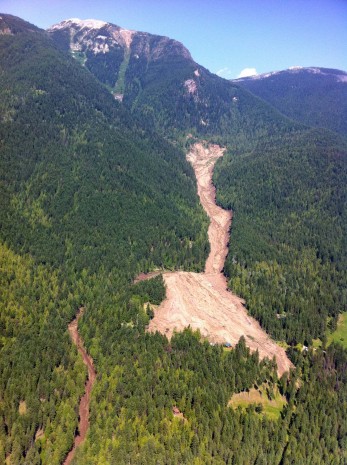
http://www.cbc.ca/news/canada/british-columbia/story/2012/07/12/bc-landslide-johnsons-landing.html
And in particular this one from TMTV News:
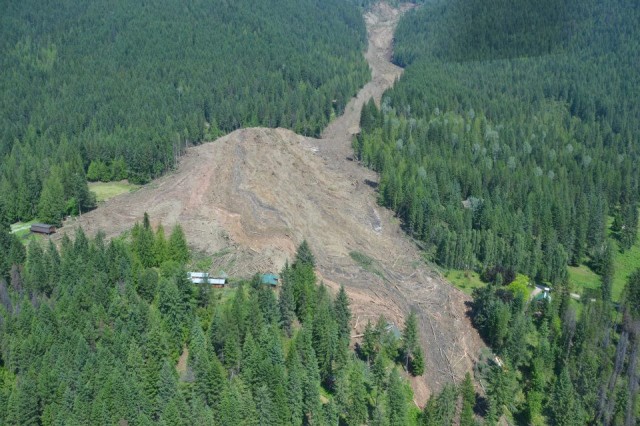
http://tmtv.net/BCTV_johnsons_landing_photo_video_Slide_kootenays_news_july_12_2012.htm
The landslide appears to have been a highly mobile flow type of event, but with quite an interesting and unusual morphology in the toe region. On a provisional inspection (and very tentatively) it appears that after an initial failure the landslide debris followed an existing channel and then spilled over the bank and down the slope, with some of the debris remaining in the channel (see the lower left of the upper image). I think that this is the area on the Google Earth imagery, but again this is pure speculation at this stage:
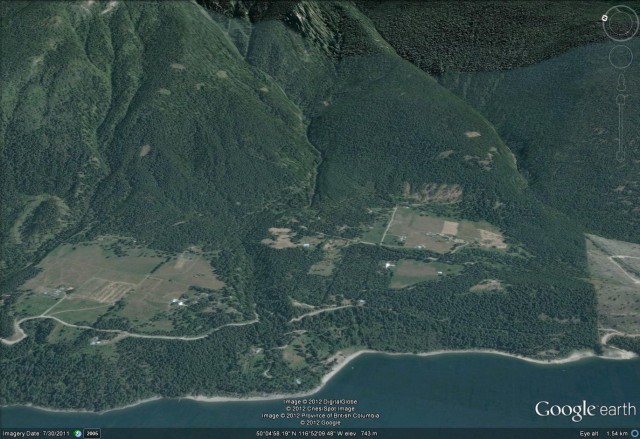 A slightly intriguing aspect of this event is that the weather at the time of the event is reported to have been sunny and warm (although there has been a lot of rain recently). Even more intriguing is the fact that just a few minutes before the landslide, at 10:22 am local time, the USGS recorded a small earthquake in BC that they are describing as a quarry blast. Initially I wondered whether this might be the seismic signature of this event. However, the location is reported to be about 275 km from Johnsons Landing, although I am not sufficiently au fait with seismic data to be able to state the likely location error. Just to be clear though, it is highly unlikely that the recorded seismic event was the trigger for the landslide, and there is a high chance that it iscompletely unrelated. I would be interested to hear the views of those with more experience of seismic data than me.
12 July 2012
The Mount Lituya landslide in Alaska – an update
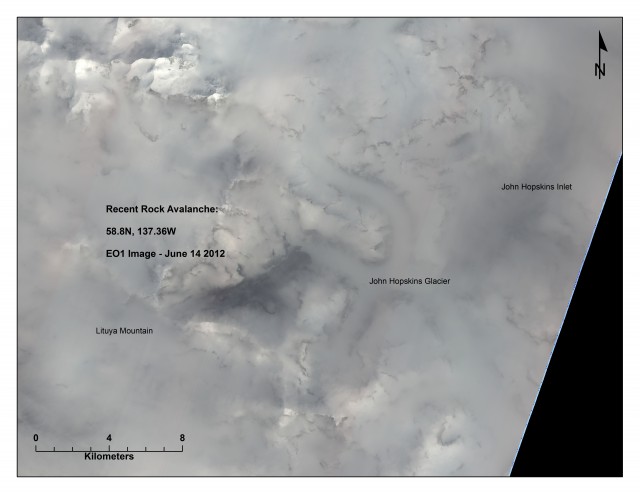
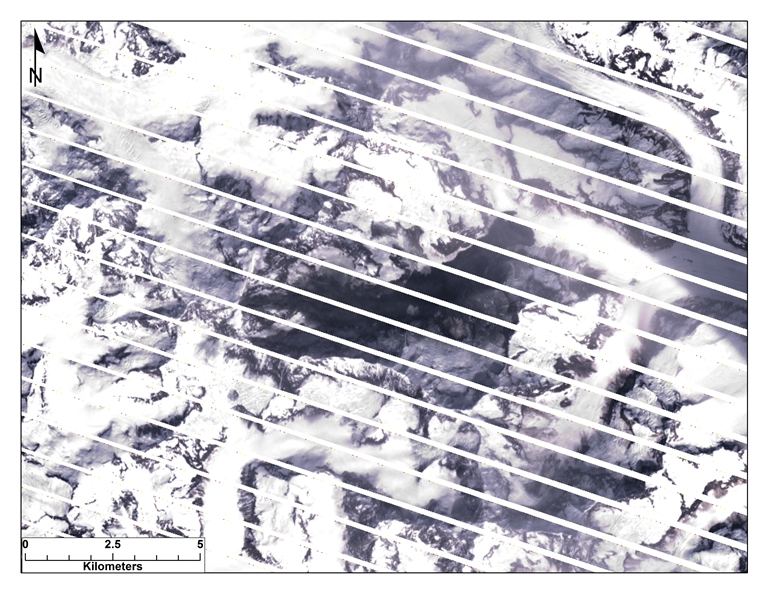
You may remember that about a month ago I posted a requested for help to identify a landslide that Colin Stark had identified from the global seismic dataset. A few days later Keith Delaney and Steve Evans from the University of Waterloo in Canada came forward having remarkably identified the landslide, which was clearly a very mobile rock avalanche, from a very cloudy NASA image collected a few days later:
 A few days later Keith produced a better image based upon Landsat 7 data. As discussed previously, this instrument has a technical fault that produces a distorted dataset. However, the image was sufficiently good to be able to estimate that the landslide had a runout distance of about 9 km and a surface area of about 9.3 square kilometres – i.e. this is a really big landslide:
 Yesterday, National Parks Traveler in the US produced a report with images of the landslide as collected by a local pilot, Drake Olsont. The dynamics of the landslide are similar is some ways to those of the Seti River landslide in Nepal about which I posted a couple of months ago, with a large rockslope failure, a large fall height and then a long runout of the debris. The National Parks Traveler article provides an image of the landslide source:
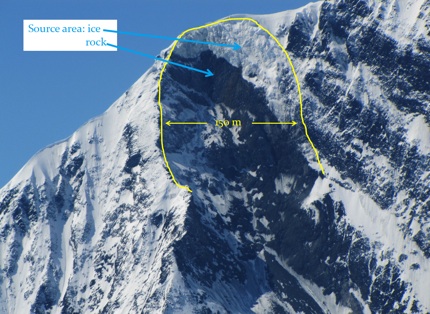 Note the scale – the scarp is 150 m wide. The total vertical extent from crown to toe is estimated to be about 2,200 metres, suggesting that the fall height was in the order of 2 km. The Drake Olson photos suggests that the landslide ran out as a highly mobile flow across the glacier surface:
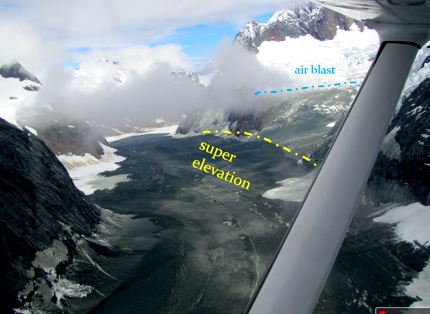 Note the area of deposited dust on the right side of the image (labelled in the article as “air blast” and the rather beautiful flow features on the landslide surface. Finally, as the satellite imagery suggested, this landslide ceased moving having run out about 9 km:
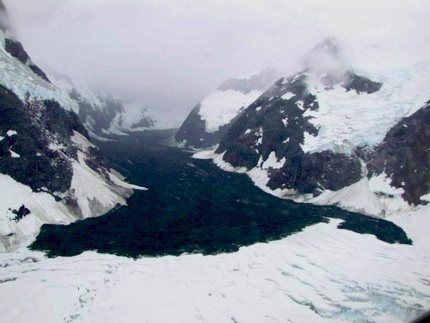 A really interesting issue now is how this will effect the dynamics of this glacier. The addition of a large volume of rock, which adds both weight and a mantle of dark material, may have some key implications for the way that the glacier moves. However, we will not know what will happen for many years, and data will be hard to obtain in such a remote location.
11 July 2012
An interesting landslide in Manitoba, Canada
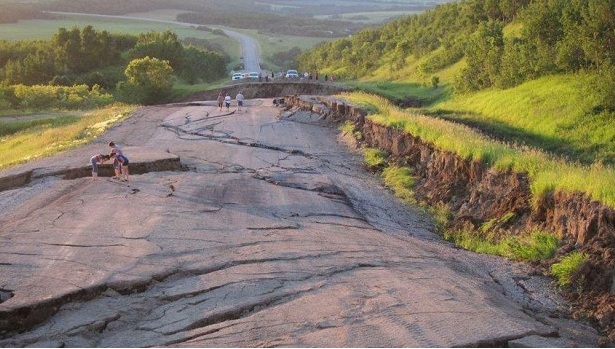
Thanks to a number of people who brought this one to my attention, and apologies for my slow response (a consequence of my new job). A few days ago a large landslide affected Highway 83 between Roblin and Asessippi Provincial Park in Manitoba, Canada. CBC News has a good report on this landslide, if you can forgive the use of the terms “crater” and “sinkhole”, with some really neat images, such as this one:
http://www.cbc.ca/news/canada/manitoba/story/2012/07/03/mb-collapsed-road-assessippi-park-manitoba.html?cmp=rss
The landslide, which appears to have been triggered by a month of heavy rainfall, has for obvious reasons caused the road to be closed. Unfortunately, mitigating this landslide is likely to be quite complex.
A quick look at Google Earth yields what is I think the location of the landslide:
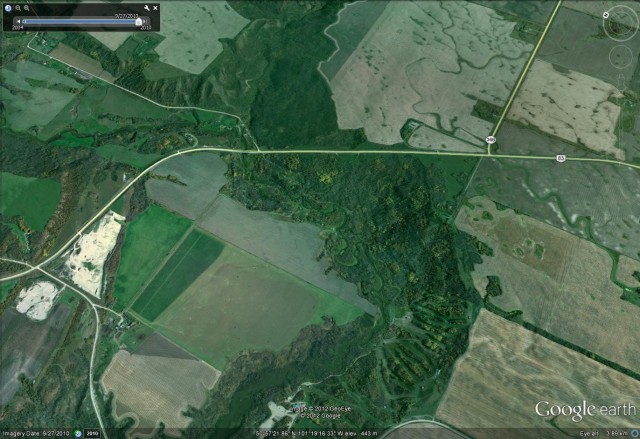 It appears to be a degraded scarp with active toe erosion. A zoom into what I think is the landslide area itself shows that the area below the road has the characteristic morphology of an old landslide, with hummocky terrain and a contorted water course. if I was investigating this landslide my hypothesis would be that this is a reactivation of an existing landslide. The potentially unstable area is quite large. Not that if you look carefully you can see that this section of road has multiple repairs, perhaps suggesting slow movement before this more recent event:
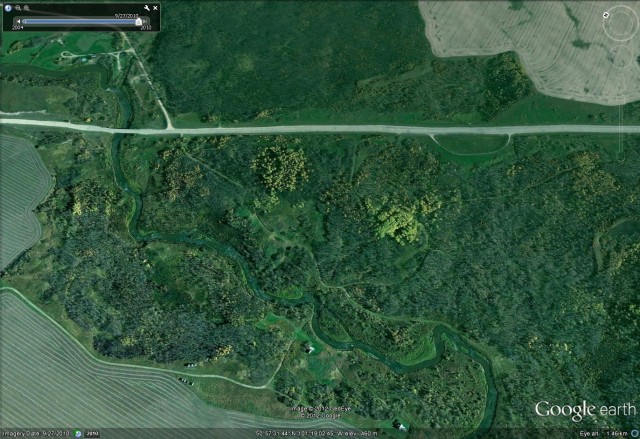 Of course all of this is no more than an initial speculation – a more detailed investigation will now be needed to work out what is going on at this site and to plan an effective mitigation strategy.
9 July 2012
Guardian article on the Attabad landslide and the Karakoram Highway
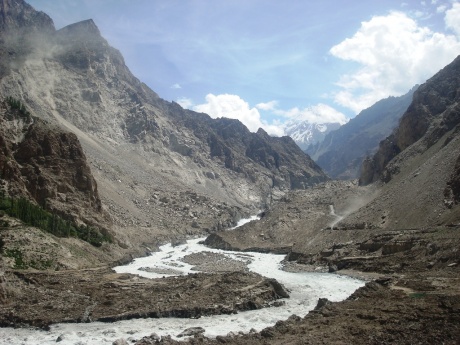
The Guardian published an article last week on the aftermath of the Attabad landslide and the long term implications for the Karakoram Highway and the local people. It includes the following:
A few dozen workers from the Frontier Works Organisation (FWO), an arm of the Pakistani military, have been making slow progress picking at the massive dam with mechanical diggers and explosives.
“They are badly equipped and not properly qualified,” said Amin Beg, an official with the Aga Khan Rural Support Programme, a charity that works in the area. “The people here wanted the contract for draining the lake to be given to the Chinese. They actually care about this road because they have a strategic interest in it.”
After two years of work, the FWO has only succeeded in lowering the water level by about 10 metres.
Whilst mostly factually correct (although I would quibble with the comment that they are unqualified and poorly equipped – that is not my experience at all), the criticism seems a little harsh on the FWO, who have been expending considerable effort on this difficult project over the last winter in very harsh conditions.
7 July 2012
An astonishing flash flood video from Steffisburg in Switzerland
Liveleak has this astonishing video of a flash flood in the town of Steffisburg in Canton Bern in Switzerland:
This wave was generated as a result of heavy rainfall on 6th July 2012.
30 June 2012
The train derailment on the West Highland line on Thursday
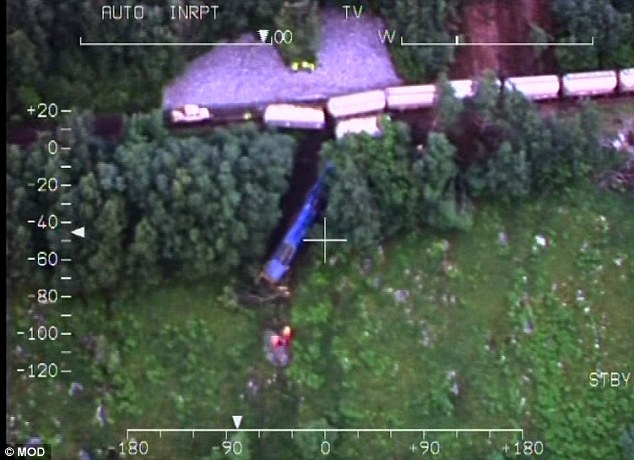
Yesterday more details emerged of the landslide incident on the West Highland line in Scotland that derailed a freight train. The incident came during the exceptional rainfall associated with thunderstorms that passed across northern Britain – a final hurrah for the wettest second quarter of the year on record in the UK. The best source of images is the Daily Mail, which has a set of stills from the video taken from the search and rescue helicopter that attended the scene and recovered the driver. It is clear that this was a serious accident, with the train being pushed off the track and the locomotive then falling down the embankment:
http://www.dailymail.co.uk/news/article-2166626/Rail-chaos-derailed-freight-train-blocks-line-West-Highlands-landslide.html?ito=feeds-newsxml
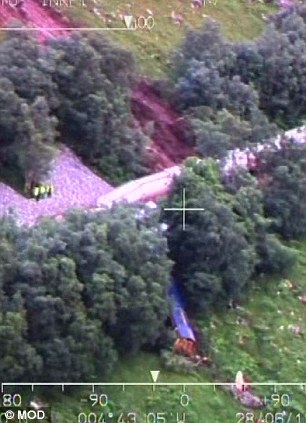
Note the landslide scar on the upper right side of the image, the wagons from the train, some of which are obviously derailed, and the locomotive in the tress on the downslope side. This image gives a better view of the relationship between the locomotive and the landslide:
http://www.dailymail.co.uk/news/article-2166626/Rail-chaos-derailed-freight-train-blocks-line-West-Highlands-landslide.html?ito=feeds-newsxml
An interesting aspect of both images is that this is a site that appears to have suffered previous landslide activity that has been mitigated by excavating the landslide and replacing with a boulder fill. Based upon the images this may have been a comparatively recent maintenance activity as the stones look very unweathered. Unfortunately the landslide did not occur in this location, which illustrates clearly one of the major challenges that the track operator faces in maintaining this old infrastructure.
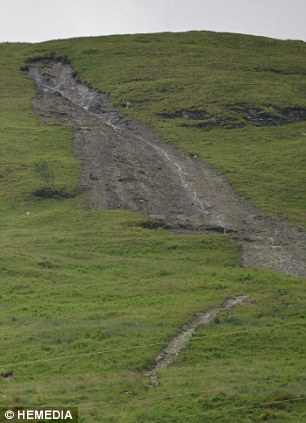
The Mail also has some images of other landslides triggered by the rainfall:
http://www.dailymail.co.uk/news/article-2166626/Rail-chaos-derailed-freight-train-blocks-line-West-Highlands-landslide.html?ito=feeds-newsxml
 Dave Petley is the Vice-Chancellor of the University of Hull in the United Kingdom. His blog provides commentary and analysis of landslide events occurring worldwide, including the landslides themselves, latest research, and conferences and meetings.
Recent Comments