

9 January 2010
Detailed information and amazing images of the catastrophic Attabad (Atabad or Atta Abad) landslide in Hunza, Pakistan
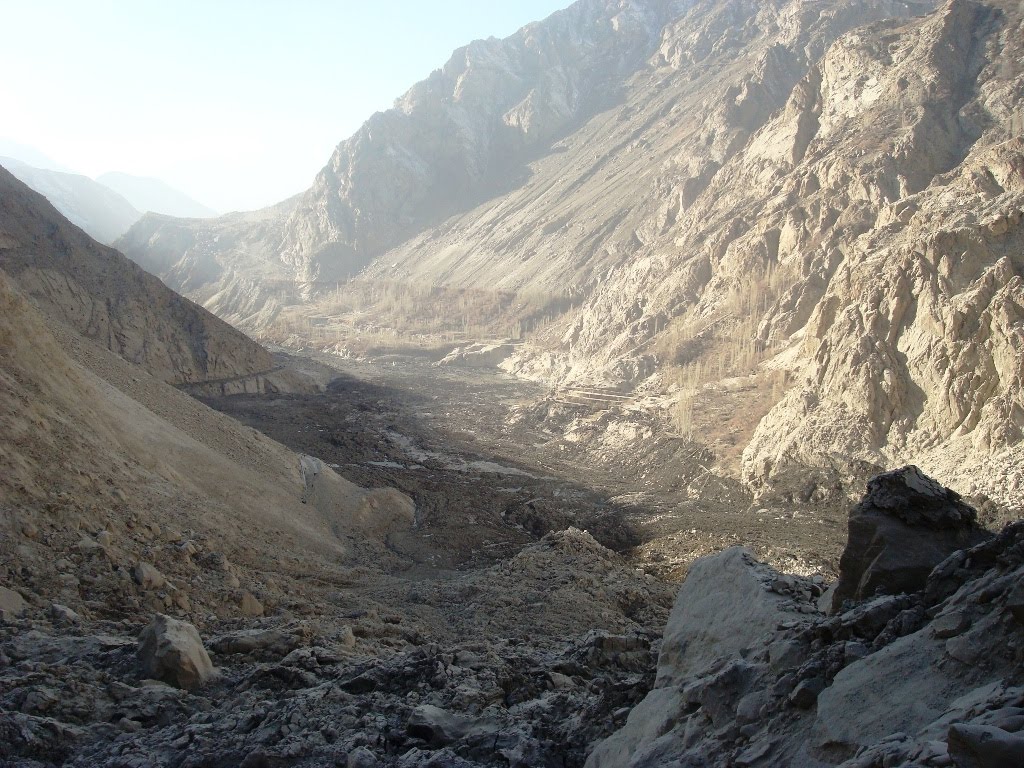
A few days I ago I posted on reports of the Attabad landslide (which is variously described as the Atabad landslide or the Atta Abad landslide) in Hunza, Pakistan. There has been very little information about this bar various reports that it was not as bad as had been feared. However, Reliefweb has today published a report from the Pakistan Red Crescent that paints a rather different picture.
The essence of the report is as follows:
- The slide occurred in two parts, the first at 13:00 (local time) on Monday 4th January, the second two hours later. The second slide was the larger of the two;
- To date 15 fatalities have been recorded; an unknown number of people are missing;
- Debris has covered a 4 km stretch of the Karakoram Highway, to a maximum height of 263 feet (80 metres) (!!!). The road is still closed;
- 1763 people have been displaced.
However, perhaps the most important part of the report states that:
“On 6th January Pakistan Red Crescent Society (PRCS) Gilgit-Baltistan branch reported that the Hunza River is still blocked and its level
had risen to 350 feet and still rising. The situation raises fears that low-lying areas across the
river would be inundated. The population of these red-zone areas is estimated to be around
20,000 people.”
350 feet = 107 metres.
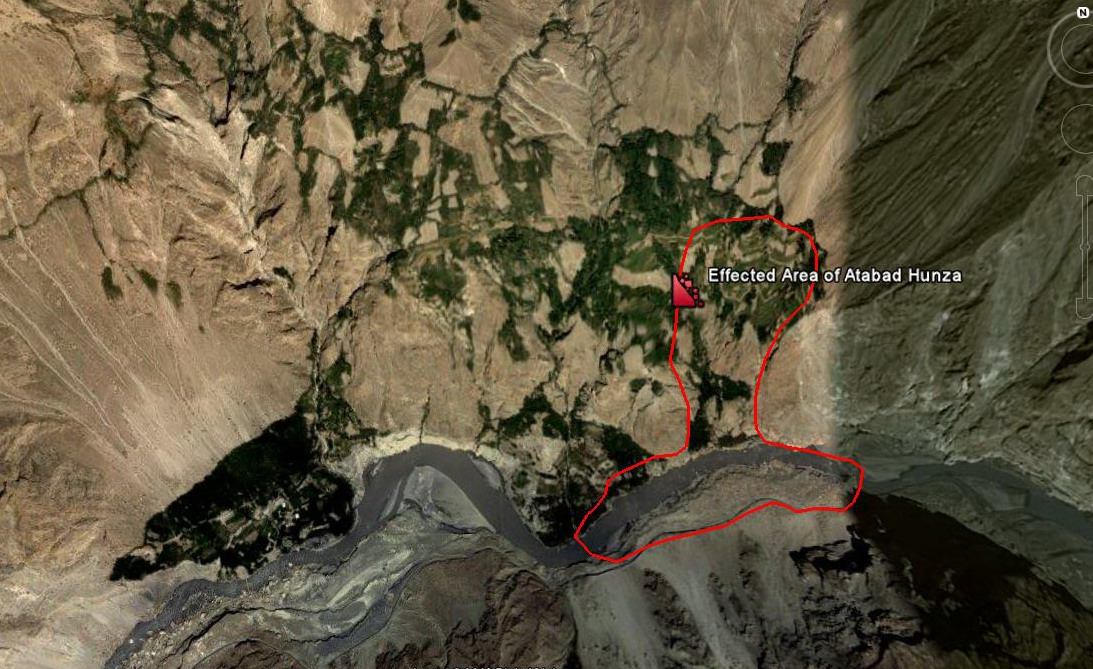
The Pamir Times has published a very high quality set of images of the landslide here. Two images are particularly useful – first, this one shows on an aerial image the area affected by the landslide:
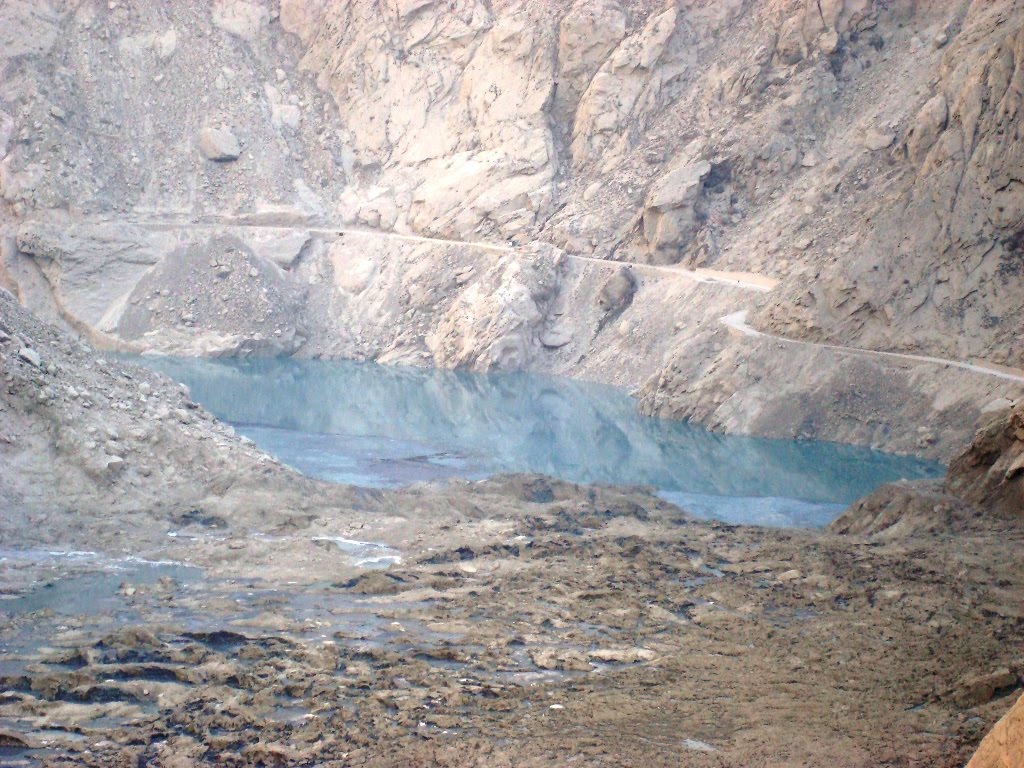
Second, this image shows the slide debris and the lake, taken I assume from the top of the landslide debris pile:
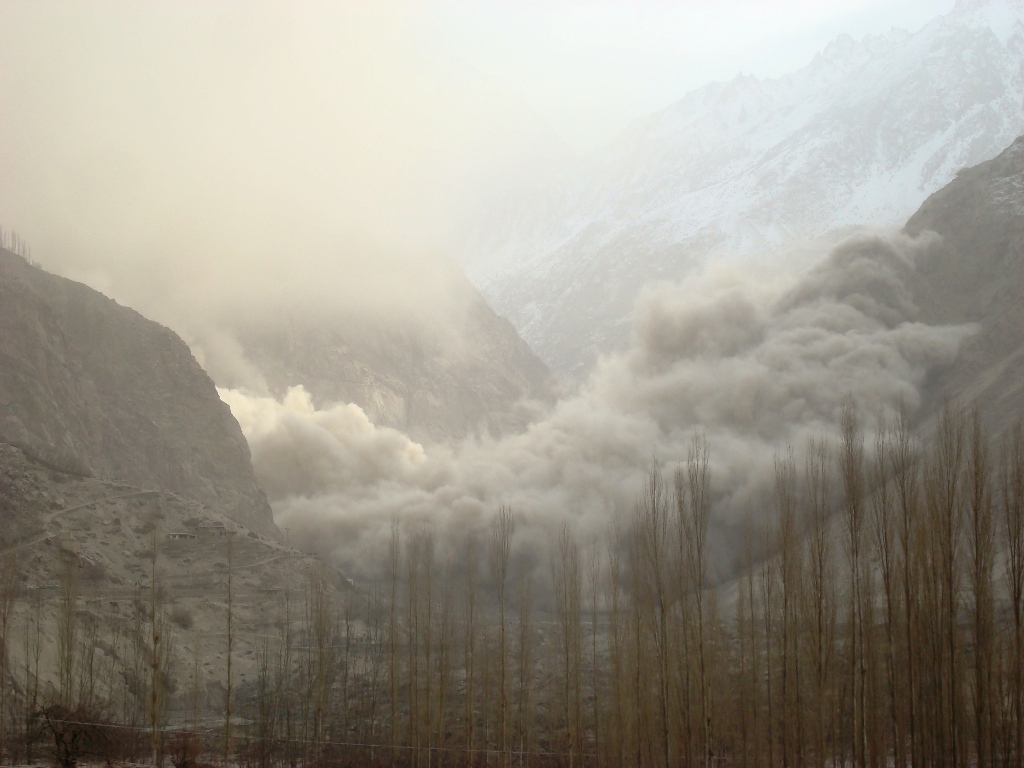
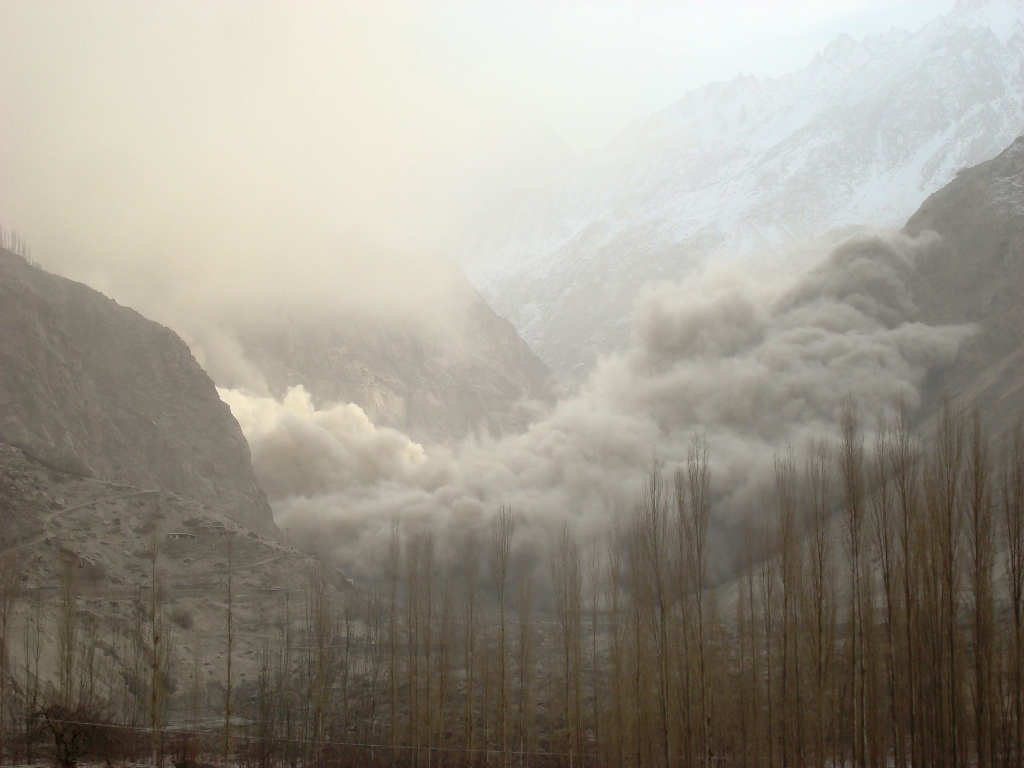
 The most extraordinary image though is this one, captioned “Huge clouds of dust arise as land sliding continued on second day of the Attabad disaster”:
 Dawn.com reports that towns up the valley from the blockage, especially Gojal, are facing real hardship due shortages of food and medicine caused by the road blockage. This is of course mid-winter in a high mountain location. They suggest that it may take a month to reopen the road. Meanwhile they also expressed concerns about the potential for failure of the dam, causing a catastrophe downstream, which judging by the images above must be a real concern.
Finally, an EEFIT report on the landslide site, dated 2003, is available online here:
http://www.istructe.org/EEFIT/files/Atabad%20Landslide.pdf
The report describes the existence of a very large tension crack, in places 1.5 metres wide, across the slope and through the village. This crack appeared in 2003.
The reports states, with an impressive level of prescience:
A sudden catastrophic failure of the size, and which not uncommon elsewhere in the Northern Areas, could have the following effects:
• Removal of fields over perhaps half the village area and also removing nearly 30% of the
farming properties.
• Destruction of the rough mountain road probably with no alternative route that could be
established at any time in the near future.
• A blockage of the Hunza River – of a temporary or permanent form. Dam breakage could
cause disastrous water wave effects down stream. The dam hypothesis should be compared
with the estimated 2Mm³ of scree soil that in 1980 formed a permanent dam across the
Ghizar River just up stream of Gupis, west of Gilgit.
• Creation of an adjacent unstable landform and which contains other houses and associated
fields.
• Knock-on effects of loss of tree stands in minor descending lateral Hunza Valley gorges.
• Destruction of buildings, farmed lands and water supply to Sarat village.
Comments and thoughts welcome. See update from 11th January 2010 here
The 2009 fatal landslide map and statistics
This post presents the data from the Durham University Fatal Landslide database for 2009. First, this is the map of fatal landslides. Each red dot represents a single landslide recorded on the database. Click on the map for a better view in a new window:
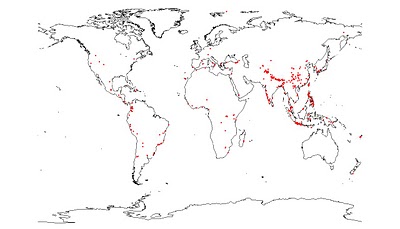
The map shows the usual distribution. Note the high incidence of landslides in SW India, the Philippines and in java in Indonesia. The high occurrence of landslides along the southern margin of the Himalayan mountain chain is also clear, but is less continuous than usual. This reflects the 2009 monsoon rainfall pattern, which was substantially below average, especially in the northwest of India, as the map below (for India only), from Monsoon Online, shows. The map indicates the departure from the mean annual monsoon rainfall:
 In terms of statistics, the key data are:
- Number of recorded fatal landslides: 493 (this is substantially above the long term average).
- Number of recorded fatalities: 3611 (this is substantially below the long term average, primarily because there were no large earthquakes in populated mountainous areas).
7 January 2010
Angler killed in rockfall in NE England
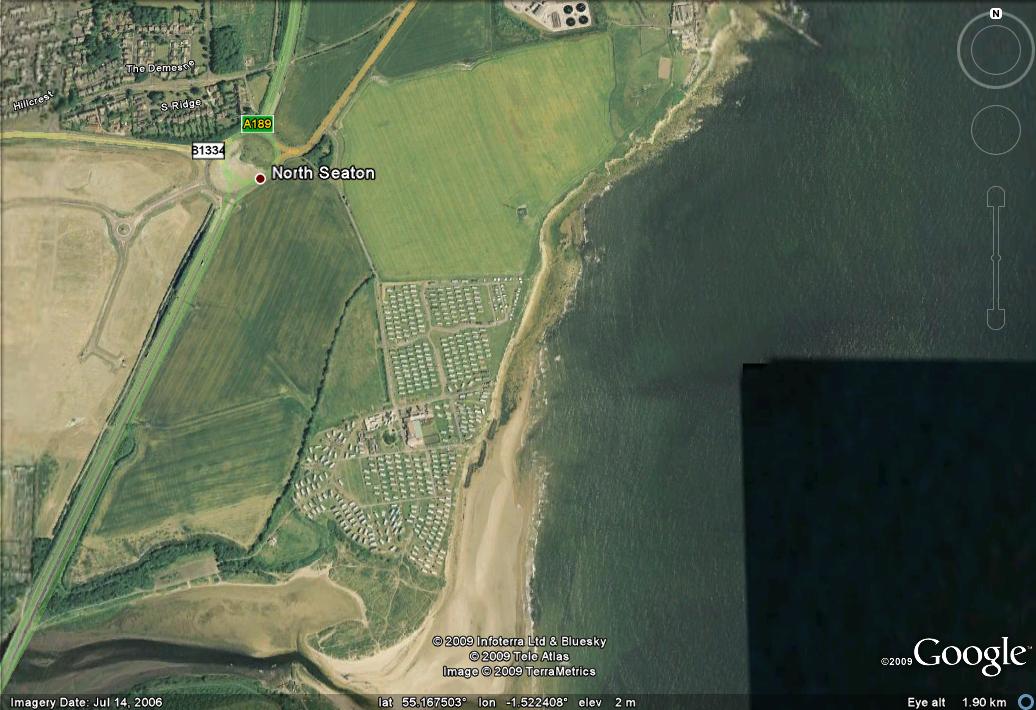
The BBC is reporting that an an angler was killed in a landslide last night in Sandy Bay, near Newbiggin-on-Sea in Northumberland, NE. England. He was reportedly standing at the top of a 15 m high cliff that collapsed, killing him when he fell.
This is Sandy Bay:
The ten most important "natural" disasters of the last ten years
As we are now at the end of the “noughties” I thought that it would be interesting to compile a list of the ten most important “natural” (i.e. geophysical and hydro-meteorological) disasters of the decade. This is not intended to be a list of the ten most damaging or with the highest number of fatalities, but more to reflect events that changed the way that we think or act about disasters. As such the list is compiled very much from my perspective – I would welcome comments on the ones that I have missed. The statistical data are from the CRED EM-DAT database.
So here goes, in reverse order:
10. The Gujurat Earthquake, India, 26th May 2001
With 20,000 fatalities, the Bhuj earthquake was a huge event. From a technical perspective the key aspect of this event was that it occurred in an intra-plate area – i.e. not in the immediate vicinity of a major tectonic fault system. Whilst the hazard in such areas has long been recognised, this earthquake served to highlight the need to focus attention on all areas with high seismic hazard, not just those in tectonically-active locations.
9. The Guinsaugon landslide, Philippines, 17th February 2006
The tragedy of the Guinsaugon landslide is that the authorities and local people were aware of the threat posed by the slope, and evacuated the town. However, when the heavy rainfall (brought by a typhoon) stopped, the people returned to their homes and schools, only to be buried by the slide. The impact was dreadful. The event illustrated the need for joined up thinking on hazards and also the need to coordinate rescue operations properly. The difficulties encountered by the rescue teams both in trying to identify where the buried infrastructure actually was, and in keeping themselves safe, served an important lesson.
8. The Bam Earthquake, Iran, 26th December 2003
The Bam earthquake was the first of the two “Boxing Day” disasters of the noughties. The earthquake was a direct hit on the ancient city of Bam, the centre of which collapsed almost completely. The death toll was fearsome (26,796 people), and the earthquake brought into sharp relief the role that poor building construction plays in disaster causation. The rammed earth citadel collapsed whilst adjacent brick buildings designed to withstand shaking were essentially undamaged. The loss of the cultural heritage of this ancient city is an enduring tragedy.
7. The Simeule / Nias earthquake, Indonesia, 28th March 2005
With a death toll of 915, this event may seem at first glance to be too small to justify a place in this list. However, this event confirmed the fears of many seismologists that large earthquakes can weaken unfailed sections of adjacent faults, allowing them to rupture in the aftermath of the big event. The recognition that this was occurring along the Sumatra subduction system led to the conclusion that Indonesia faces a period of elevated seismic activity – as has subsequently proven to be the case. This also served to further raise concern about the other fault that we know behaves in this way – the North Anatolian fault in Turkey.
6. The Kashmir earthquake (Pakistan and India), 8th October 2005
The true toll from the Kashmir earthquake remains unclear – the official total in Pakistan is 73,338, whilst the Red Cross has suggested that a more realistic number may be 100,000. The extraordinary destruction, in particular in the towns of Balakot and Muzaffarabad, was big news for many days. The difficulties of providing assistance to a mountain population as winter approached was perhaps the biggest story. The combined efforts of air forces and NGOs from around the world, working with the Pakistan Army, averted the second potential tragedy and opened new lines of communication in the aftermath of large events.
5. The summer 2003 heatwave in Europe
The exceptional temperatures recorded in Europe in Summer 2003 is estimated to have killed over 60,000 people. The long term impact of this event has been equally profound – subsequent analysis has shown that this event is difficult to explain but for the impacts of anthropogenic climate change – probably for the first time scientists could say with justification that climate change is inducing severe weather events. The realisation that these conditions, or worse, may affect Europe on an annual basis as the climate warms undoubtedly changed the perspective of politicians with regard to the climate change debate.
4. The Wenchuan Earthquake, China, 12th May 2008
The impact of the Wenchuan earthquake on the mountains of the Longminshan range was extraordinary. The destruction of the schools in particular will remain in the memory for a long time. In the aftermath of the earthquake the world watched as the government strove to cope with both the disaster itself and the landslide dams that littered the landscape. The successful mitigation of these dams was an extraordinary achievement, but the treatment of the parents of children killed in schools puts the authorities in a different light.
3. Cyclone Nargis, Burma (Myanmar), 2nd May 2008
Cyclone Nargis feels like the big event that everyone has forgotten. At the time it was big news, but it rapidly fell off the TV screens and, given that Burma is a military state, there was little hope of prolonged world attention, especially given the impact of the Wenchuan earthquake just ten days later. However, the extreme death toll (138,366 people) should serve to remind us that Indian Ocean cyclones remain a major threat.
2. Hurricane Katrina, USA, 29th August 2005
The impact of Katrina on New Orleans remains one of the enduring images of the decade. That a major city in a developed country could be so disastrously affected by a hurricane was a shock to many. In many ways the greatest shock was the failure of the US authorities to take action in the aftermath of the event. Around the world government’s became aware of the vulnerability of coastal cities to large events.
1. The Indian Ocean earthquake and tsunami, 26th December 2004
The two obvious aspects of this disaster are of course the huge death-toll (165,708 in Indonesia alone, probably c.250,000 worldwide, according to the EM-DAT database) across a huge swathe of the coast around the Indian Ocean, and the dramatic footage captured by CCTV and personal videos. However, this was a game-changing disaster, causing governments around the world to sit up and take notice of the potential impact of large events.
Postscript
The dreadful impact of the disasters listed above, and many others, should serve to remind us that we have a long way to go to reduce disaster losses. I cannot help but feel that, dreadful though the above list undoubtedly is, we have once again dodged the bullet. None of the above represented a direct hit on a major city in a less developed country. The threat to places such as Kathmandu and Tehran, and many other places, remains unacceptably high – the million fatality natural disaster remains a genuine possibility.
The ten most important “natural” disasters of the last ten years
As we are now at the end of the “noughties” I thought that it would be interesting to compile a list of the ten most important “natural” (i.e. geophysical and hydro-meteorological) disasters of the decade. This is not intended to be a list of the ten most damaging or with the highest number of fatalities, but more to reflect events that changed the way that we think or act about disasters. As such the list is compiled very much from my perspective – I would welcome comments on the ones that I have missed. The statistical data are from the CRED EM-DAT database.
So here goes, in reverse order:
10. The Gujurat Earthquake, India, 26th May 2001
With 20,000 fatalities, the Bhuj earthquake was a huge event. From a technical perspective the key aspect of this event was that it occurred in an intra-plate area – i.e. not in the immediate vicinity of a major tectonic fault system. Whilst the hazard in such areas has long been recognised, this earthquake served to highlight the need to focus attention on all areas with high seismic hazard, not just those in tectonically-active locations.
9. The Guinsaugon landslide, Philippines, 17th February 2006
The tragedy of the Guinsaugon landslide is that the authorities and local people were aware of the threat posed by the slope, and evacuated the town. However, when the heavy rainfall (brought by a typhoon) stopped, the people returned to their homes and schools, only to be buried by the slide. The impact was dreadful. The event illustrated the need for joined up thinking on hazards and also the need to coordinate rescue operations properly. The difficulties encountered by the rescue teams both in trying to identify where the buried infrastructure actually was, and in keeping themselves safe, served an important lesson.
8. The Bam Earthquake, Iran, 26th December 2003
The Bam earthquake was the first of the two “Boxing Day” disasters of the noughties. The earthquake was a direct hit on the ancient city of Bam, the centre of which collapsed almost completely. The death toll was fearsome (26,796 people), and the earthquake brought into sharp relief the role that poor building construction plays in disaster causation. The rammed earth citadel collapsed whilst adjacent brick buildings designed to withstand shaking were essentially undamaged. The loss of the cultural heritage of this ancient city is an enduring tragedy.
7. The Simeule / Nias earthquake, Indonesia, 28th March 2005
With a death toll of 915, this event may seem at first glance to be too small to justify a place in this list. However, this event confirmed the fears of many seismologists that large earthquakes can weaken unfailed sections of adjacent faults, allowing them to rupture in the aftermath of the big event. The recognition that this was occurring along the Sumatra subduction system led to the conclusion that Indonesia faces a period of elevated seismic activity – as has subsequently proven to be the case. This also served to further raise concern about the other fault that we know behaves in this way – the North Anatolian fault in Turkey.
6. The Kashmir earthquake (Pakistan and India), 8th October 2005
The true toll from the Kashmir earthquake remains unclear – the official total in Pakistan is 73,338, whilst the Red Cross has suggested that a more realistic number may be 100,000. The extraordinary destruction, in particular in the towns of Balakot and Muzaffarabad, was big news for many days. The difficulties of providing assistance to a mountain population as winter approached was perhaps the biggest story. The combined efforts of air forces and NGOs from around the world, working with the Pakistan Army, averted the second potential tragedy and opened new lines of communication in the aftermath of large events.
5. The summer 2003 heatwave in Europe
The exceptional temperatures recorded in Europe in Summer 2003 is estimated to have killed over 60,000 people. The long term impact of this event has been equally profound – subsequent analysis has shown that this event is difficult to explain but for the impacts of anthropogenic climate change – probably for the first time scientists could say with justification that climate change is inducing severe weather events. The realisation that these conditions, or worse, may affect Europe on an annual basis as the climate warms undoubtedly changed the perspective of politicians with regard to the climate change debate.
4. The Wenchuan Earthquake, China, 12th May 2008
The impact of the Wenchuan earthquake on the mountains of the Longminshan range was extraordinary. The destruction of the schools in particular will remain in the memory for a long time. In the aftermath of the earthquake the world watched as the government strove to cope with both the disaster itself and the landslide dams that littered the landscape. The successful mitigation of these dams was an extraordinary achievement, but the treatment of the parents of children killed in schools puts the authorities in a different light.
3. Cyclone Nargis, Burma (Myanmar), 2nd May 2008
Cyclone Nargis feels like the big event that everyone has forgotten. At the time it was big news, but it rapidly fell off the TV screens and, given that Burma is a military state, there was little hope of prolonged world attention, especially given the impact of the Wenchuan earthquake just ten days later. However, the extreme death toll (138,366 people) should serve to remind us that Indian Ocean cyclones remain a major threat.
2. Hurricane Katrina, USA, 29th August 2005
The impact of Katrina on New Orleans remains one of the enduring images of the decade. That a major city in a developed country could be so disastrously affected by a hurricane was a shock to many. In many ways the greatest shock was the failure of the US authorities to take action in the aftermath of the event. Around the world government’s became aware of the vulnerability of coastal cities to large events.
1. The Indian Ocean earthquake and tsunami, 26th December 2004
The two obvious aspects of this disaster are of course the huge death-toll (165,708 in Indonesia alone, probably c.250,000 worldwide, according to the EM-DAT database) across a huge swathe of the coast around the Indian Ocean, and the dramatic footage captured by CCTV and personal videos. However, this was a game-changing disaster, causing governments around the world to sit up and take notice of the potential impact of large events.
Postscript
The dreadful impact of the disasters listed above, and many others, should serve to remind us that we have a long way to go to reduce disaster losses. I cannot help but feel that, dreadful though the above list undoubtedly is, we have once again dodged the bullet. None of the above represented a direct hit on a major city in a less developed country. The threat to places such as Kathmandu and Tehran, and many other places, remains unacceptably high – the million fatality natural disaster remains a genuine possibility.
4 January 2010
Landslide at Attabad (Atabad) village, Hunza, Pakistan
Updated with Google Earth image and further details
Updated 5th January at 08:27 UT with new fatality count.
The media in Pakistan is reporting that at least 10 people (NB see update below) have been killed in a landslide at Attabad village (sometimes written as Atabad) in northern Pakistan. This report from Dawn.com is a good example:
“At least 10 people have been killed and several injured due to a landslide in Attabad village of Hunza district of Gilgit-Baltistan as rescuers battle with extreme weather. Under the direction of Prime Minister Syed Yusuf Raza Gilani, teams of doctors and rescue workers have been dispatched to Hunza to conduct a massive rescue and relief operation there to save the lives of the people who are still stranded under the rubble…According to Home secretary Gilgit-Baltistan Muhammad Usman Younus, Attabad village slid into the river. Attabad village had already been declared dangerous some two years ago when it had started sliding down.”
Some reports suggest that up to 50 people may be missing.
Latest update: The Nation reports that 20 people have been killed, although only ten bodies have been recovered:
“At least 20 people were killed and several others injured when a massive landslide followed by boulders and rocks slid two villages including Atta Abad of Hunza district of Gilgit-Baltistan into river. At least 10 bodies were retrieved from the debris as rescuers battled with extreme weather to reach any survivors.”
However, the real picture at this site can be gained from this news report dated 14th December 2009:
Attaabad, a beautiful hamlet, is located at a distance of 760 Kilometers from the federal capital, and about thirty kilometers from Aliabad, the main town of Hunza valley. It is located at a distance of 55 kilometers from the Karakuram Highway, above Sarat village on a steep slope in Central Hunza. Continuous land movement for the past four years has made houses pitched on mountain slopes of Attaabad risky for people of live in. The government had asked the people to vacate Attabad and they lived for months in Tents and huts in a nearby location…The inhabitants of Attabad village claim that the first cracks appeared in the land when a high magnitude earth quack waves hit the village in 1994, causing a land mass to shift place, 1000 feet above the residential cluster. The cracks began to widen when the upper land mass stated to move, causing land sliding and uneven leveling of land. As a result, the human settlement was badly affected as houses of about twenty six developed cracks and agricultural land property of sixty six families was destroyed. The families were forced to leave the hamlet. The situation became more serious when the earth quake on October 8, 2005 shook the entire region and intensified the movement of rocks, destroyed houses…Reports like that of Geological Survey of Pakistan (GSP) have declare the area a potential threat, at the verge of complete destruction. These reports have recommended for public safety, animal and agricultural property…When closely observed, the eastern part of the village is gradually moving, causing enlargement of cracks and a main reason for slope failure. Dozen of residential houses and cattle shelters have been destroyed due to recent slope failure. The bed rock is completely fractured and jointed through tectonic process in the area. Heavy pieces of rocks have started to slide down…While, the hydrological factors have caused the movement and intensified slope failure as water during rain and snow melt enters the rocks. The movement in network of cracks in the area can be a future calamity and loss of any human life will be a great mistake on part of both conscious minds of the region and government simultaneously.
It is pertinent to mention that on advice of few narrow-sighted and politically immature elders, the population boycotted the election in a hope to get notice of the rest of masses of Hunza. Yet, the strategy seems irrational, as participation in democratic processes is the first step towards resolution. It is expected that the ruling party will do some thing irrespective of their attitude in terms of boycott only for the welfare of humanity.
It is right time for the two representatives of Hunza, Wazir Baig, speaker of GBLA, and Mutabiat Shah, technocrat, to take serious notice of the plight of people of Attabad and work towards seeking permanent solutions for the human suffering in Attabad.
So yet again we have multiple fatalities occurring on a slope with known stability issues. This is a tragic start to the New Year.
According to a GNS location search, this is Attabad:
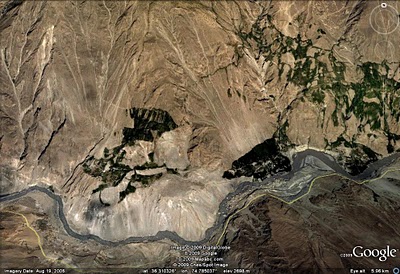
If true (and this is unconfirmed) then the signs of serious instability are absolutely clear:
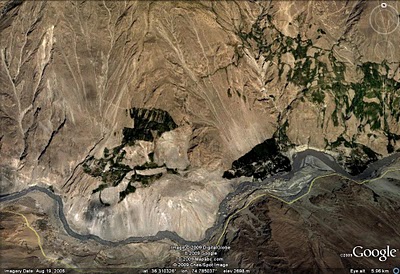
Note the large tension cracks, with displacement, running across the slope.
Prokerala is reporting that a substantial barrier lake has developed:
The debris fell into the adjacent Hunza River and blocked the flow of water. The stoppage of the river created a huge lake and danger of flooding in the area. The local administration started the rescue work and asked the people on low lying areas to immediately shift to safer places. Efforts were on to restore the normal flow of the river.
3 January 2010
Loss of life in the Brazil landslides
Updated 18:40UT on 4th January 2010
The loss of life in the Brazil landslides is now as follows:
1. Pousada Sankay (Sankai) in Praia do Bananal, Ilha Grande
So far 29 bodies have been recovered. Three victims are still believed to be buried in the debris, although the authorities cannot rule out the possibility of further victims.
2. The landslide at Morro da Carioca, Angra dos Reis
The number of recovered victims now stands at 21, with a high chance of further victims yet to be recovered.
The Brazilian Newspaper Globo has a superb Flash-based before and after comparison for both sites on its news webpage here. It is well worth a look.
1 January 2010
Latest updates on the Brazil landslides
Latest update (3rd Jan 22:40 UT) here
Updated 22:47 UT with revised fatality count
Updated with an additional photo
Globo now has a more detailed report with images of the landslides today in Brazil that I covered in an earlier post.
1. The landslide at pousada Sankay (Sankai) in Praia do Bananal, Ilha Grande
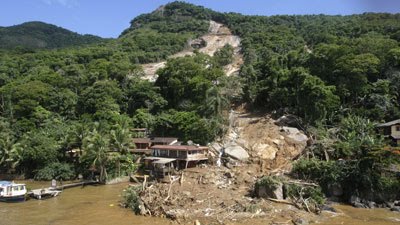
Nineteen (Nb updated from 14) bodies have now been found at the site of the lodge and in the sea around. The images of the site show a shallow slide at the interface between the regolith and bedrock. Five people have been rescued alive.
Update: Sky News has this additional image, which shows that the slide is much larger than the image above suggests:
2. The landslide at Morro da Carioca, Angra dos Reis
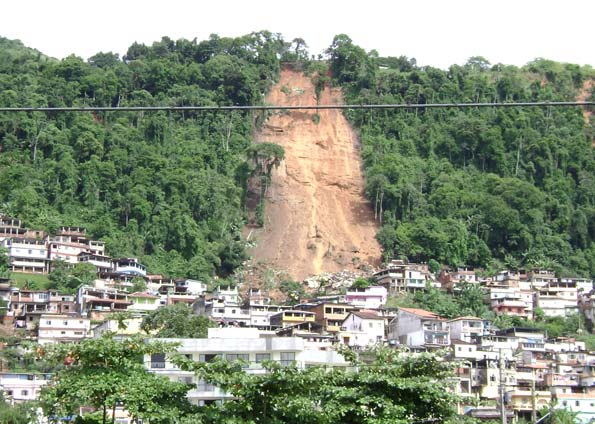 This landslide is believed to have killed ten (updated from five) people. There must be real concern about the other houses located at the toe of this slope, which appears to have signs of distress in other locations in addition to the new landslide.
3. Other landslides
Sadly, the three year old girl rescued from the landslide in Cascadura, a suburb of Rio de Janeiro, yesterday, has died. This brings the toll from this period of heavy rainfall to 39.
Another large landslide in Brazil?
News on these landslides has been updated here
The Washington Post is reporting another substantive landslide in Brazil, this time on Ilha Grande, an island off the city of Angra dos Reis, near to Rio de Janeiro. The report says that the slide hit a vacation lodge and three houses, killing at least ten people.
The original source of this story appears to be this Globo report, which carries an image of the lodge, called the Sankay in Enseada do Bananal:
 The report suggests that the slide happened at 3:30 am when most of the guests were sleeping.
A description of the lodge can be found here, and this is their website, which is currently down.
Interestingly, the report also suggests that “In the center of Angra dos Reis, the Civil Defense said that 22 people were missing in the Morro da Carioca, where a landslide hit several houses”, although at the moment I am unsure as to whether this report is correct.
News on these landslides has been updated here
Landslide case studies from the Xian Center of Geological Survey, China
The Xian Center of Geological Survey is compiling a set of very useful web resources of case studies of large landslides in Central China. This is particularly interesting as many of the slides are loess failures, which are comparatively poorly documented. The home page is here:
http://www.xian.cgs.gov.cn/english/achievements/land/
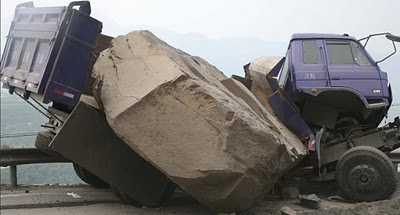
There are two items of particular interest there. The first is a PDF of a presentation on the landslides triggered by the Wenchuan earthquake. This contains some great images of the slides – I include this image from the presentation as a taster:
 The second comes in the form of two PDFs of a book entitled “Landslides in China – Selected Case Studies by Yin Yueping. This is a very impressive book, again with a selection of wonderful images.
 Dave Petley is the Vice-Chancellor of the University of Hull in the United Kingdom. His blog provides commentary and analysis of landslide events occurring worldwide, including the landslides themselves, latest research, and conferences and meetings.

Recent Comments