

31 December 2009
Mudslides in Rio de Janeiro, Brazil
Various international news agencies are reporting that the year is ending with a number of fatal landslides in and around Rio de Janeiro in Brazil. For example, the BBC report says:
“Heavy rains have caused floods and landslides in Brazil, leaving at least 11 people dead. Officials said the worst incident had occurred in Jacarepagua, in the western part of Rio de Janeiro state, where a family of five died in a landslide. The state has been hit by 24 hours of downpours threatening new year celebrations on Copacabana Beach”
Whilst the report on AP says:
“Heavy rains in the Rio de Janeiro area have triggered mudslides that have killed at least 18 people. Rio de Janeiro state’s Office of Civil Defence says that more deaths are likely as more rains are expected.”
A quick look at the TRMM cumulative precipitation graphs for this area suggests that it has suffered from a prolonged period of heavy rainfall, mostly falling in heavy rainfall events:
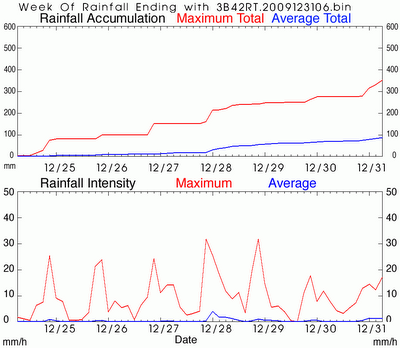 Further rain is forecast for the next 24 hours.
30 December 2009
Munich Re's list of the largest disasters of 2009
The reinsurance giant Munich Re releases annual statistics on the losses from natural catastrophes each year. They released the data for 2009 yesterday, presumably banking on the balance of probabilities that there would be no more major events in the three days left of the year. The release is available here:
http://www.munichre.com/en/press/press_releases/2009/2009_12_29_press_release.aspx
Overall results
The news for 2009 is good, with no disasters causing mass (i.e. >10,000) fatalities. There list of the top ten events in terms of fatalities is as follows (NB using the logical European style date format of dd.mm.yyyy):
- 30.09/1.10.2009: Indonesia: Earthquakes, 1,195 deaths
- 26-30.09.2009: South East Asia, East Asia: Typhoon Ketsana, 694 deaths
- 07-10.08.2009: China, Philippines, Taiwan: Typhoon Morakot, 614 deaths
- 03-14.10.2009: South East Asia, East Asia: Typhoon Parma, 469 deaths
- 25-27.05.2009: Bangladesh, Bhutan, India: Cyclone Aila, 320 deaths
- 29.09.-15.10.2009: India: Floods, 300 deaths
- 06.04.2009: Italy: Earthquakes, 295 deaths
- 21.08-15.09.2009: India: Floods, 223 deaths
- Aug-Sep 2009: West Africa, Central Africa: Floods, 215 deaths
- 04-13.11.2009 El Salvador, Nicaragua, Mexico, USA: Hurricane Ida, 204 deaths
Two aspects of these statistics are particularly interesting. First, the lack of a really large event is pleasing, but is probably no more than a serendipitous lack of a large earthquake in a populated area and limited numbers of large land-falling tropical cyclones, especially in the Atlantic basin. Second, the top five events were all associated with large numbers of landslide fatalities, most notably perhaps typhoon Morakot in Taiwan, the landslides triggered by the Indonesian earthquake and the multiple slides in the Philippines caused by typhoon Parma.
Geographical distribution
The geographical spread of these larger events is quite wide, including SE Asia, E. Asia, S. Asia, Africa, Europe and Central America. However, probably the most interesting aspect of this entire release is a map of showing the location of all the natural catastrophes that have occurred through the year:
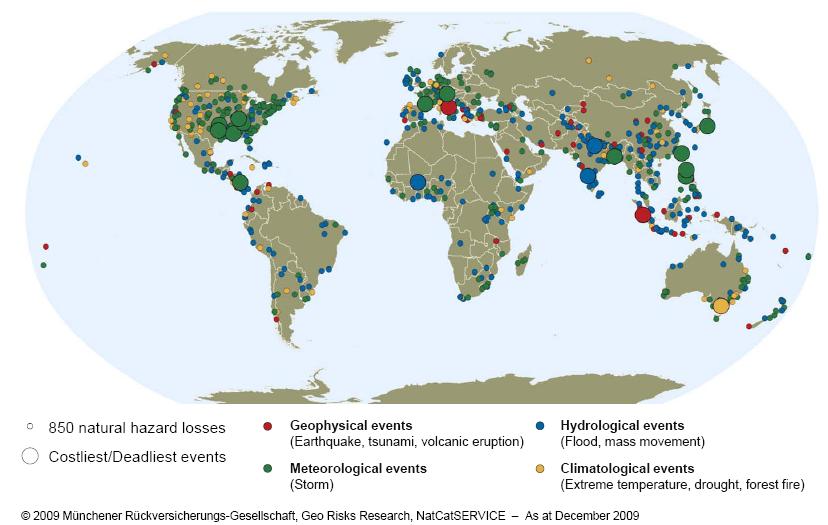 There are several things to note here. First, you may well have spotted that the highest density of catastrophes appears to have occurred in the United States, Europe and China. This of course reflects the vulnerability of countries with large asset values to geophysical and meteorological processes. Second, the distribution of the event types is quite varied. The climatological events are mostly concentrated in the USA and Australia; Europe and N. America is mostly affected by storms, whilst in Asia the events are primarily floods. Africa probably has far fewer catastrophes than most people would expect.
Economic Losses
Economic losses were also lower than in previous years at $50 billion, compared with $200 billion in 2008. The largest loss-inducing event was a winter storm that affected N. Spain and France in late January, inducing losses of $5.1 billion. The USA was affected by four of the ten events that caused the highest costs in terms of losses.
Climate Change
The effects of climate change on disaster losses is very complex issue. I am increasingly persuaded by the argument that there is now a strong climate change signal in the loss data, primarily due to increased precipitation intensities and increased intensities of the largest tropical cyclones, both of which are supported by strong scientific evidence that has been subjected to peer review. Interestingly, Munich Re are also pretty clear on this point:
‘Torsten Jeworrek, Munich Re Board member responsible for global reinsurance business, drew attention to the marked increase in major weather-related natural catastrophes worldwide since 1950, the number now having more or less tripled. Economic losses from weather-related natural catastrophes in the period since 1980 totalled approximately US$ 1,600 bn (in original values). “Climate change probably already accounts for a significant share. In the light of these facts, it is very disappointing that no breakthrough was achieved at the Copenhagen climate summit in December 2009. At Munich Re, we look closely at a multitude of risks and how best to handle them. Risks that change in the course of time are especially hazardous. Climate change is just such a risk of change.”
Losses caused by climate change will continue to increase in the future. Jeworrek: “We need as soon as possible an agreement that significantly reduces greenhouse gas emissions because the climate reacts slowly and what we fail to do now will have a bearing for decades to come.”‘
In the next few days I will review landslide events both for 2009 and for the “noughties”, and also the major, game-changing disasters of the last decade.
Munich Re’s list of the largest disasters of 2009
The reinsurance giant Munich Re releases annual statistics on the losses from natural catastrophes each year. They released the data for 2009 yesterday, presumably banking on the balance of probabilities that there would be no more major events in the three days left of the year. The release is available here:
http://www.munichre.com/en/press/press_releases/2009/2009_12_29_press_release.aspx
Overall results
The news for 2009 is good, with no disasters causing mass (i.e. >10,000) fatalities. There list of the top ten events in terms of fatalities is as follows (NB using the logical European style date format of dd.mm.yyyy):
- 30.09/1.10.2009: Indonesia: Earthquakes, 1,195 deaths
- 26-30.09.2009: South East Asia, East Asia: Typhoon Ketsana, 694 deaths
- 07-10.08.2009: China, Philippines, Taiwan: Typhoon Morakot, 614 deaths
- 03-14.10.2009: South East Asia, East Asia: Typhoon Parma, 469 deaths
- 25-27.05.2009: Bangladesh, Bhutan, India: Cyclone Aila, 320 deaths
- 29.09.-15.10.2009: India: Floods, 300 deaths
- 06.04.2009: Italy: Earthquakes, 295 deaths
- 21.08-15.09.2009: India: Floods, 223 deaths
- Aug-Sep 2009: West Africa, Central Africa: Floods, 215 deaths
- 04-13.11.2009 El Salvador, Nicaragua, Mexico, USA: Hurricane Ida, 204 deaths
Two aspects of these statistics are particularly interesting. First, the lack of a really large event is pleasing, but is probably no more than a serendipitous lack of a large earthquake in a populated area and limited numbers of large land-falling tropical cyclones, especially in the Atlantic basin. Second, the top five events were all associated with large numbers of landslide fatalities, most notably perhaps typhoon Morakot in Taiwan, the landslides triggered by the Indonesian earthquake and the multiple slides in the Philippines caused by typhoon Parma.
Geographical distribution
The geographical spread of these larger events is quite wide, including SE Asia, E. Asia, S. Asia, Africa, Europe and Central America. However, probably the most interesting aspect of this entire release is a map of showing the location of all the natural catastrophes that have occurred through the year:
There are several things to note here. First, you may well have spotted that the highest density of catastrophes appears to have occurred in the United States, Europe and China. This of course reflects the vulnerability of countries with large asset values to geophysical and meteorological processes. Second, the distribution of the event types is quite varied. The climatological events are mostly concentrated in the USA and Australia; Europe and N. America is mostly affected by storms, whilst in Asia the events are primarily floods. Africa probably has far fewer catastrophes than most people would expect.
Economic Losses
Economic losses were also lower than in previous years at $50 billion, compared with $200 billion in 2008. The largest loss-inducing event was a winter storm that affected N. Spain and France in late January, inducing losses of $5.1 billion. The USA was affected by four of the ten events that caused the highest costs in terms of losses.
Climate Change
The effects of climate change on disaster losses is very complex issue. I am increasingly persuaded by the argument that there is now a strong climate change signal in the loss data, primarily due to increased precipitation intensities and increased intensities of the largest tropical cyclones, both of which are supported by strong scientific evidence that has been subjected to peer review. Interestingly, Munich Re are also pretty clear on this point:
‘Torsten Jeworrek, Munich Re Board member responsible for global reinsurance business, drew attention to the marked increase in major weather-related natural catastrophes worldwide since 1950, the number now having more or less tripled. Economic losses from weather-related natural catastrophes in the period since 1980 totalled approximately US$ 1,600 bn (in original values). “Climate change probably already accounts for a significant share. In the light of these facts, it is very disappointing that no breakthrough was achieved at the Copenhagen climate summit in December 2009. At Munich Re, we look closely at a multitude of risks and how best to handle them. Risks that change in the course of time are especially hazardous. Climate change is just such a risk of change.”
Losses caused by climate change will continue to increase in the future. Jeworrek: “We need as soon as possible an agreement that significantly reduces greenhouse gas emissions because the climate reacts slowly and what we fail to do now will have a bearing for decades to come.”‘
In the next few days I will review landslide events both for 2009 and for the “noughties”, and also the major, game-changing disasters of the last decade.
23 December 2009
Happy Christmas
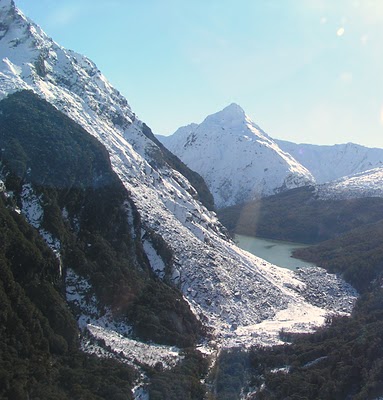 A wintry scene to wish readers everywhere a Happy Christmas! I will be back after the weekend.
21 December 2009
Landslides in Oregon
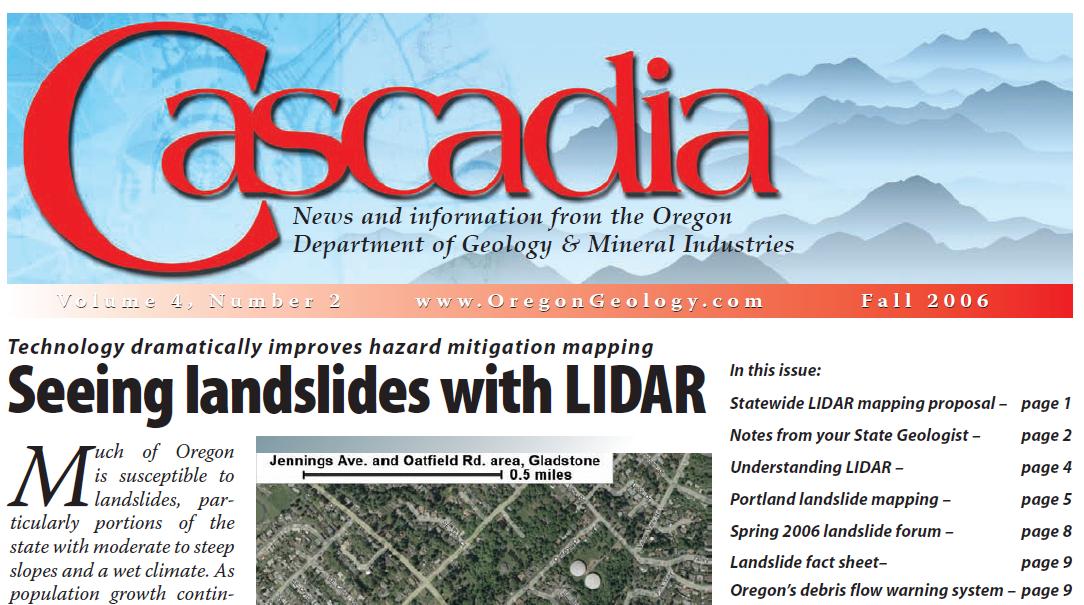
The Oregon Geological Survey has a quarterly magazine called Cascadia highlighting some aspect of the geology of that state. Their Fall 2006 edition focuses on landslides, with a series of articles on different aspects of landslides in that state. Some of the articles have a broader interest, such as the use of LIDAR for landslide mapping.
The magazine is here: Cascadia
20 December 2009
On the perils of Lake Sarez (Usoi) in Tajikistan
Science this week has an article (Stone 2009) on the perils associated with Lake Sarez in the Pamirs. Sarez is a huge lake (56 km long and with a volume of 17 billion cubic metres of water) that was formed by a landslide triggered by the 1911 earthquake in Tajikistan (see image below).
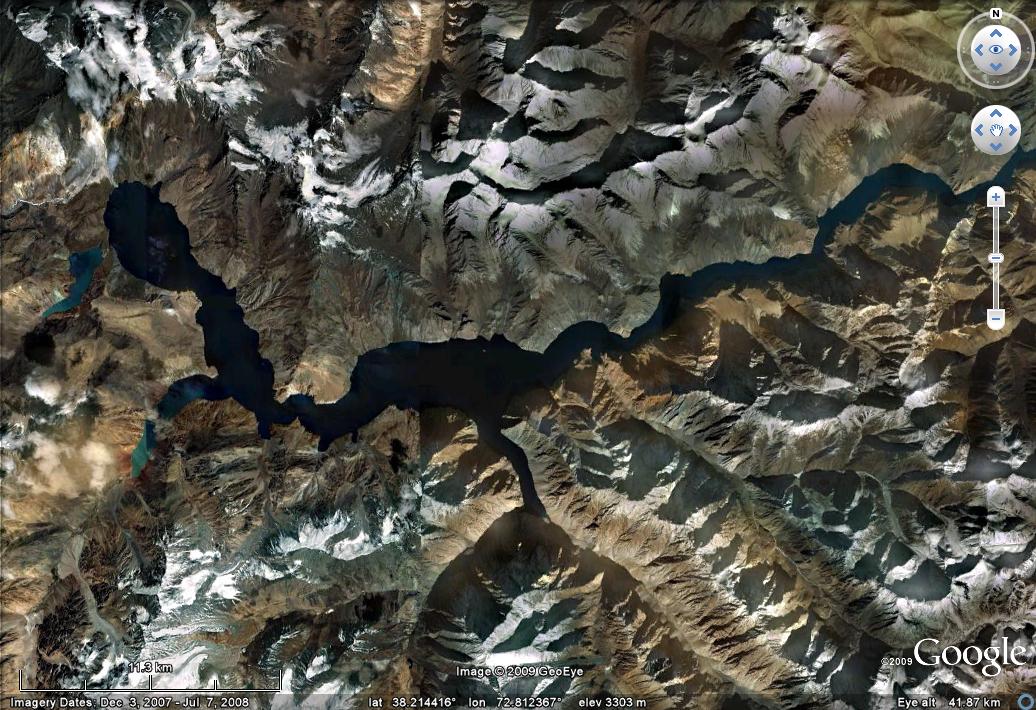 Google Earth image of Lake Sarez. The landslide dam is to west (left).
 Google Earth image of the landslide dam at Usoi. The source of the landslide was to the north of the current deposit.
The landslide dam (see image above) stands 567 metres tall. To put that in perspective, the image below shows Taipei 101, until recently the world’s tallest building. It is 501 metres tall:
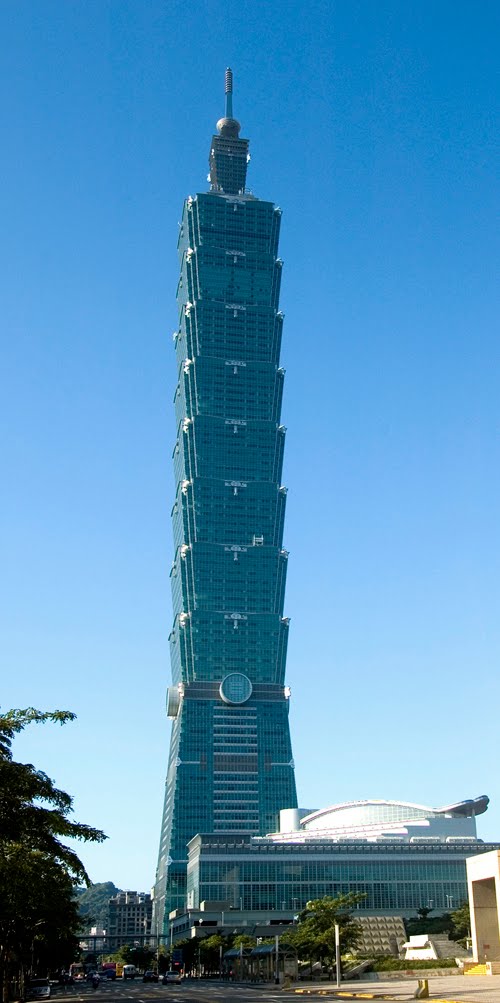 Taipei 101 (source Wikipedia)
Since its creation Lake Sarez has been steadily filling, which has long been a concern. There are an estimated 5.5 million people living downstream of the dam in the Amu Darya river valley, which flows through Tajikistan, Afghanistan, Turkmenistan, and Uzbekistan. There are really three key concerns with this dam:
- The dam could fail through seepage – a few years ago water started to seep through the landslide deposit, the concern is that this will erode out the core of the landslide;
- The dam could fail in an earthquake – this is a seismically-active zone, but the threat is considered to be quite low as the dam is considered to be quite stable;
- The dam could fail as a result of another landslide going into the lake, creating a displacement wave (similar to the Vaiont landslide) that causes the dam to overtop. Of course this is most likely to be triggered by an earthquake landslide.
The article points out that the third of these is the most likely, such that the site has a sizable warning system just in case.
The article points out that given the number of people downstream the risks are now considered to be too high. The dam itself cannot be stabilised, so there is a need to draw down the level of the lake by at least 50 m. However, there can be little doubt that this falls in the “easier said than done” category.
The key component of the article is highlighting that there are a range of views as to the level of danger at this site, both in terms of the possibility of another landslide and of the stability of the dam itself. The article quotes a number of notable landslide experts:
- Jorg Hanisch is quoted as saying that “the probability is 1 in a million,”of the dam being overtopped by a wave created by a landslide. He also rules out any possibility of the dame being eroded by seepage.
- Jean Schneider from BOKU in Vienna is quoted as saying that “The risk of even a partial outbreak is exaggerated…the dam will only possibly be overtopped in the far future.”
- On the other hand, Kadam Maskaev (deputy director of the emergency situations committee in Tajikistan) views the seepage in a different way: “The filtration regime of the dam is changing, and that makes me nervous.”
- Kyoji Sassa, the chair of the International Consortium on Landslides, has a different view again. The article claims that he argues that the threat from a further landslide is significant.
The suggested optimum mitigation approach is a diversion tunnel that would be used to generate hydroelectric power, with the water also being made available to downstream communities. However, the costs are high ($500 million) and such a project is not without risks. In the sort term it appears that there will be a research campaign that will culminate in a conference in 2011, the 100th anniversary of the dam. That would be an interesting meeting to attend!
Reference
Stone, R. (2009). Peril in the Pamirs Science, 326 (5960), 1614-1617 DOI: 10.1126/science.326.5960.1614
18 December 2009
AGU Presentation on the Societal Impacts of Landslides
This is the Powerpoint file from my presentation at AGU Fall Meeting in 2009 on quantifying the impacts of landslides on society, which is scheduled for Friday morning.
Quantifying the impacts of landslides on society
http://www.authorstream.com/player/player.swf?p=293494_633966923761398750
Please feel free to download it and to make use of it in presentations etc, but please acknowledge me. If you do use it please reference the presentation / abstract as follows:
Petley, D.N., Rosser, N.J and Parker, R. 2009. Quantifying the impacts of landslides on society. Eos Trans. AGU, 90(52), Fall Meet. Suppl., Abstract NH52A-04.
AGU Day 4: landslide sessions
There were two landslide sessions at AGU today, both in the afternoon. This was the part of the meeting about which I was most excited, but sadly to be honest the reality did not meet my expectations. I won’t write about all of the talks here, just a selected few.
First up was Bruce Malamud, who talked about the statistics of landslide clusters. This is great work, showing the remarkable similarity between landslide distributions for different multi-landslide events from different areas with different triggers. Helpfully he sumarised the ket implications of this work:
• It provides thae basis for a multi-landslide magnitude scale (like the Richter scale for earthquakes;
• The average landslide area in a multi-landslide event appears to be about 3000 square metres;
• It is at least theoretically possible to determine a volume of sediment production based on a volume area relationship;
• If large landslides arfe preserved in the landscape it shoukd be possible to determine the number of landslides that have been “lost” from erosion (turned out to be >99% in both Japan and Italy)
Interestingly, rockfalls have a very different statistical distribution – I wonder why.
Next up was Colin Stark, who tried to explain aspects of this distribution, and in particular the so-called “roll-over” component (basically there are fewer small slides than one would expect) but building a model of rupture propagation. This was interesting for two reasons. First, the model makes some assumptions about failure that cause concern (but this may have been misunderstanding; second, he came over as being exceptionally unsure of his own model, which was a little odd. The model appears to me to make some predictions that are very testable indeed – so this should evolve quickly.
Larsen, Montgomery and Korup gave a really interesting paper on the role of materials in controlling volume –area scaling for landslides. They challenged recent papers that have suggested that this scaling is independent of material, showing that in fact the scaling is very different from soil than for rock.
The final paper that I want to mention here was by Goren on the absolutely amazing Heart Mountain landslide. This will be the subject of a future post – but basically she was talked about the mechanics of this landslide – surely the largest terrestrial failure of all time! Wow!
AGU Day 4 – session on Scientists' Communication on Critical Global Environmental Issues
I am going to split my AGU Day 4 report into two posts. This one will cover the session this morning on the communication of the science of environmental change, whilst the second post will cover the landslide sessions.
The first session that I attended this morning was an excellent, experience-led examination of how to communicate environmental science to the public and to policy-makers. The central theme was, perhaps inevitably, aspects of climate change and its associated impacts, with a great array of speakers giving different perspectives on their experiences.
First up was the man the denialists love to hate (well, perhaps second to Al Gore and on a par with James Hanson), Michael Mann. His theme was on communicating temperature change, and he started with a quip that he has spent a fair amount of time on that theme of late, which raised something of a belly laugh from the audience. His central theme was that the science case is now clear (he noted that AGW is not controversial scientifically, only societally), and the case is not hard to make to an educated and rational audience. So why is there a problem? Well, the issue is that it is clear that there is a group that wish to do no more than sew doubt in the minds of the public, and so repeatedly stir up ill-founded controversies about climate change. He referred to the ongoing hockey stick discussion – noting that as a poster-child of the debate it was inevitable that it would be attacked – but also noting that the case for anthropogenic warming does not rely on this dataset in any way, even though it continues to withstand attacks by its detractors.
So what can we do? Mann argued that all scientists need to get out there to make the case. Basically with a few exceptions the mainstream media has proven incapable of understanding the science, or at least of presenting the argument in a rational way. It is essentially up to the science community to sort this out – something of a rallying call to us all. I hope that the science community will step up to the plate.
Second up was Richard Alley, talking about ice sheets and sea level. As with his Bjerknes lecture there was a sense of extraordinary enthusiasm for his science. It was sad to see that once again he put a disclaimer on the front of his talk, noting that he was not presenting the views of Penn State (it is deeply troubling that senior academics are driven to have to do that). He started by showing a map of the effects of a sea level rise of 6 m on the eastern seaboard of the USA to show why sea level rise matters.
Alley argued that scientists have the best job description going (essentially to find out about things), but that arguing is part of the job – we are required to continually challenge, chase and discuss. Although absolutely correct, this does not play well with policy makers or the public, who don’t like to feel that there is uncertainty about science.
He then went on to look at the IPCC predictions from 2001 on CO2, warming and sea level rise. He noted that they were pretty good for the first two, but sea level was too uncertain to be able to predict. In 2007 a better prediction was made, with caveats for the unknown components, but the reality is that sea level is rising faster than expected. He then went on to talk about how melt on the large ice caps can lead to increased rates of collapse either from the loss of buttressing around the margins or from the movement of melt water from the surface to the base. The upshot was that he suggested that a sea level rise of a metre or so by 2100 is not unreasonable from a science perspective, but much higher rates look unlikely unless there is an unknown gorilla in the room.
Whilst he didn’t spend a huge amount of time on issues of communication directly, the talk was an excellent summary – essentially a masterclass in how to communicate the science.
Third up was a talk by Serreze on Communicating Arctic Change – essentially focusing on sea ice loss. Again, the key observation was that the ice loss trend was more rapid than the scientific models had forecast. He then spent some time thinking through the key aspects of science communication, which included:
- The use of analogy – for example he showed some great maps from Donald Perovich showing areas of seasonal ice loss as a proportion of the land mass of Europe or N. America
- The need to find themes that resonate for the community in question
- The need to be open and transparent, and to use opportunities to explain properly the scientific process
- The need to respond to misinformation and challenges quickly, but to do so in a thoughtful manner.
One of the questions asked about how the Arctic Sea Ice looked for next year. His response was that it doesn’t look good right now as the surface area is well below normal, and the ice is very thin and young. However, it will all depend upon the weather, which is unpredictable.
Next up was a great talk on changes in hurricane intensity by Elsner. He noted that his recent paper on the increasing strength of the most intense tropical cyclones had caused a storm (I bet he has never used that joke before…). He showed strong evidence to demonstrate that although the overall number of hurricanes had not really changed, the strength of the most intense ones had increased, especially in the N. Atlantic. He noted that arguments that this didn’t matter as the most intense hurricanes occur out to sea do not stand up to scrutiny. However, he also noted that in the Caribbean it may well be that the number of hurricanes declines with warming, but that the strength of those that do occur increases.
From a science communication perspective he noted that they had put their data and their code on a website, providing open access to allow people to test their ideas. This has been very effective.
The penultimate talk was on the impacts of growing levels of hypoxia (oxygen deficits) in the ocean, given by Whitney. He noted that higher levels of nutrients from the land mass (mostly from fertilisers and human waste) is driving oxygen deficits in the oceans that are impacting their ecology. He noted in particular that there is a tendency to replace fish with jelly fish and that the squeeze that reduced oxygen levels are placing on the usable habitats is making species such as tuna and sailfish more susceptible to predation. Perhaps the most interesting part of the talk was the demonstration that warming in the seas off eastern N. Asia is affecting oxygen levels off the west coast of the USA, which is now seeing invasions of organisms that favour low oxygen conditions. He then went on to look at issues of communication with stakeholders, noting the need to:
- Identify issues to which the local community can relate;
- Make story understandable;
- Use case studies that the people can relate to;
- Separate scientific analysis from advice on policy;
- Prepare for resistance to the scientific message.
Finally, Gleick from Oakland talked about scientific communication. This talk was a neat summary of the key themes that had emerged from the other talks, with one difference – he was unconvinced that it is really easy to separate science from policy, although there is a need to differentiate between science and opinion.
I guess his key point was that policy makers need good scientists. There is only one thing worse than policies based on no science at all, and that is policy that is based on bad science. He noted that the fact is that we don’t communicate science well enough, or enough, or to the right audiences, or to the right audiences enough. He reminded the audience that the level of science education and awareness is low, whi
ch allows unnecessary controversies rage out of control. His final poin
t was again that we all need to do our bit, and that we need better journalists!
In questions he made reference to the frustration of denialst blogs, and the need to respond to them, through reference to this cartoon – “someone is wrong on the internet”:
 Source of the cartoon: http://xkcd.com/386/
This raised quite a laugh.
Overall, it was a great session with good speakers and an audience was engaged and interested. The sense across the hall was of frustration that the strength of the science of environmental change, and the threat that this poses, just is not getting through. The lack of scientific controversy on all the key planks that underpin our understanding of anthropogenic climate change is a clear theme of the conference. We really do need to try to find ways to ensure that policy makers and the public at large understand this.
AGU Day 4 – session on Scientists’ Communication on Critical Global Environmental Issues
I am going to split my AGU Day 4 report into two posts. This one will cover the session this morning on the communication of the science of environmental change, whilst the second post will cover the landslide sessions.
The first session that I attended this morning was an excellent, experience-led examination of how to communicate environmental science to the public and to policy-makers. The central theme was, perhaps inevitably, aspects of climate change and its associated impacts, with a great array of speakers giving different perspectives on their experiences.
First up was the man the denialists love to hate (well, perhaps second to Al Gore and on a par with James Hanson), Michael Mann. His theme was on communicating temperature change, and he started with a quip that he has spent a fair amount of time on that theme of late, which raised something of a belly laugh from the audience. His central theme was that the science case is now clear (he noted that AGW is not controversial scientifically, only societally), and the case is not hard to make to an educated and rational audience. So why is there a problem? Well, the issue is that it is clear that there is a group that wish to do no more than sew doubt in the minds of the public, and so repeatedly stir up ill-founded controversies about climate change. He referred to the ongoing hockey stick discussion – noting that as a poster-child of the debate it was inevitable that it would be attacked – but also noting that the case for anthropogenic warming does not rely on this dataset in any way, even though it continues to withstand attacks by its detractors.
So what can we do? Mann argued that all scientists need to get out there to make the case. Basically with a few exceptions the mainstream media has proven incapable of understanding the science, or at least of presenting the argument in a rational way. It is essentially up to the science community to sort this out – something of a rallying call to us all. I hope that the science community will step up to the plate.
Second up was Richard Alley, talking about ice sheets and sea level. As with his Bjerknes lecture there was a sense of extraordinary enthusiasm for his science. It was sad to see that once again he put a disclaimer on the front of his talk, noting that he was not presenting the views of Penn State (it is deeply troubling that senior academics are driven to have to do that). He started by showing a map of the effects of a sea level rise of 6 m on the eastern seaboard of the USA to show why sea level rise matters.
Alley argued that scientists have the best job description going (essentially to find out about things), but that arguing is part of the job – we are required to continually challenge, chase and discuss. Although absolutely correct, this does not play well with policy makers or the public, who don’t like to feel that there is uncertainty about science.
He then went on to look at the IPCC predictions from 2001 on CO2, warming and sea level rise. He noted that they were pretty good for the first two, but sea level was too uncertain to be able to predict. In 2007 a better prediction was made, with caveats for the unknown components, but the reality is that sea level is rising faster than expected. He then went on to talk about how melt on the large ice caps can lead to increased rates of collapse either from the loss of buttressing around the margins or from the movement of melt water from the surface to the base. The upshot was that he suggested that a sea level rise of a metre or so by 2100 is not unreasonable from a science perspective, but much higher rates look unlikely unless there is an unknown gorilla in the room.
Whilst he didn’t spend a huge amount of time on issues of communication directly, the talk was an excellent summary – essentially a masterclass in how to communicate the science.
Third up was a talk by Serreze on Communicating Arctic Change – essentially focusing on sea ice loss. Again, the key observation was that the ice loss trend was more rapid than the scientific models had forecast. He then spent some time thinking through the key aspects of science communication, which included:
- The use of analogy – for example he showed some great maps from Donald Perovich showing areas of seasonal ice loss as a proportion of the land mass of Europe or N. America
- The need to find themes that resonate for the community in question
- The need to be open and transparent, and to use opportunities to explain properly the scientific process
- The need to respond to misinformation and challenges quickly, but to do so in a thoughtful manner.
One of the questions asked about how the Arctic Sea Ice looked for next year. His response was that it doesn’t look good right now as the surface area is well below normal, and the ice is very thin and young. However, it will all depend upon the weather, which is unpredictable.
Next up was a great talk on changes in hurricane intensity by Elsner. He noted that his recent paper on the increasing strength of the most intense tropical cyclones had caused a storm (I bet he has never used that joke before…). He showed strong evidence to demonstrate that although the overall number of hurricanes had not really changed, the strength of the most intense ones had increased, especially in the N. Atlantic. He noted that arguments that this didn’t matter as the most intense hurricanes occur out to sea do not stand up to scrutiny. However, he also noted that in the Caribbean it may well be that the number of hurricanes declines with warming, but that the strength of those that do occur increases.
From a science communication perspective he noted that they had put their data and their code on a website, providing open access to allow people to test their ideas. This has been very effective.
The penultimate talk was on the impacts of growing levels of hypoxia (oxygen deficits) in the ocean, given by Whitney. He noted that higher levels of nutrients from the land mass (mostly from fertilisers and human waste) is driving oxygen deficits in the oceans that are impacting their ecology. He noted in particular that there is a tendency to replace fish with jelly fish and that the squeeze that reduced oxygen levels are placing on the usable habitats is making species such as tuna and sailfish more susceptible to predation. Perhaps the most interesting part of the talk was the demonstration that warming in the seas off eastern N. Asia is affecting oxygen levels off the west coast of the USA, which is now seeing invasions of organisms that favour low oxygen conditions. He then went on to look at issues of communication with stakeholders, noting the need to:
- Identify issues to which the local community can relate;
- Make story understandable;
- Use case studies that the people can relate to;
- Separate scientific analysis from advice on policy;
- Prepare for resistance to the scientific message.
Finally, Gleick from Oakland talked about scientific communication. This talk was a neat summary of the key themes that had emerged from the other talks, with one difference – he was unconvinced that it is really easy to separate science from policy, although there is a need to differentiate between science and opinion.
I guess his key point was that policy makers need good scientists. There is only one thing worse than policies based on no science at all, and that is policy that is based on bad science. He noted that the fact is that we don’t communicate science well enough, or enough, or to the right audiences, or to the right audiences enough. He reminded the audience that the level of science education and awareness is low, which allows unnecessary controversies rage out of control. His final poin
t was again that we all need to do our bit, and that we need better journalists!
In questions he made reference to the frustration of denialst blogs, and the need to respond to them, through reference to this cartoon – “someone is wrong on the internet”:
Source of the cartoon: http://xkcd.com/386/This raised quite a laugh.
Overall, it was a great session with good speakers and an audience was engaged and interested. The sense across the hall was of frustration that the strength of the science of environmental change, and the threat that this poses, just is not getting through. The lack of scientific controversy on all the key planks that underpin our understanding of anthropogenic climate change is a clear theme of the conference. We really do need to try to find ways to ensure that policy makers and the public at large understand this.
 Dave Petley is the Vice-Chancellor of the University of Hull in the United Kingdom. His blog provides commentary and analysis of landslide events occurring worldwide, including the landslides themselves, latest research, and conferences and meetings.

Recent Comments