

23 November 2010
How many structures can you see here?
Posted by Callan Bentley
Last summer, in Bonner, Montana on my Rockies field course, I took the students to see some nice exposures of Belt Supergroup strata on the side of the road. We were keeping our eyes peeled for both primary structures (i.e., patterns in the sediment that formed at the time of their deposition) and secondary, or tectonic, structures (i.e., those that formed as a result of the rock being strained under tectonically-imposed stresses).
One student found this sample, which made me go all ga-ga because of the wealth of different structures it displays:
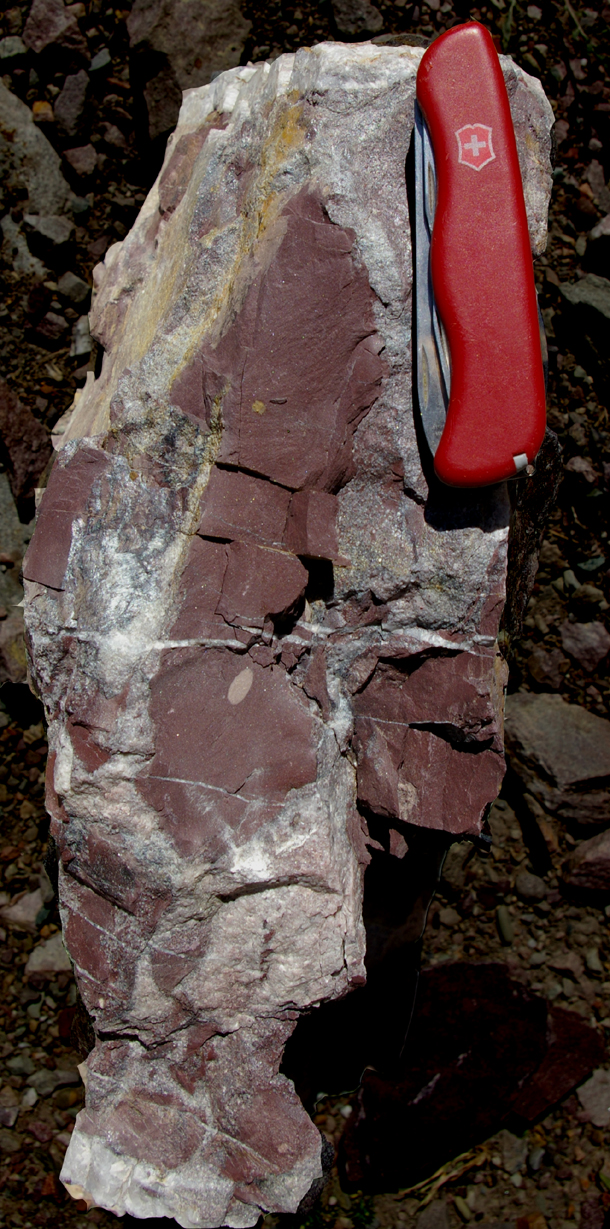
How many different structures can you identify here? Start naming them in the comments! I’ll post an annotated version of the diagram tomorrow so you can compare your structure-o-vision to mine…


 Callan Bentley is Associate Professor of Geology at Piedmont Virginia Community College in Charlottesville, Virginia. He is a Fellow of the Geological Society of America. For his work on this blog, the National Association of Geoscience Teachers recognized him with the James Shea Award. He has also won the Outstanding Faculty Award from the State Council on Higher Education in Virginia, and the Biggs Award for Excellence in Geoscience Teaching from the Geoscience Education Division of the Geological Society of America. In previous years, Callan served as a contributing editor at EARTH magazine, President of the Geological Society of Washington and President the Geo2YC division of NAGT.
Let’s start off with…
Tension gashes (quite prominent) filled with quartz or, more likely, calcite. Wish I had my bottle of HCl handy!
Lovely jointing which pops out thanks to the angle of the light. These appear to be subparallel to the tension gashes. Makes sense.
A plumose joint in that maroon clast – I can convince myself I’m seeing hackles propagating from very near the right edge of the clast, just to the left of the Victorinox knife tip.
I’ll stop there for now, for it’s time to refill the coffee pot.
Here are the structures I see:
1. en echelon veins
2. Ductile and brittle deformation of clast
The maroon clasts look like they might be rip-ups.
Besides the brittle stuff mentioned already, I see a cleavage (in the yellow stuff) near parallel to the long axis of the elliptical reduction spot.
And there’s something odd about the maroon clasts. I was going to guess that they’re clasts in a breccia, though rip-up clasts are also a possibility.
ABC joints, chill border, tension cracks.
[…] I asked for you to evaluate this rock sample of the Belt supergroup and tell me how many structures (both primary and tectonic) that you could […]