

3 October 2011
A landslide in Armenia with slightly unclear, but undoubtedly serious, impacts
Various new agencies are reporting a substantial landslide in Armenia in Lchkadzor village, Tavush Region, on the road linking Armenia with Georgia that occurred yesterday. The most convincing report, in that it quotes the Ministry of Emergency Situations, suggests that eight people were killed, mostly in and around their cars. However, other reports suggest that 35 cars were buried and that three, four or seven people may be missing. It appears that seven people were injured. One news report lists seven people reported to be missing in the landslide.
The landslide appears to have been triggered by heavy rainfall. It is reportedly quite large, burying up to 250 metres of road. The video below, which shows raw footage from a TV crew, shows the aftermath of the landslide (and some continuing activity). The video certainly shows vehicles buried and toppled by the landslide:
30 September 2011
Typhoon Nalgae: High landslide potential in the Philippines over the next 24 Hours
As the map below shows, three days ago Typhoon Nesat tracked across Luzon in the northern part of the Philippines, bringing intense rainfall that triggered landslides and widespread flooding. That storm has now tracked to the west and will shortly make landfall in the northern part of Vietnam, again bringing intense rainfall that is likely to trigger landslides.
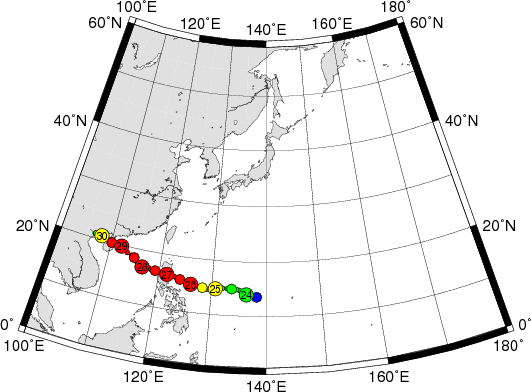
Of perhaps greater otential importance, in terms of impact at least, is the track of the next typhoon, Nalgae. Over the nest 24 hours this is expected to make landfall over the same area of the Philippines, also bringing very heavy rainfall:
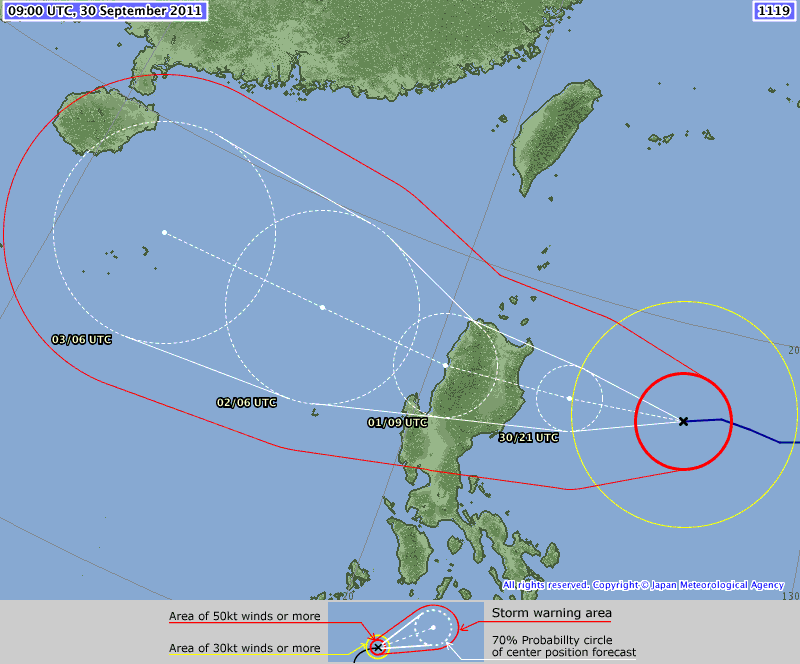
In landslide and flood terms, the potential impact of this intense storm is very serious. The heavy rainfall that it is likely to bring will fall on ground that is already saturated and rivers that are still in flood. The potential for damaging landslides is thus much higher. Unfortunately, past history has shown that this part of the Philippines is very vulnerable to typhoon-induced landslides. The next 24 hours will be a very dangerous time in this part of the Philippines. One can only hope that the storm passes across Luzon quickly.
28 September 2011
Helicopter images and other resource for the landslide dams in Japan
The Ministry of Land, Infrastructure, Travel and Tourism in Japan is continuing to provide an impressive array of information about the valley-blocking landslides, triggered during Typhoon Talas in the southern part of the country. Understandably, this is in Japanese, but nonetheless it is still a very useful resource. The front page can be rendered surprisingly intelligible with the use of Google Translate. The key parts that I have found are:
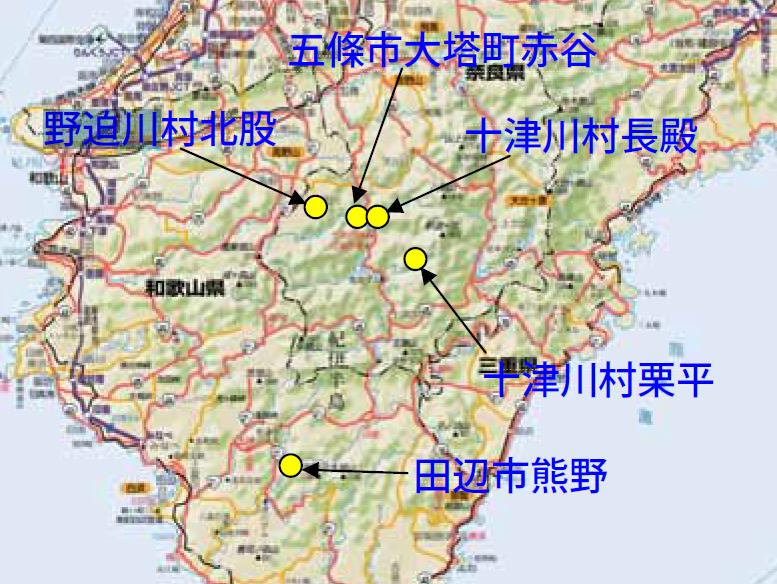
1. The location of the five sites (as shown above) can be found here.
2. Monitoring data for the five dams can be found at this page.
3. Perhaps most interestingly, almost daily photo updates on the state of the five dams can be found on this page. The links go to pdf documents that show each of the dams from two different directions on each day that the weather allows a helicopter flight.
4. From the front page there is also a set of astonishingly detailed documents about the mitigation works underway at each of the sites – such as this document outlining drainage efforts at one of the sites. Again, Google translate renders them readable.
The ways in which the Japanese authorities are using the internet to keep the public informed about the situation at these dams is remarkable. The contrast to the situation at Attabad last year is notable.
27 September 2011
New video – a pick-up truck being hit by a landslide in Taiwan
Apologies for two video posts in a week, but this just appeared on Liveleak. It is from the Chien-Shih Shan mountain road in Hsinchu County in Taiwan, and was collected on 11th June 2011:
I am unsure of the outcome for the occupants of the vehicle. It is interesting to note that the road was partly dry and there was no rainfall at the time.
26 September 2011
Photo album from the Himalayan earthquake
Thanks to Ray Duray for the heads up on this one. The Sacramento Bee has a photo blog with remarkable images of the destruction in Sikkim resulting from the earthquake. Many of these show the landslides, such as this one:

Meanwhile, the death toll is now reported to be about 120 people, but bodies continue to be recovered from beneath the landslides. Post-seismic landslides appear to be causing some problems.
25 September 2011
Landslide videos from India (x2), USA and China
Some remarkable new landslide videos have appeared this week:
First, a nice new video has appeared on Youtube showing a landslide, reportedly from Uttrakhand in India, in action. It gets quite exciting at around the 3 minutes 45 second mark:
http://www.youtube.com/watch?v=oKID3LSOYrk
And if you think it is interesting, take a look at this one, from Garwhal in India:
This was also posted yesterday – definitely a landslide, but I am unsure what is going on. Comments and thoughts welcome on what is going on here:
Interesting case of cutslope failure, causing a highway overpass to collapse (this is a news report after the event, but fascinating nonetheless):
http://www.youtube.com/watch?v=V0WZbdi1ZBk
Remarkable!
22 September 2011
Catching up part 2: landslides in NY State and Germany; the trial of the Italian Seismologists; and a video of a landslide on the Mohawk River
This is the second catchup post (the first is here) after my recent travels. Thanks for the patience of everyone who sent me information!
1. The Italian trial of seismologists and government officials
The most farcical natural hazard event of the decade must be the ridiculous trial of Italian seismologists and government officials over their “failure” to issue a warning (i.e. to predict) the L’Aquila earthquake. Italy has been very proactive in the management of natural hazards – this process undermines so much of what has been achieved. It is hard to see how anyone involved in natural hazard research and mitigation would be willing to work in Italy if these individuals are convicted.
2. Landslides triggered by Hurricane Irene in the Adironack mountains
Thanks to William Howell Whitney for highlighting this terrific gallery of images of landslides triggered by Hurricane Irene in the High Peaks region of the Adirondack Mountains of upstate New York (US). There are some highly impressive channelized flows there!
3. A video of a landslide on the Mohawk River, also triggered by Hurricane Irene
Dr John Garver Of Union College has been working on the Mohawk River, which was seriously affected by flooding induced by Hurricane Irene. I will quote his email from nine days ago:
“The lower Mohawk River has been in flood stage and clogged with debris from communities upstream. This action has compromised the lock/dams along the lower Mohawk. This weekend, after two weeks of this, the river carved new channels around Locks 8, 9, and 10. During this rapid channel migration, we’ve seen tremendous mass failure. I caught one with my camera last Friday. This is posted to YouTube. Here is the description that I wrote for that video:
The Mohawk Watershed in Upstate New York has seen tremendous flooding from Hurricane Irene and the Tropical Storm Lee (Aug-Sept 2011). On the lower Mohawk, where the River has a series of dams/locks for the Erie Canal, there has been significant damage, partly because so much debris has clogged the locks. As a result, the River has carved a channels around Lock 8, Lock 9, and Lock 10. Here is video showing this process at Lock 9. As the Mohawk River carves a new channel on the side of Lock 9 (Glenville NY), the road that crosses the lock (Rt. 103 from Rt. 5 to Rotterdam Junction) is eaten away by landslides. This video was taken at 5 pm 10 Sept, 2011. Note that this is just one of a series of landslides in this reach of the river that has resulted in this current geometry of the river channel.”
http://www.youtube.com/watch?v=Uy2yF-CFhjU
John has posted another video of the next lock upriver at Cranesville, which illustrates beautifully the magnitude of the flood damage:
http://www.youtube.com/watch?v=zBeHAq6o9l0
4. Another train-related landslide, this time in Germany
Landslides affecting trains are a regular feature of this blog (for example here, here and here). Thanks to Volker Trede-Mutz for highlighting another incident, this time an accident at St Goar on the River Rhine in Germany. Fifteen people were injured in the derailment.
21 September 2011
The earthquake in the Himalayas, Typhoon Roke, and landslides in Guatemala and Rwanda
The Tapeljung earthquake
As expected, the death toll from the Tapeljung (Nepal) earthquake continued to rise yesterday. Latest reports suggest that 61 people died in Sikkim, plus 12 in West Bengal, nine in Bihar, 11 in Nepal and seven in Tibet, generating a total of 91 deaths so far. However, AP is now reporting that there are fears that a landslide buried a further 40 people at a construction site for a hydroelectric plant at the town of Saffo on the Teesta River. Presumably this is the project described in this website – it will be interesting to see how this story develops. It is unclear to me at the moment whether the reported death toll for Sikkim includes the 12 workers known to have died at the site.
Landslides continue to hinder the emergency operations, as described in this news report. Some news reports suggest that two soldiers (Jawans, meaning infantryman, in the local terminology) have been killed during the landslide removal operations. Finally, the Save the Hills blog now has a very thoughtful, and indeed thought-provoking, piece on the experience of living through the earthquake in Darjeeling.
Finally, there has been little coverage of the damage in Bhutan, but Kuensel provides details.
Typhoon Roke and the landslide dams on the Kii Peninsular in Japa
Meanwhile, typhoon Roke is just about to make landfall in Japan (image from Tropical Storm Risk):
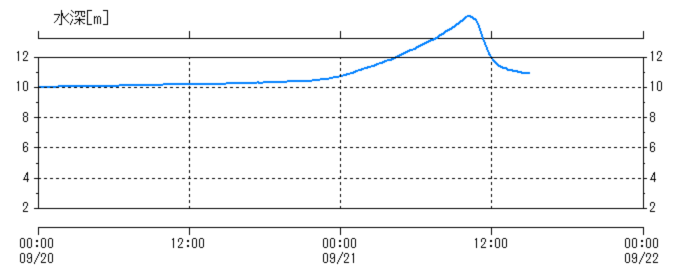
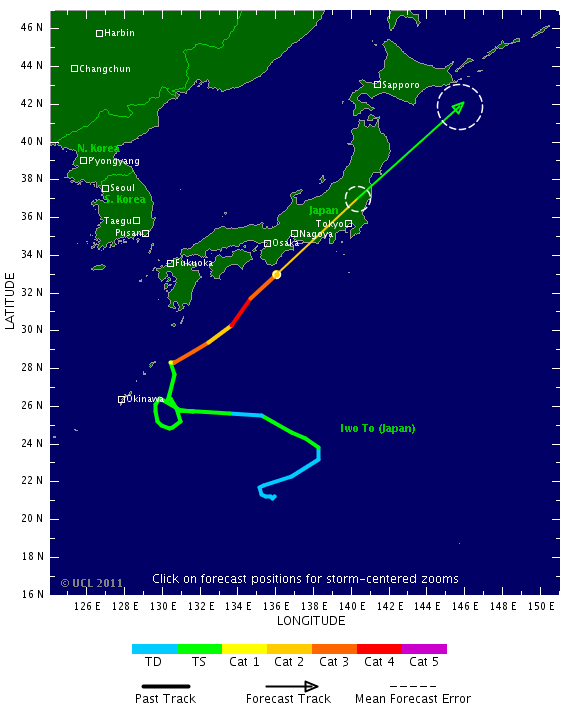 Colin Stark drew my attention to the real-time monitoring of the landslide dams, which suggests that all four are behaving in an interesting manner! The graphs below show the measured water levels in the lake with time. The Akatani dam appears to have overtopped and breached:
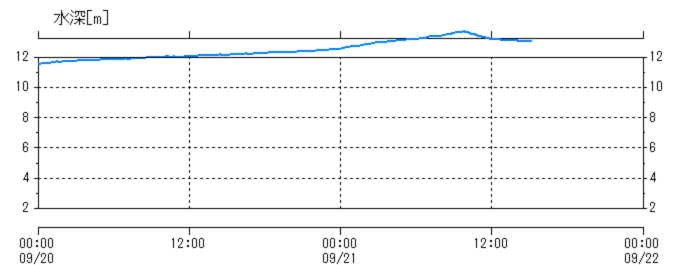
Meanwhile, the Iwo dam appears to have also overtopped, although less spectacularly:
Meanwhile the other two (KD and NT) are intact but showing a very rapid increase in water level, but note that the monitoring for the first appears to have failed:
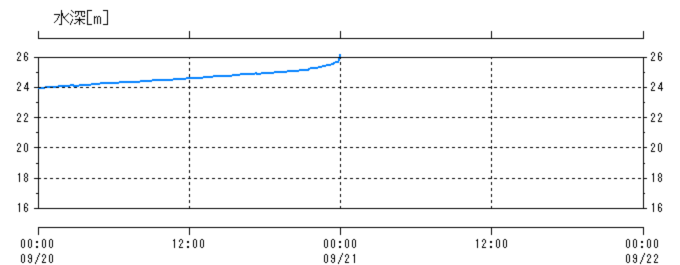
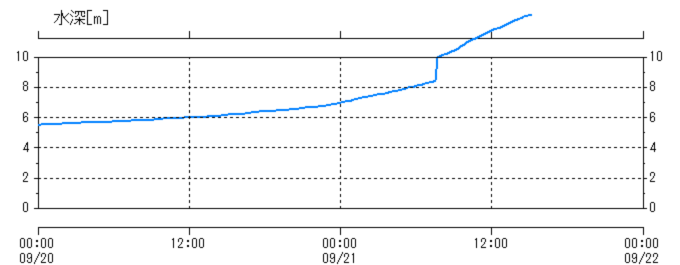
It will be very interesting to see how these dams perform over the next few hours. Meanwhile, the storm is likely to bring very heavy rainfall over the Tokuku earthquake area, which could induce many landslides in this region as well. Fortunately at the moment the storm is quite fast-moving, which may reduce the rainfall impacts a little. Rain radar images are available online; at the time of writing the picture looks rather grim for the earthquake affected areas:
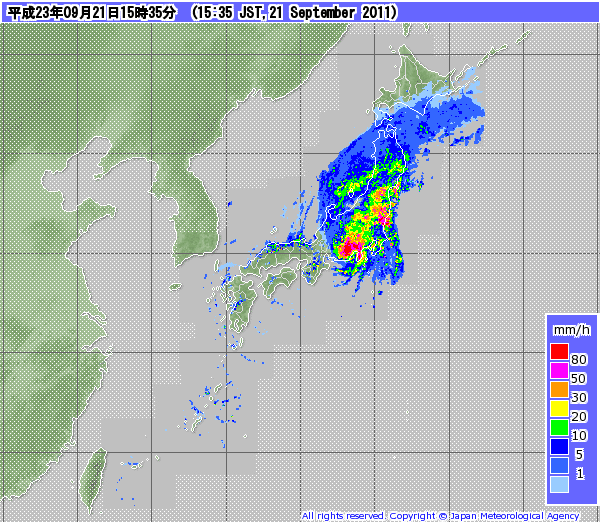
3. A landslide in Guatemala
Reuters reports that a landslide in Guatemala yesterday killed 15 people – of which three bodies (all children) have been recovered so far. This slide occurred a day after the earthquakes that also triggered at least one landslide, though it is unclear as to whether there is a link. It appears that this is more likely to have been rainfall-induced.
4. A landslide in Rwanda
And just to complete this tale of destruction, allAfrica.com reports a landslide in Rwanda two days ago that killed five children and destroyed 60 homes in Butaro and Rusarabuye, Burera District. Another child was killed whilst crossing a river.
Many of these stories are developing rapidly – I will try to post updates later.
20 September 2011
First photos of the earthquake damage in Sikkim
The Sikkim Now blog has images of the damage caused by the earthquake on Sunday. This includes some pictures of landslides affecting the road network:
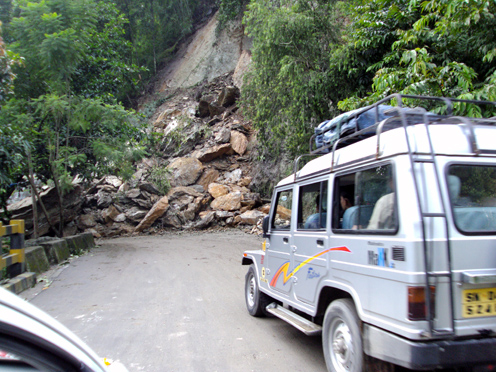
http://sikkimnow.blogspot.com/2011/09/rs-39680-lakh-deptts-projection-to.html
The Save the Hills blog has not yet received a post since the earthquake, but it will be very interesting to see what appears in due course.
Update on the earthquake in the Himalayas, plus typhoon Roke, an earthquake in Guatemala and landslides in China and Italy
There is a great deal going on in the world of landslides at the moment – so much so that I am struggling to keep up with the news! If you have sent me material for the blog then please accept my thanks and my apologies – I will get to it in the next few days as everything calms down. This post is a summary of the major ongoing incidents:
1. The Sikkim / Nepal earthquake
As I predicted yesterday, the death toll from Sunday’s earthquake has steadily crept upwards. Landslides remain a major problem in this emergency phase, and it is increasingly clear that they played a major role in the loss of life. An intriguing aspect of this earthquake is that there appear to have been so many landslides, even though the earthquake mechanism was essentially strike-slip (see the tectonic explanation for this event here). Generally speaking, strike slip events generate smaller numbers of landslides than do thrust events, which raises the question as to whether the major factor here was the monsoon. This would be a good PhD topic…
The latest situation that I have been able to ascertain from each country is as follows:
Nepal
Nepal News reports that 11 people were killed in this country, with the loss of life being quite spread out across the eastern part of the country. Many houses have been damaged and the Mechi Highway is apparently blocked by a landslide. It may be that information has not come through from the more isolated areas in the northeast as yet (see below), so the toll my increase a little.
Bhutan
Kuensel has a gallery of photos of the impact of the earthquake, and reports a single fatality in a landslide: “A 43-year old woman, who was on her way to fetch water, died on the spot in Lumithang village under Darla gewog, Chukha, after the earthquake last evening triggered a landslide that buried her.”
India
AFP has a report focusing on the major problems that roads blocked by landslides are causing to the relief effort. The reported death toll appears to be 41 people in Sikkim, plus nine in West Bengal and six in Bihar, giving a total on 56 in India, though again this total is likely to creep upwards over the next 24 hours. Kangla Online carries a report of an additional eight deaths in a bus that was caught in a landslide in North District.
Tibet
Xinhua reports seven deaths and 22 people injured in Yadong County in Tibet, with a large numbers of landslides and 70% of houses in the county having been damaged.
As an aside, the USGS shakemap, which should be seen as just a first order estimation of the potential impact, highlights two things:
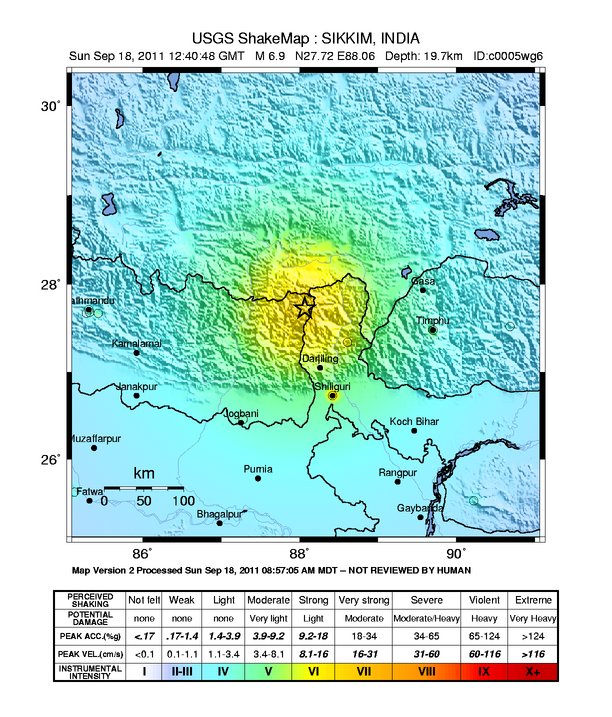 First, the epicentre is in Nepal and not India, so we should not be calling this the Sikkim earthquake. Actually, this is Tapeljung district of Nepal, so the Tapeljung earthquake would be a more accurate name. Second, as large an area of Nepal as of India should have been affected by strong shaking – so the apparently lower level of loss in Nepal is probably a consequence smaller number of people in this area. However, it is likely that conditions are very serious for those living in that area.
2. Typhoon Roke
Meanwhile, Japan is preparing for a direct hit from typhoon Roke, which is following a somewhat unpredictable course northwards and should reach the southern part of the country in the next 24 hours (map from Tropical Storm Risk):
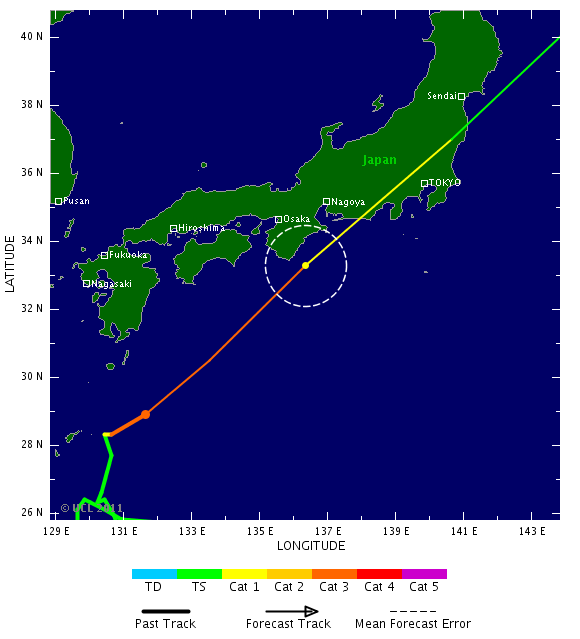
The storm is already bringing heavy rainfall across much of southern Japan. Meanwhile (and thanks once again to Colin Stark for his help with information about this situation), efforts continue to monitor and mitigate the landslide dams created by Typhoon Talas in late August – and of course the heavy rainfall from Roke may exacerbate that situation considerably. This pdf document provides an overview of two of the landslide dams (In Japanese, but easily translated with Google translate). There is also a wonderful information page about these dams online here (also in Japanese, but again easily translatable with Google translate). This includes real-time monitoring data of the water level on four of the dams.
Once again, the Japanese are showing the way in terms of managing landslide problems. If only a similar approach had been taken at Attabad.
3. Earthquakes in Guatemala
Meanwhile, Guatemala yesterday suffered four earthquakes in a 150 minute period, the largest of which had a magnitude of 5.8 according to the USGS. Reports suggest that two people were killed in their cars by a landslide.
4. Landslides in China
China has also suffered a spate of heavy rainfall, which is ongoing, in this late monsoon period. The most serious incident was a landslide in Baqiao, a suburb of Xi’an in Shaanxi Province, when a landslide with a volume of 100,000 cubic metres buried a number of small workshops, killing 32 people (of which 17 bodies have been recovered). Xinhua has a dramatic image of the landslide:
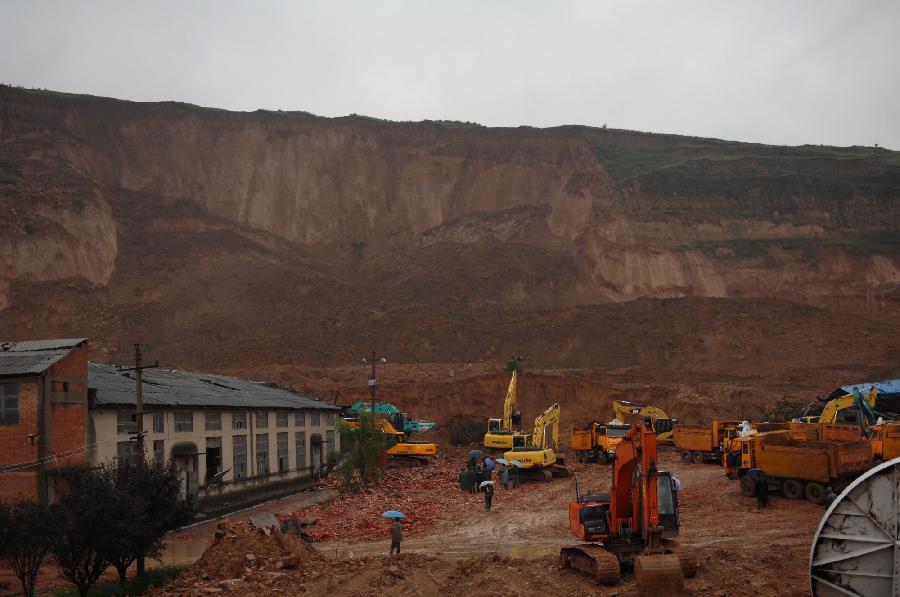
http://news.xinhuanet.com/english2010/photo/2011-09/18/c_131144879_2.htm
This looks to be a slide in loess. The site is clearly a quarry, so there may be a strong human element to the causation of the landslide.
There have been other landslides too – for example, Xinhua reports that three people were killed in a landslide in Chaoyu Township in Weibin District, Baoji this morning.
5. Two killed in a landslide in Italy
Finally, two hikers were reportedly killed on Sunday by a landslide to the south of Aosta in the Alps.
 Dave Petley is the Vice-Chancellor of the University of Hull in the United Kingdom. His blog provides commentary and analysis of landslide events occurring worldwide, including the landslides themselves, latest research, and conferences and meetings.
Recent Comments