

2 November 2012
Landslides in Art Part 16 – Dan Holdsworth Part 1
This is the latest installment of my occasional series featuring landslides as they appear in different types of art. Part 15 can be found here.
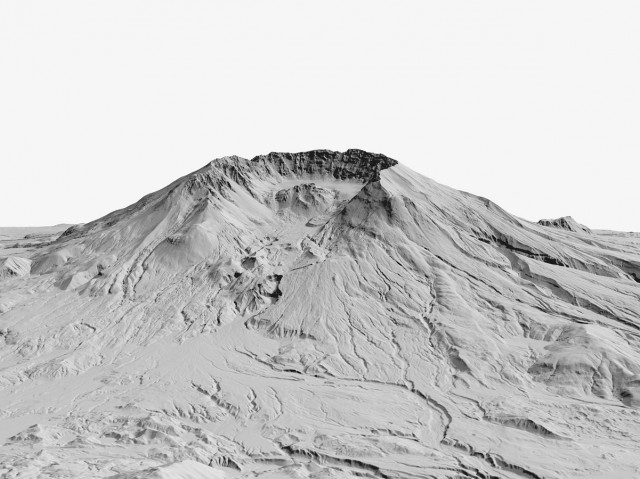
Dan Holdsworth is a photographic artist based near to Durham in Newcastle-upon-Tyne, where he teaches at Northumbria University. His work is varied and interesting, combining traditional photography with the use of novel imaging techniques to produce challenging and often very beautiful pieces of art. This year he has generated a really interesting series of works entitled “Transmission: New Remote Earth Views“, which appears to use high-resolution digital elevation models to generate images of topography. The full set of images can be viewed online here.
One set of images is of Mount St Helens, which of course suffered the largest landslide of the last century or so when it erupted in 1980. The image below captures beautifully the scar of the that landslide, which removed one side of the volcanic edifice:
Dan’s work features at least one other very large landslide, which will be the subject of Part 2 – can you guess which one?
1 November 2012
Images of landslides from the Sikkim Earthquake
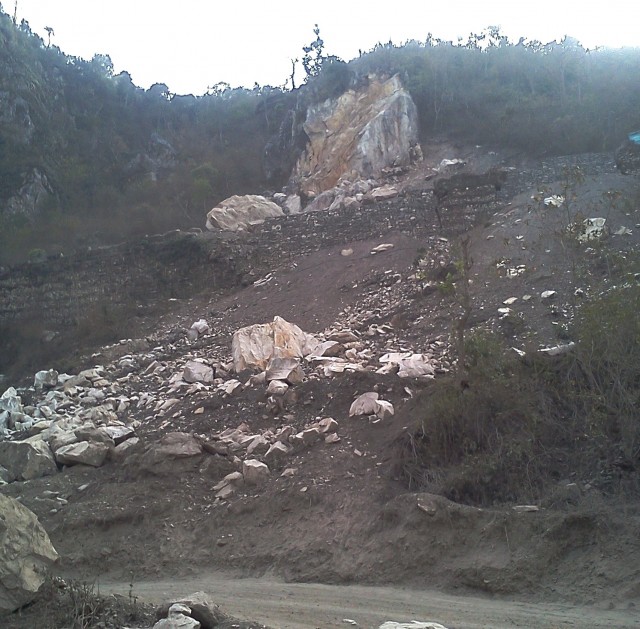
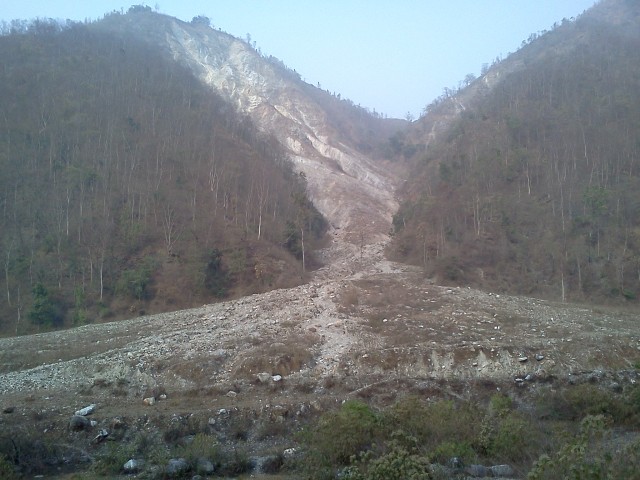
Last year, on 18th September, an earthquake struck the Sikkim area of India and the east of Nepal. This event, which had a moment magnitude of 6.9, triggered extensive landsliding. In the aftermath of the event there was considerable coverage of the impacts in India, but very little information about Nepal. Sumit Dugar, a student on the MSc in Risk and Environmental Hazards here at the Institute of Hazard, Risk and Resilience at Durham, visited the area and has very kindly made some images of the landslides that he observed available. I reproduce them here with his permission, but note that he retains the copyright:
31 October 2012
Fully funded PhD studentship in my research team
My colleague Dr Nick Rosser and I are advertising a fully funded PhD studentship to join our team at Durham. The PhD project, entitled “Numerical Rock Slope Modelling”, will start in January 2013 or shortly thereafter. The project will form part of a large industry-funded research programme, combining the work of two members of academic staff, two post-doctoral research associates, a PhD student and a technician,which aims to understand the mechanisms of rock slope failure. The successful candidate will be responsible for developing numerical models of rock slope stability using finite and discrete element rock mechanics software. The aim is to improve understanding of the mode, scale and timing of rock slope failure in response to both internal and external controls and triggers.
We are looking for a candidate with a background in rock mechanics, engineering geology, quantitative geomorphology, applied mathematics or a related discipline. You will need to be able demonstrate experience and competence in numerical modelling and/or the assessment of rock slope stability.
Details of the studentship are available here. The deadline for applications is 14th November 2012. Please contact me for any further details or information using my work email address: [email protected]
30 October 2012
New paper: a historic landslide-induced tsunami in Lake Geneva
 A fascinating paper as just been published online in Nature Geoscience, detailing a geophysical investigation of a tsunami deposit in Lake Geneva. There are two accounts of a tsunami event affecting the lake in 563 AD; the wave is reported to have inundated much of the ancient city of Geneva, suggesting that it was sufficiently large to overtop the city walls. Several villages along the length of the lake were destroyed. There are no reports that the tsunami was preceded by an earthquake, suggesting that a landslide was likely to have been the cause.
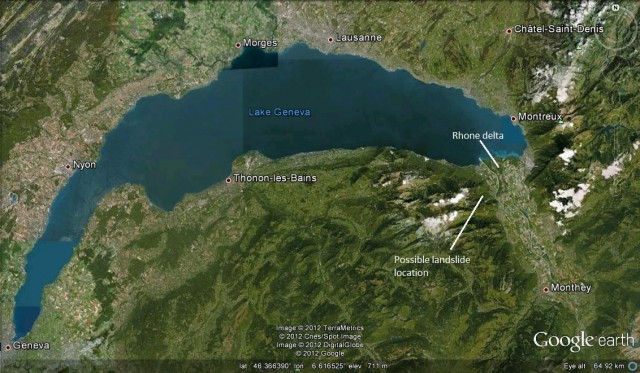
The proposal in the paper is that a rockslide triggered destabilization of the Rhone delta deposits at the far end of the lake (more than 70 km from the city), generating a destructive tsunami. The location of the major cities along the banks of Lake Geneva, the subaerial part of the Rhone Delta and the possible landslide scar are shown on the Google Earth image below:
 .
.
The location of the landslide is suggested to be above the Rhone Delta on the east side of the valley, indicating that the rockslide did not directly enter the lake. The Google Earth perspective view below shows the proposed landslide scar above the modern day village of Le Bouveret). It is certainly credible that this is a large rockslide scar. If the failure was a single event then this would have been a very large landslide:
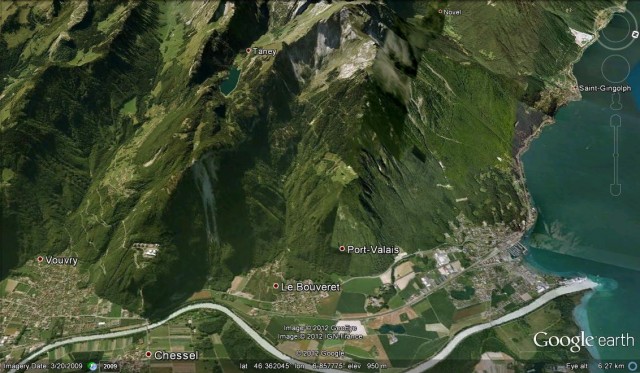 .
.
The study (Kremer et al. 2012) used a large-scale seismic reflection survey to investigate the sediments on the bed of the deep part of the lake, backed up with cores obtained from the lake bed. They found a huge mass movement deposit in the deep lake basin, extending over a length of 10 km and a width of 5 km, and with an average thickness of about 5 m. The authors have interpreted this as being a turbidite deposit typical of that associated with the collapse of a delta. The deposit was radiocarbon dated, giving a result that indicates that it was probably associated with the 563 AD event.
Kremer et al. (2012) have then used this sedimentary evidence to constrain a shallow water model of the tsunami event. The results are shown in the map below from the paper, where the numbers on the banks are the modelled tsunami heights and the red lines and numbers indicate the time taken for the tsunami to reach that point:
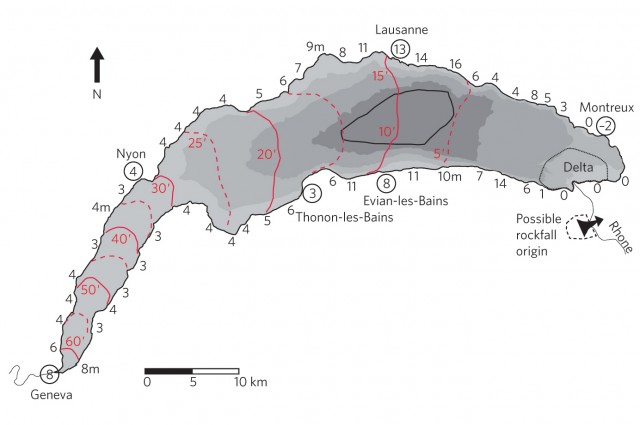 .
.
Thus, the tsunami reached the site of the modern-day city of Lausanne in 15 minutes and was 13 m high. Even Geneva, now a city of over 200,000 people, was struck by a wave 8 m high just an hour after the initial collapse.
Clearly, a modern-day repeat of this disaster would be catastrophic, with thousands of deaths and huge economic damage. The chances are of course likely to be low, but with such high consequence they cannot be ignored. Kremer et al. (2012) note that their seismic reflection profile indicates several earlier tsunami deposits in the bed of the lake, indicating that this event was not unique by any means. Given that these deposits are likely to have occurred since the last glaciation (when the glaciers would have removed the sediment), the return period is perhaps significant in human term. On that basis it is reasonable to hypothesise that at some very unknown point in the future, there could to be a repeat event. This may not be for hundreds or even thousands of years of course, so there is no real cause for immediate alarm. Protecting settlements against this type of hazard is exceptionally difficult – the amenity value of a lakeside location is so high that it counterbalances the hazard, and it is not possible to build protective structures without seriously reducing the value of the location. A warning system, with clear evacuation plans, is likely to be the optimum mitigation. However, as Kremer et al. (2012) note “We believe that the risk associated with tsunamis in lakes is currently underestimated, and that these phenomena require greater attention if future catastrophes are to be avoided”. It would be sensible to assess properly the hazards pose by the rock masses above the delta, and to evaluate the stability of the sediment pile itself, and to put in place an emergency plan for the lakeside areas if appropriate.
Reference
Kremer, K., Simpson, G., & Girardclos, S. (2012). Giant Lake Geneva tsunami in AD 563 Nature Geoscience DOI: 10.1038/ngeo1618
27 October 2012
Two interesting forthcoming conferences – the five years after the Wenchuan (Sichuan) earthquake and 50 years after Vajont
1. Five Years after the Wenchuan (Sichuan) earthquake
May 2012 will mark the fifth anniversary of the Wenchuan (Sichuan) Earthquake in China, in which more than 20,000 perished in landslides. To mark this anniversary, the Chengdu University of Technology will be holding a conference entitled: “Long Term Geo-Hazard and Risk Consequences of Areas Struck by High Magnitude Earthquakes”. This will be held from 12th-18th May 2012 in Chengdu. It will include two days of technical sessions and four days of field excursions into the earthquake affected areas. I will be attending – this is a great opportunity to exchange information about seismically-induced landslides.
Further details are available by emailing: [email protected]
2. Vajont 2013
October 2013 will also mark the 50th anniversary of the Vajont (Vaiont) dam disaster in Italy, Europe’s worst landslide accident. To mark this event there will be a conference in Padua, at which I will be presenting a keynote lecture. Details are available here. The conference will involve two days of technical sessions plus a one day field trip to the landslide site.
26 October 2012
Landslides in Art Part 15 – The Landslide Blues
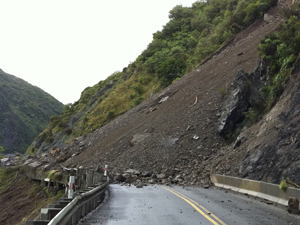
http://tvnz.co.nz/national-news/gorge-closure-costs-region-2-million-report-4414247
This is the latest installment of my occasional series featuring landslides as they appear in different types of art (and part 16 will follow soon!). The previous edition, Part 14, is here.
On this occasion, for only the second time, I have a song for yo (here is the previous song, on my original blog site). This song, which was written by Mark Owen, is about the Manawatu Gorge landslide in New Zealand. You should be able to play it below, if not you can access it (and indeed download it if you so wish) here:
Will we now see a host of landslide videos on Youtube that use the song?
24 October 2012
Caveat Emptor
Two news stories in the last few days have highlighted the danger posed by landslides to property, and with insurance mot covering landslide losses in most areas, the concept of caveat emptor (let the buyer beware) most definitely applies. The first involves a property transaction in the UK. The case is detailed (in its own unique style) in the Daily Mail. It involves this house and this landslide in Torquay in SW England:
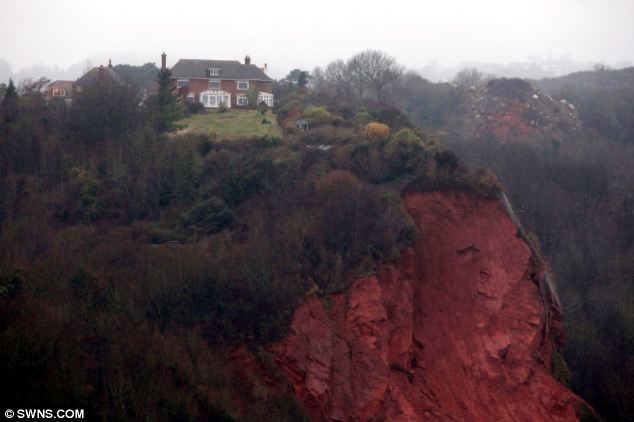
http://www.dailymail.co.uk/news/article-2221965/Torquay-house-left-teetering-cliff-edge-landslide-week-disabled-Sue-Diamond-paid-154k-it.html
According to the article, the buyer bought the house at auction with a telephone bid, despite: a. Not having seen the property; b. having had no survey undertaken; and c. auction particulars that “warned buyers that the six-bedroom house was severely structurally damaged and might be beyond economic repair”. Six days after the purchase the landslide shown above occurred, triggering a legal battle between the home owner and the vendor. The former is now having to sell her other property to cover the costs.
The second does not involve a property sale, but is a case where access to a property has been lost due to the collapse of an access track. This example, which occurred at Gippsland in SW Australia, is detailed here. In this case the access track to their farm has been destroyed by a landslide, and it is not thought to be possible to repair it. The report indicates that the owners have not been able to access their property since June this year as a result.
23 October 2012
An interesting rockslide from New York State
First, a huge thanks to Mike Huggins for all his help with this post.
Last Monday, a large rockslide closed Route 4 in Washington County in New York State. The landslide consisted primarily of large blocks of late Precambrian metamorphic rock. PostStar.com has a good image gallery of the landslide:
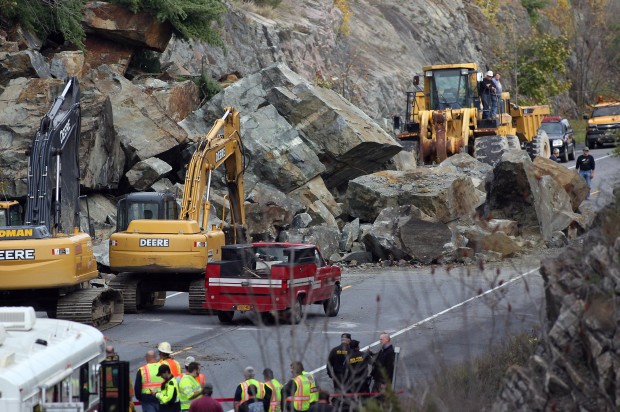
http://poststar.com/news/local/rock-slide-closes-route-in-fort-ann/article_132e96ee-16cb-11e2-ae07-001a4bcf887a.html
Although the landslide occurred at just after 9 am, no-one was buried or hit by the landslide. Inevitably, clear up took a few days – this article details the challenges that they faced. There is also a video of the site on this site (once you get past the Christmas advert), although it is unclear to me as to why this was “an accident waiting to happen as indicated by the report”.
It would be interesting to analyse the stability of this slope. The failure has clearly been controlled by existing joints in the rock mass.
20 October 2012
A very cool riverbank collapse video
This is rather fun (link here for those of you using iPads):
.
The location is not really clear, but NH53 is the road that links Badarpur in Assam with Imphal in Manipur, India, so I would speculate that it is on that road. Standing so close to those tension cracks as the main mass collapsed was somewhat foolhardy. It is a luck that there was no retrogression of the landslide mass.
17 October 2012
Photographs of the Kranevo landslide in Bulgaria
Yesterday I asked for assistance in finding out more about the Kranevo landslide in Bulgaria. As ever you have come up trumps – many thanks. I would in particular like to thank Chris Atkinson and Alexandre Matthieu for their tireless assistance.
So, first there is an image gallery of the landslide on the vesti.bg website, which includes this image:
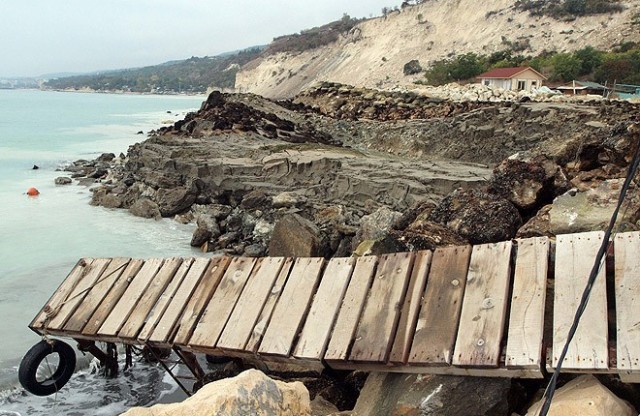
http://www.vesti.bg/index.phtml?tid=20&oid=12300&galid=85502
Based upon this and the other images, I think that the area affected is roughly as shown on the Google Earth perspective view below:
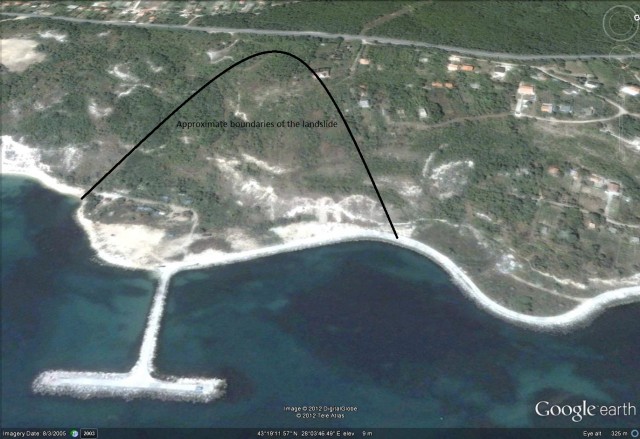
.
The landslide is definitely rotational in nature, with near-vertical rear scarps and an uplifted toe (including a part of the near-shore sea floor). The morphology of the area suggests that this type of landslide is common in this area, and this appears to be supported by this document (NB pdf in Bulgarian!).
 Dave Petley is the Vice-Chancellor of the University of Hull in the United Kingdom. His blog provides commentary and analysis of landslide events occurring worldwide, including the landslides themselves, latest research, and conferences and meetings.
Recent Comments