

10 June 2013
A new landslide video showing the transition from a soil slump to a soil slide
Many thanks to Graziella Devoli for the heads up on this one
Across Europe in the last few weeks there has been very heavy rainfall, triggering landslides and floods across a wide area. The most recent event occurred in Switzerland overnight, and Germany is experiencing extensive and very damaging floods as the water moves through the river system.
Starting on 17th May, a band of rain traveled up across Europe from Northern Italy, where it caused widespread flooding:
..
On 22nd May, this rainstorm reached southern Norway, where of course the snow melt season is underway. Rain on thawing snow is a combination that is effective in initiating landslides; unsurprisingly landslides, debris flows and failures in fill slopes all occurred. Perhaps most interesting is this video of a slump in the affected area:
I have now removed this video as it starts automatically. It can be viewed here.
..
This video beautifully captures a key element of the process of this type of landslide, just before the runaway failure. This is the rapid change of state of the soil from an intact mass into a very weak, highly mobile flowing material. Note that this is a material change – the rapid acceleration is not caused by an increase in slope gradient or suchlike. It would be interesting to know more about the materials involved, but a possible explanation is the static liquefaction process that was also responsible for the landslides in Brazil in early 2011. It is unsurprising that these slides cause loss of life – something that looks quite unimpressive almost instantaneously becomes a very rapid slide, with huge damage potential.
This video, which I cannot embed, also captures a reporter’s experience of getting rather too close to the landslides and floods as they occurred. Around the one minute mark some dramatic footage of a debris flow and then a slope collapse event, is included.
4 June 2013
Rockfalls and landslides from the Taiwan earthquake on Sunday
The M=6.2 earthquake in Central Taiwan on Sunday (2nd June 2013) was located in a highly mountainous, but fortunately sparsely populated, area. Landslides are inevitable in such an event, and news reports suggest that much of the damage and most of the deaths and injuries were the result of rockfalls. This video, captured just after the earthquake, demonstrates the landslide activity that it caused:
http://www.youtube.com/watch?v=jaqGBZKkeho
..
The current toll from the earthquake is four people. It appears likely that all were killed by rockfalls.
2 June 2013
The physics of snow and ice – two videos
Whilst my interest in landslides does not really extend to snow and ice avalanches, sometimes the flow of snow and ice can be quite informative about the ways in which landslides work. Two videos have popped up recently that illustrate this – both on Livelink. The first shows a slow snow avalanche in Austria, but in landslide terms this is quite similar to a slow debris flow:
.
.
The interesting aspect of this is the way that the structure of the mass and the comparatively low velocities allow the complexities of the flow to be examined. Thanks to Pasi Jokela for highlighting this one.
The second is a video from the Kuskokwim River in Alaska. This hows the importance of momentum, and in particular the ways in which mobile masses behind the front on the flow influences behaviour:
.
28 May 2013
Another landslide on a reservoir flank – Yesa in Spain
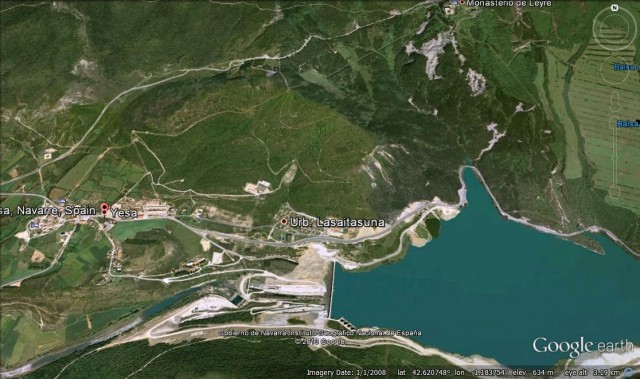
In the last few days I have posted a couple of times about a landslide on the banks of the reservoir from the Laxiwa Dam in China. It hs been brought to my attention that there is another interesting, but this time in Europe, at Yesa in Spain. The dam, which is located at 42.615N, 1.183E, has an interesting history. A concrete dam was constructed some years ago, with impoundment being undertaken in 1959. However, in recent years a new, much larger, dam has been proposed for the site. There is a description of the proposed project (NB PDF) – the structure is a 117 m high, concrete-faced gravel dam – but this has not yet been built.
It is probably fair to say that the project has not met universal approval, and there are organisations that are actively campaigning against this development. One of the major concerns appears to be the presence of a landslide on the flank of the dam site. One of these organisations has a website about the landslide (in Spanish) – Google translate does a good job of rendering it comprehensible for those without Spanish language skills. Note that the website is clearly presented from a particular viewpoint and I cannot verify the content.
The slope in question is this one – the Google Earth image was taken in 2008:
..
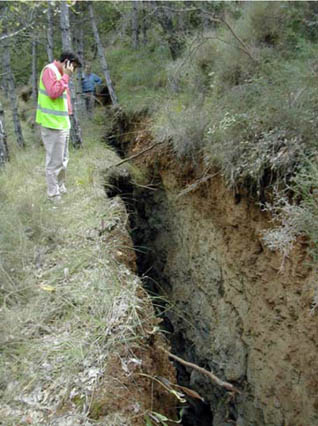
The landslide was first identified in the 1930s, when a failure occurred during construction of the original dam. Reactivations of the movement occurred in 1960 as impoundment occurred, and during heavy rainfall in 1964. According to the Yesano website, movement was reactivated in November 2003 as the slope was being excavated for the abutment of the proposed larger dam. The Yesano website has images of the tension cracks, such as this one:
http://www.yesano.com/deslizamientos_Yesa.htm
…
In July 2007 sliding continued to develop and works were suspended whilst a new investigation was undertaken. Further movement occurred in April 2008.
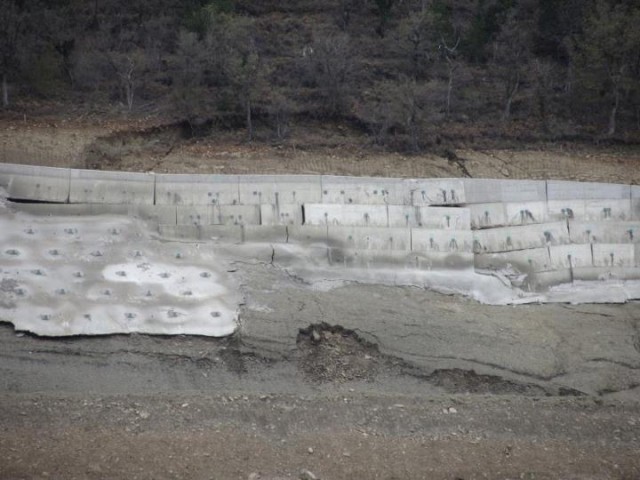
More recently, in April 2012, the Yesano website reports that further movement occurred 200 m downstream of the dam:
http://www.yesano.com/deslizamientos_Yesa.htm
..
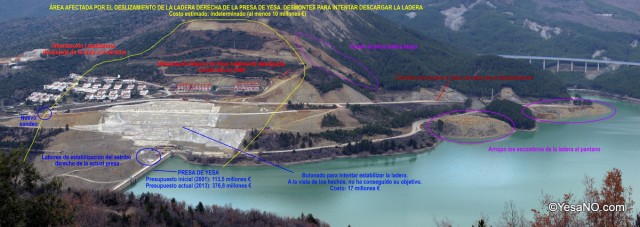
In February 2013 the situation deteriorated during heavy rainfall, and considerable additional movement occurred, such that the authorities announced works to stabilise this flank of the abutment. The Yesano website notes that 60 houses on the landslide were evacuated. They won’t know until next month when they can return to their homes.
They have an image showing their interpretation of outline of the landslide as it is now:
http://www.yesano.com/deslizamientos_Yesa.htm
..
The authorities report that movement rates are currently low (about 1.5 mm pr month), but a large landslide on the flanks of a concrete gravity dam must be a source of real concern..
27 May 2013
Landslides in Art Part 18: Elena Damiani
This is the 18th part of my occasional series on Landslides in Art. Part 17 can be found here.
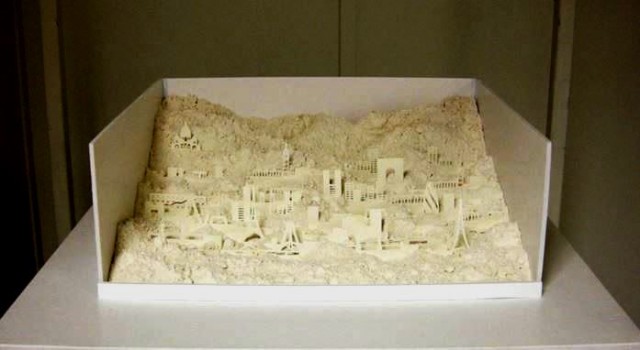
Elena Damiani is a Peruvian artist based in London whose work combines sculpture and architecture to challenge notions of space and place. Her work is really interesting, and she has both a personal website and a blog, which are well worth a look. In 2009 and she produced a piece of work entitled landslide, which is a scale model installation that depicts a series of building apparently over-run by a granular flow. There are a series of images of the work on both her blog and her website:
 ..
..
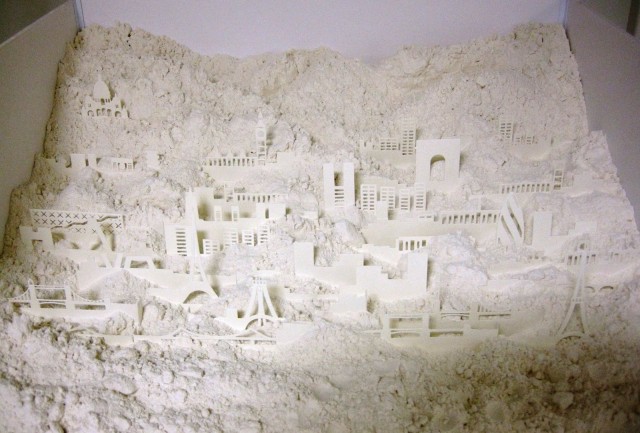
It is an interesting piece in that structures are a combination of mostly recognisable and often iconic buildings from around the world, set in a steep mountain environment, with the granular flow around their foundations:
 ..
..
The source of the landslide is not obvious, and the buildings have not been toppled, perhaps suggesting a slow flow rather than a rock avalanche?
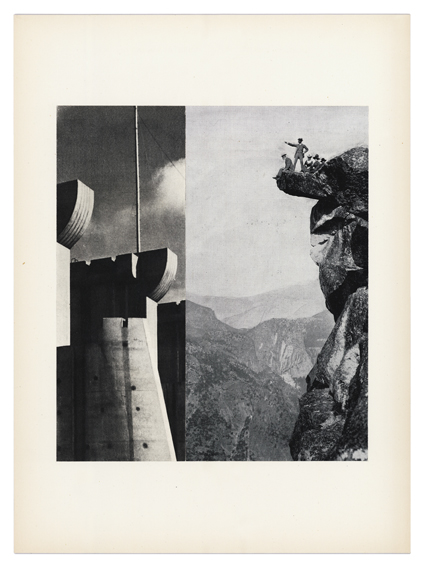
In fact her work quite often features other aspects of landslides, in some cases incipient failures:
http://www.elenadamiani.com/palimpsests.html
..
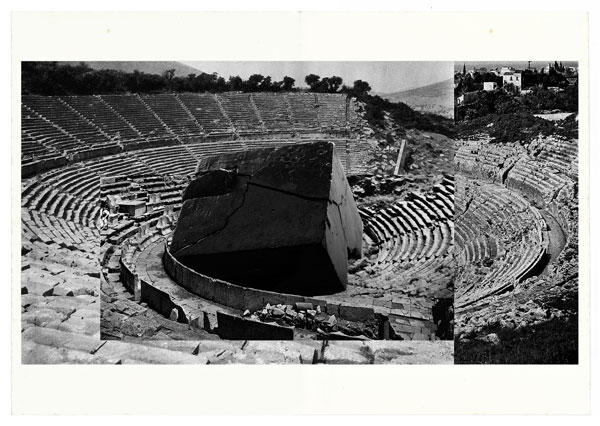
And in others the aftermath of large rockfalls:
http://www.elenadamiani.com/palimpsests.html
26 May 2013
Landslides and large dams – there may be trouble ahead…
Yesterday I posted for the second time on the extraordinary landslide problem that has developed at the Laxiwa HEP station in China. The wider question that goes with this is the degree to which this is an isolated problem, or could it be that this is an indication of a larger issue? Later this year there is a conference in Italy to mark the 50th anniversary of the Vajont landslide disaster, at which I am presenting a keynote lecture. The paper that I have written focuses on an analysis of landslides associated with large dams over the last ten years. The paper is out in October and I don’t pre-publish my work. However, I thought it would be interesting in the context of Laxiwa to show two maps. The first is the global distribution of large dams – this is from the UN GrandD database, which provides information of large dams worldwide, mapped onto a global digital elevation model using ArcMap:
 ..
..
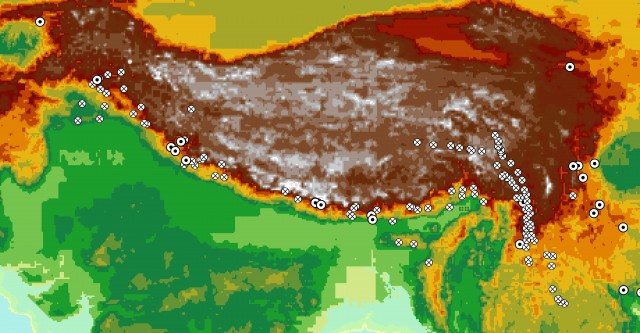
So each red dot here is a large dam (defined as having a storage capacity of greater than 0.1 cubic kilometres). The interesting thing here is the paucity of large dams in and around the Himalayan chain (and indeed the Andes). As I have shown before, the Himalayas are really the global epicentre for landslide activity, so this is the environment that requires the highest level of care with respect to landslide problems. The map below homes in on the Himalayas, again with a DEM as the backdrop:
 ..
..
You will see that there are two types of symbol shown here. The circles with dots in the centre are locations in which my database indicates there have been fatality-inducing landslides associated with large dams in the last ten years. These are mostly landslides at dam construction sites or landslides that have impacted the camps housing employees associated with dam construction or operation. There are a surprising number of landslides given the numbers of dams in this part of the world. This suggests to me that we are not managing landslides properly in this part of the world. The real worry lies in the other symbols – the circles with crosses. These are large dams that are proposed, planned or under construction in this area, compiled from a variety of sources but drawing heaving on the International Rivers datasets. Not all of these will be constructed, but the number of new dams in this region is extraordinary, especially in the east of the region.
The threat is clear – the recorded landslides shown above and the Laxiwa problem clearly indicate that there is a landslide problem associated with these structures. Unless we improve the quality of landslide detection and mitigation, these problems are going to get much worse as these dams are built.
There hasn’t been a repeat of the Vajont disaster in the intervening 50 years, mostly through prudent management of the hazard and perhaps a sprinkling of good fortune. My sense is that we are pushing our luck to the limit with the planned dams in and around the Himalayan Arc. The question as to whether these dams should be built at all is important but beyond the scope of this blog. However, the potential landslide problems in these areas are acute and will require a much higher level of management than appears to be occurring at present.
25 May 2013
So where is the lateral margin of the Laxiwa Hydropower Station landslide?
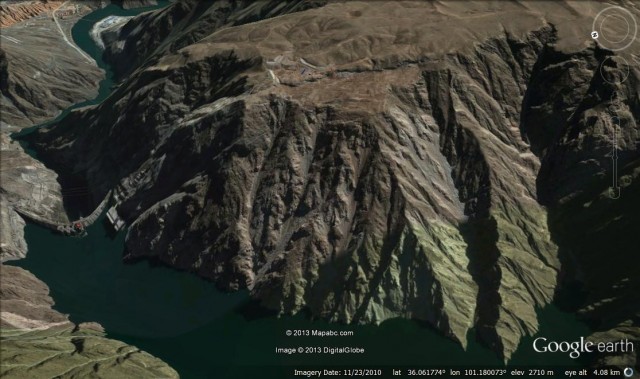
A few days ago I posted about the worrying landslide that has developed on the banks of the reservoir created by the Laxiwa Hydropower Station in China, as highlighted in a recent paper by Zhang et al. (2013). As a reminder, this is the Google Earth image of the slope, with the rear scarp of the landslide very clearly visible:
 ..
..
There are three aspects of this landslide that are worth examining in more detail. All are reasons to be concerned:
1. Evidence for the presence of an ancient landslide before construction of the dam
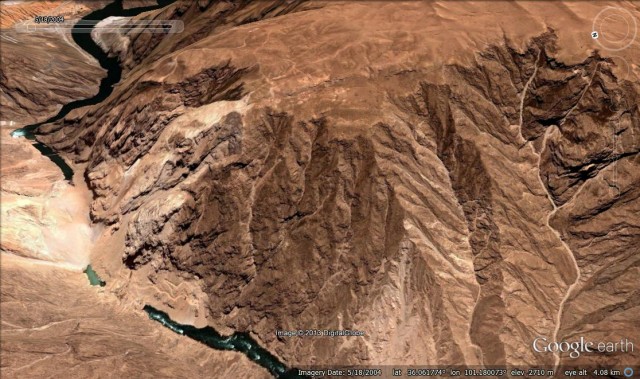
On Google Earth there is also a set of images of the site before the dam was constructed, dated May 2004. This image is below, taken from the same perspective as the image above:
 ..
..
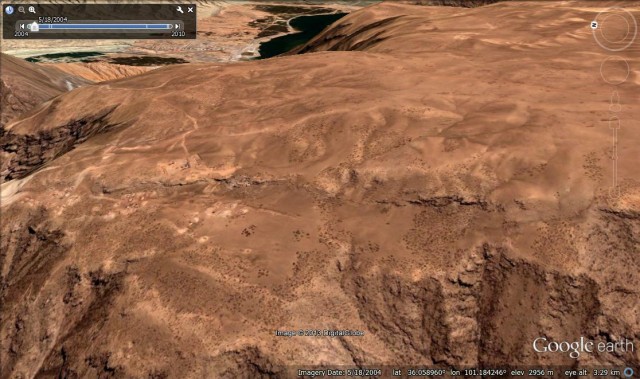
Careful examination of the image shows that the landslide scarp was already present – in other words this is an ancient landslide that predates the construction of the dam. A closer view of the scarp suggests that this might be a quite ancient feature – it appears to be quite weathered and degraded. Nonetheless, there can be no doubt that this is an old landslide scarp:
 ..
..
It is surprising to me that a dam would be constructed in such close proximity to a large landslide, or that extensive works were not undertaken to stabilise the mass. This is a very large landslide – as a rough guide the vertical extent is about 700 m, it is about 1000 m from crown to toe, and it is over 1500 m wide. A rapid collapse of such a large block would be disastrous. So what happened? Was this mass not identified as being a landslide before the dam was constructed – I don’t see how that can be the case as the scarp is so obvious. Or was it thought that the lake would not affect the stability of the block? This is also somewhat surprising, and if so has proven to be incorrect.
2. So where is the lateral margin of the landslide?
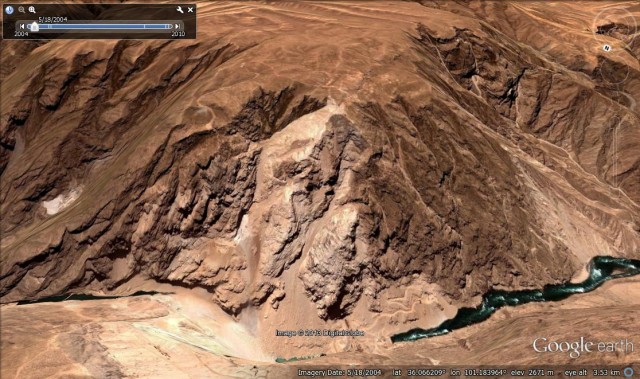
A second interesting issue that emerges is the location of the lateral margin of this block. This is another view of the 2004 image; the rear scarp is clearly visible running across the plateau:
 ..
..
The obvious location of the lateral margin is down the gully that has the huge accumulation of scree at the toe. A logical hypothesis would be that the shear surface is highly fractured, which has allowed active erosion, creating the gully. The concern that arises from this is the location of the dam, as shown in the more recent image:
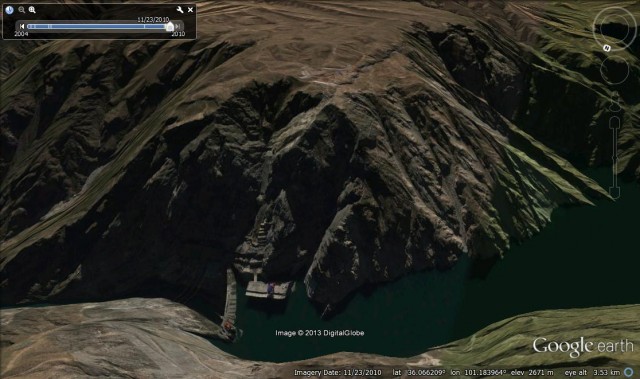 ..
..
The good news is that the dam is probably (though not definitively) off the landslide. The worry is that the lateral scarp of the landslide is with 300 m of the dam at the crest of the structure. This is disturbingly close should a large landslide occur, and it would be interesting to model the change in the stress state of the abutment in the event of a large movement of the landslide.
3. Other possible landslides in the valley
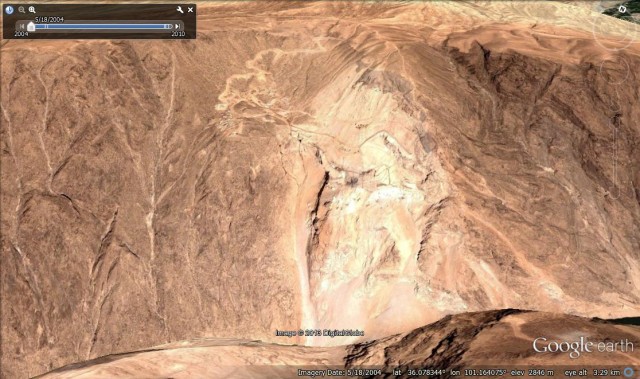
The mass identified is not the only possible landslide in the valley. On the other bank, directly opposite the landslide above, is this mass as shown in the 2004 image:
 ..
..
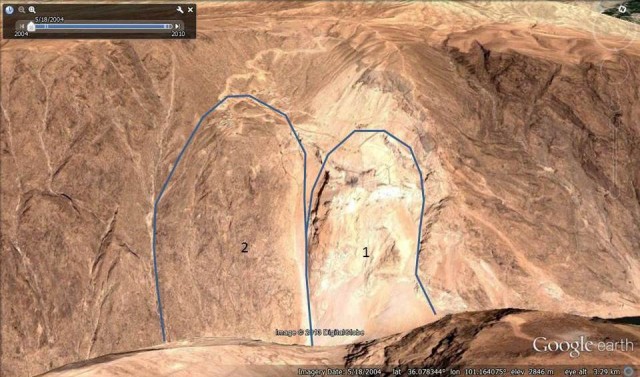
There are two candidate landslides here – I have delineated them below:
 ..
..
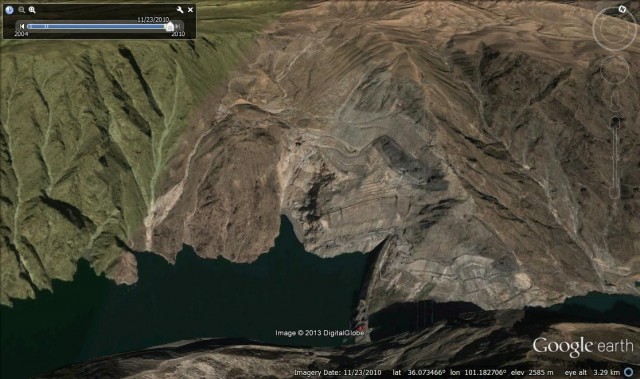
Landslide 1 is think quite obvious; landslide 2 is more subtle. In reality these are probably two portions of the same landslide complex that has originated from the large arcuate scarp above. These are rather different landslides from the one on the other bank, with lower gradient sliding surfaces for example. If we look at the recent satellite image, it appears that extensive works have been undertaken on landslide 1; perhaps unsurprising given the proximity of the dam. This appears to include regrading of the slope and possibly some drainage works.
 ..
..
Much less work appears to have been done on landslide 2 though. This is a much smaller landslide than is the one on the other bank, and at the moment there are no obvious signs of movement, but this slope needs to be monitored very carefully too. A rapid movement event on this slope would be very interesting given the proximity of the dam.
The landslide problems at this dam site are quite extraordinary. At the Japan Geoscience Union meeting this week we had a discussion about how reservoir bank landslides are managed in Japan. The verdict was that when these problems are identified the lake should be drawn right down (carefully) in order to reduce groundwater levels in the slopes and to ensure that any wave generated by a collapse would not overtop the dam. The water level in this satellite image looks to be high, although of course a different approach may have been adopted since then.
Reference
Zhang, D., Wang, G., Yang, T., Zhang, M., Chen, S., & Zhang, F. (2012). Satellite remote sensing-based detection of the deformation of a reservoir bank slope in Laxiwa Hydropower Station, China Landslides, 10 (2), 231-238 DOI: 10.1007/s10346-012-0378-9
24 May 2013
A round-up of recent landslide incidents, including two American children tragically killed by a mudslide whilst collecting fossils
The following landslide incidents caught my eye in the last few days:
1. A tragic mudslide in St Paul, Minnesota
Two young children were killed on Wednesday, and another was seriously injured, when a mudslide struck a school trip collecting fossils in Lilydale Regional Park. It is a little unclear as to exactly what happened, but it appears that the collapse was triggered by heavy rainfall. To lose young children in such circumstances is desperately sad; one can only imagine the shear sense of panic amongst the teachers and children after the event. Collecting fossils is a really important activity that must continue. However, exposure of fossils that can be collected requires both soft rocks and active erosion, which means that care must be taken with regard to landslides, especially during heavy and/or prolonged rainfall.
2. The report on the Johnson’s Landing landslide in BC
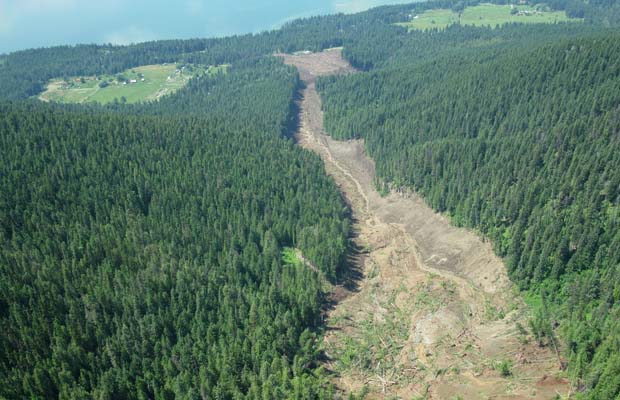
On 12th July 2012 a landslide struck the small community of Johnsons Landing in BC, Canada. I covered the landslide extensively at the time (including this memorable video) – it was an unusually large and rapid slide that engulfed the houses below, killing four people:
BC Government image
..
The full report is available here – I shall blog again on this in due course – and there is a nice news report about it here. The salient points are:
- The landslide was triggered by record rainfall and snowmelt;
- It was the largest landslide in the region for 12,000 years;
- It could not have been foreseen;
- A high level of threat remains, such that 18 properties are considered to lie in the path of a potential landslide, with five of those being at a very high level of risk.
3. The Bingham Canyon landslide impacts continue
The enormous cost of the Bingham Canyon landslide continue to be felt. Kennecott Utah Copper, the mine operators, have today released information about the “initial workforce implications” of the landslide, which make grim reading. About 100 employees have lost their jobs, with the company warning that more redundancies will follow over the next month.
4. Landslides and the Day of Judgement
According to Arab News, one sign that the Day of Judgement is nigh is that three landslides will strike. In the words of the article:
One will occur in the East, one in the West and one in the Arabian Peninsula. Not much further information has been given concerning these events—and therefore not much can be added. However, the well-known Hadith exegete Ibn Hajar does note that landslides are a well-known occurrence and have occurred often. Therefore, he says, it is likely that the nature of these three landslides which will occur shortly before the Day of Judgment will be of a much greater magnitude and severity, setting them apart from what occurs customarily in this world.
Please be assured that I will keep readers posted should such events occur.
5. Landslides in Hong Kong during heavy rainfall
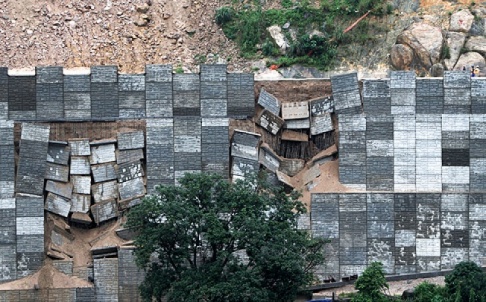
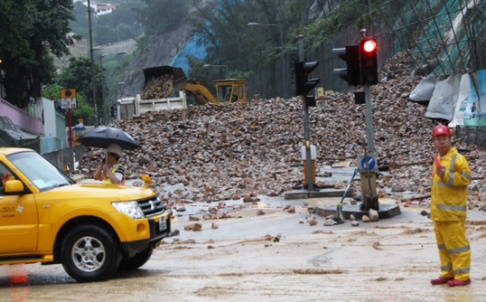
During heavy rainfall early on Wednesday morning, there were 19 reported minor landslides in Hong Kong:
David Wong vis SCMP
David Wong via SCMP
..
Those who follow my Twitter feed ( @davepetley ) will know that I was in Hong Kong at the time, en route to Japan. I can confirm that the rainfall was somewhat intense!
23 May 2013
A wonderful new progressive failure rockslide video
With a hat-tip to Lélé, who pointed this out to me, below is probably the best video of a progressive failure event that has appeared to date. It has been posted on the rts.ch website. This is a landslide that occurred at Riddes in Southwest Switzerland on Friday. It had volume of about 60,000 cubic metres. I have tried to embed it, but WordPress does funny things (life was so much easier on Blogger sometimes!), so if it doesn’t work take a look here:
..
The block was presumably creeping, generating the collapses at the margins. The event (rockfall) rate noticeably increases before final failure.
It appears to me that there is still a great deal of material to leave this slope.
17 May 2013
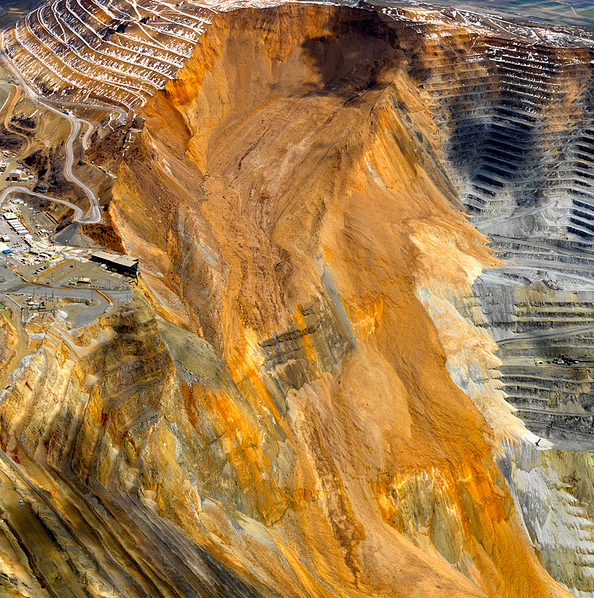
Was the Bingham Canyon landslide the largest historic non-volcanic landslip in North America?
Kennecott Utah, used with permission
Various media agencies are reporting a story about the Bingham Canyon landslide of a few weeks ago, suggesting that this might be the largest landslide in North America in historic times. This has been prompted by some work by Jeff Moore of the University of Utah, who has compared the landslide with other events in North America. Jeff kindly emailed me about the analysis. First, to set the record straight, his analysis is that Bingham Canyon is the largest historic, non-volcanic landslide in North American history. This is an important qualifier as the 1980 Mount St Helens eruption started with a flank collapse that had a volume of about 2.9 to 3.7 billion cubic metres, and so was much larger
Jeff’s calculation for Bingham Canyon looks like this: the estimated mass is 165 million tons, which corresponds to about 55 million cubic metres of source volume and 65-70 million cubic metres of deposit (allowing for bulking of the mass during movement). In comparison, these are the largest recorded non-volcanic landslides in North America according to Jeff’s review:
- Mt. Stellar AK – Sept 14, 2005 – 50 million cubic metres of rock and ice total, but initial detachment = 10-20 million cubic metres of rock.
- Mt. Steele Yukon – July 24, 2007 – between 28 and 80 million cubic metres including a “significant volume of ice”, modeled as 50 million cubic metres deposit.
- Mt. Meager BC Canada – 48 million cubic metres – 6 August 2010 – turned into 12 km debris flow, no deaths, ~largest in Canada.
- Hope slide BC Canada – 47 million cubic metres, January 9, 1965, 4 people killed – two seismic events noted, previous largest in Canada.
- Frank slide NWT Canada – Apr 29, 1903 – 30 million cubic metres – 70-90 deaths – Turtle mountain area today.
- Madison River Canyon (Earthquake lake) Montana – Aug 17, 1959 – 28-33 million cubic metres – 28 deaths.
- Lituya Mountain AK – June 11, 2012 – 5-60 million cubic metres – no deaths, poor volume estimate from deposit on glacier.
- Lituya Bay AK – July 9, 1958 – 30 million cubic metres – 5 killed from tsunami.
I cannot really disagree with this list, but would point out a couple of things. The first is that of course there are larger ones in pre-historic times. Indeed the largest of them all in terms of ancient landslides is the deeply bizarre Heart Mountain landslide in Wyoming, which has a volume of about 3,400 billion cubic metres. But as this is over 40 million years old it does not count as being historic. I think the landslide at Seaward in Alaska triggered by the 1964 earthquake had a volume of about 210 million cubic metres, although the vast majority of this was underwater.
So I think he is probably right that this is the largest historic, non-volcanic, terrestrial landslide in North America in recorded history. That is quite remarkable given that it is man-made. Indeed I have been trying to work out whether this is the largest manmade landslide in history. The obvious candidate is the 1984 Ok Tedi landslide in Papua New Guinea (Griffiths et al. 2004), which was also triggered by mining. However, that appears to have had a volume of about 35 million cubic metres, so it smaller. Can anyone come up with anything larger?
It is a surprise to me that large, historic landslides in North America are so small! The Daguangboa landslide, triggered by the 2008 Wenchuan earthquake, is over 1 billion cubic metres in volume, and this list includes many that are larger than Bingham Canyon. I wonder why this is the case?
Finally, I think it would be fun to start to compile a list of the largest landslides of the 21st Century. Any suggestions?
 Dave Petley is the Vice-Chancellor of the University of Hull in the United Kingdom. His blog provides commentary and analysis of landslide events occurring worldwide, including the landslides themselves, latest research, and conferences and meetings.
Recent Comments