

27 February 2012
Updated (twice) with videos: Breaking news – the Attabad landslide spillway has been reopened
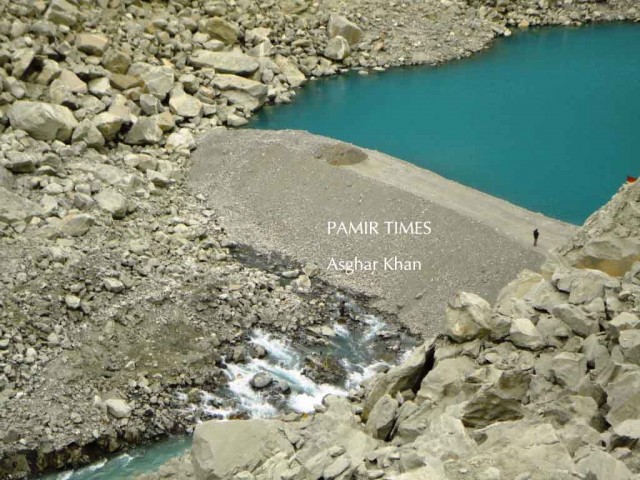
http://pamirtimes.net/wp-content/uploads/2012/02/Attabad-Spillway-Hunza-1.jpg
The Pamir Times is reporting that the coffer dam at the Attabad spillway, shown in the above image from the Pamir Times, has been blasted today, allowing water to flow through the newly reopened spillway. At the time of writing that are reporting that the discharge is about 50,000 cubic feet per second (1415 cubic metres per second), which is amongst the highest flow rates recorded through the spillway to date. The lake level is reported to have dropped by about 45 cm so far.
Update 1: The following video has now been posted on Youtube. The flow looks to be impressive:
Update 2: A video of the blast is now available too:
24 February 2012
New landslide video: The Ijkdijk (dike) failure experiment
Thanks to Brian Barrett at Zetica, this video shows an experiment run on the Ijkdijk in the Netherlands in 2008 to show test warning systems for dike failures. Watch the movement develop in the containers adding surcharge at the top of the slope and, later on, the way that the toe of the slope moves outwards.
22 February 2012
The Tumbi Quarry landslide – an initial forensic examination of the images
The LNG Watch blog has posted online some new images of the aftermath of the Tumbi Quarry landslide in Papua New Guinea. This is a good time to look in a little more detail at the landslide itself. The most interesting images are these two:
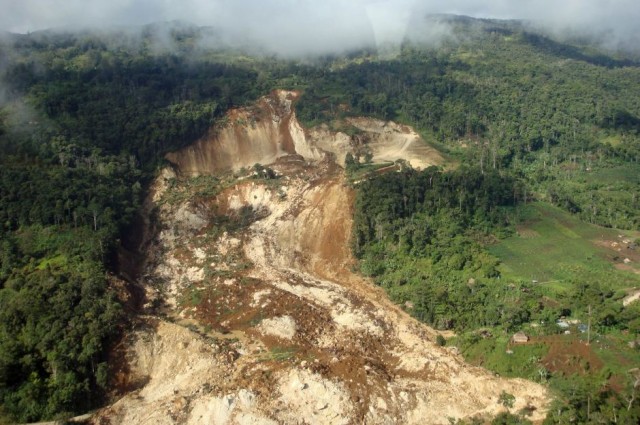
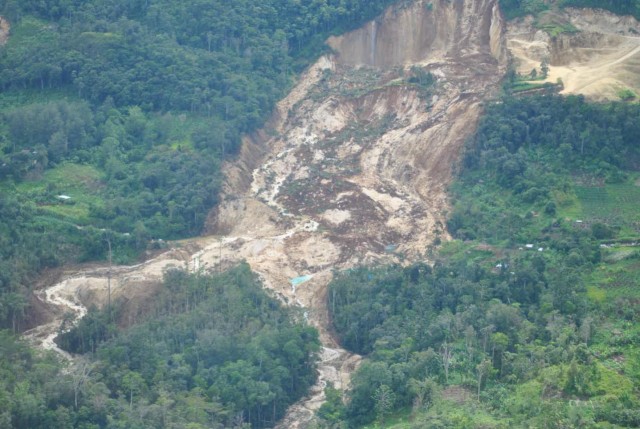
The second of these, assisted with some information from the first, suggests that this was a multi-phase landslide event. Let’s start by looking at the central portion of the landslide:-
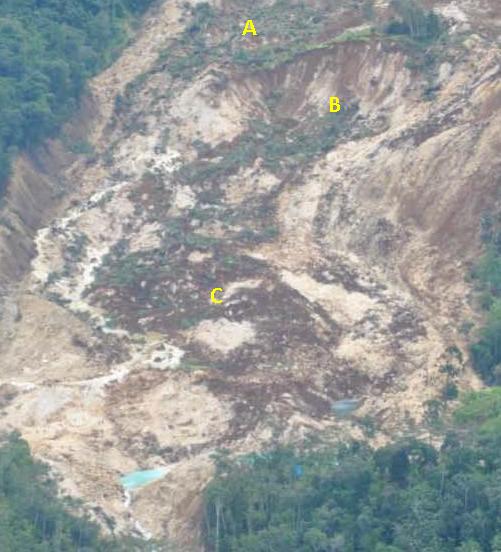
I have annotated on the image above three key areas. In A there is an area of disrupted but intact vegetation, which must have come ass an almost intact block from the slope above. It is not back tilted, so the slide is not rotational, which is consistent with the very planar form of the (presumably joint-controlled) back scarp. At B there is an arcuate secondary scarp cut into the block that forms A, and below this is a flow deposit, of which the upper component clearly derives from B.
If we now look at the upper part of the landslide we see another secondary failure:
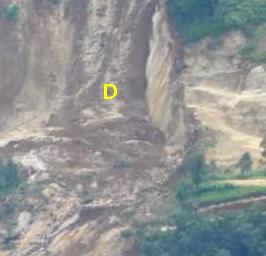
This landslide, marked D above, appears to be a late stage earthflow (it is mostly soil) over the back scarp.
Let’s now take a look at the mid-part of the landslide. There is a marked difference between the left and right (as viewed from the image) sides of the landslide. The left side (marked E below) has a steep scarp that appears to be at least 10 m high:
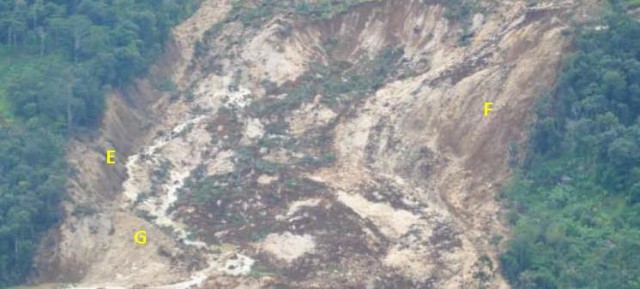
The right side on the other hand still shows the extension of the ridge that runs across the slope, albeit with the vegetation stripped off, suggesting that the landslide was shallow in this region. So the landslide was deep on one side and quite shallow on the other. At G the landslide debris appears to have in part ridden over a section of rock, but presumably most of the debris was diverted around this into the centre of the landslide.
Done at the toe the landslide debris clearly spilt into two and followed the drainage lines. On the left side there is some evidence that it “cut the corner” on the inside of the first bend (marked H below) and super-elevated on the outside (marked as I):
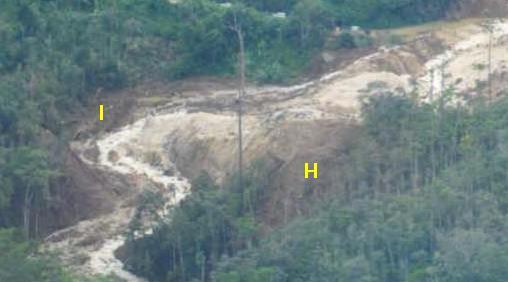
On the other (right) side the debris appears to have travelled straight down the drainage line:

Of course what is not shown by all of this is the first event – i.e. the major failure that started the sequence of failures. We really need some idea of the form of the topography before the slides to get an idea of this, and we need to get on the ground to look in detail at the deposits that are not covered by the secondary failures. The most intriguing aspect is that the distribution of volume change in the head scarp source area does not seem to match the distribution along the track very well. In the image below, the zone of largest volume change is at J (ignore the superficial earthflow that has partially filled this area), but most of the debris appears to have passed through the area marked K (look at the flow lines, and bear in mind the almost vertical scarp on the left side). This implies that the initial part of the landslide may have followed the general trajectory shown by the arrow:
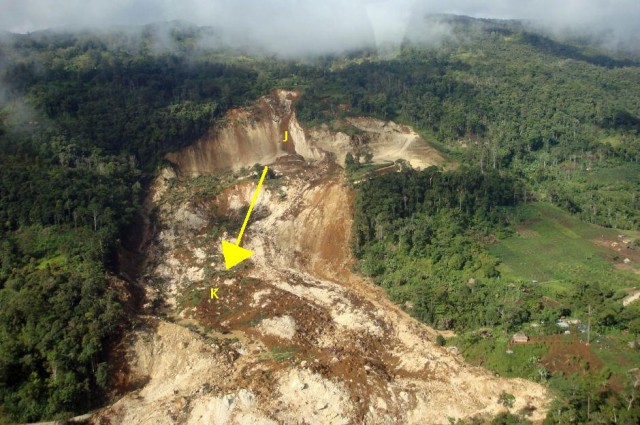
However, for the material highlighted in A in the third image above to move into the landslide, material from this zone must have moved out first. It seems likely therefore that the initial failure occupied the deeper portion of the area from J to K. To understand how and why this section failed we really do need to have an idea of the pre-failure topography and, critically, the location of the quarry and its spoil. I am particularly interested in the latter as none of the images show any waste tips that I can see, which means that this debris was either removed from the site or it has been incorporated into the slope failure.
So the burning questions remain:
1. Where was the quarry excavation?
2. Where was the spoil?
3. What was the rainfall in the period leading up to the slip?
It is deeply frustrating that we seem to be no closer to an answer to any of these questions.
Comments and thoughts, and alternative suggestions, are very welcome. It would be good to crowd-source an interpretation of this landslide head of the official investigation (?). My interpretation above should be considered to be no more than a set of hypotheses that need testing properly by the investigation team.
21 February 2012
A round-up of recent UK landslide events of interest
Here is one of my occasional round-up of landslide events that have caught my eye, this time with a UK focus:
1. On-going problems on the A980 in Scotland
Back in December the A980 Lochcarron to Plockton road was closed at the Strome Ferry due to rockfalls from a steep section of cliff. This has had major impacts in terms of diversions, resulting in the Highland Council laying on a car ferry service to provide a detour. There have been multiple unsuccessful attempts to re-open the road, which remains closed until at least next Monday.
2. A near-miss in Dorset
Meanwhile, a couple had a near-miss from a coastal rockfall near to Burton Bradstock in Dorset:
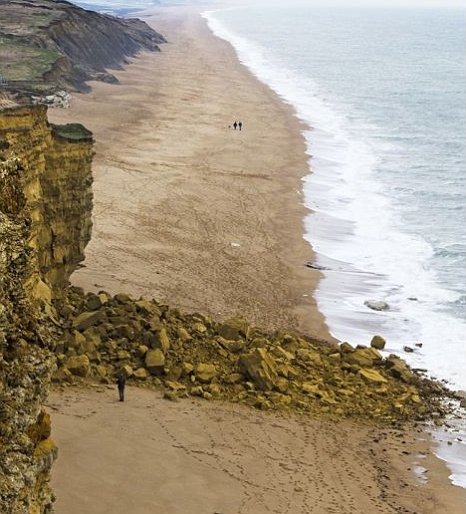
” The couple were enjoying a gentle stroll along the beach when giant boulders – some the size of cars – began tumbling down the 45 m cliff.It was only because Ms Pollard stopped to pick up a shell on the beach at Burton Bradstock, Dorset, that the couple didn’t walk under the mass of falling rocks. The 45-year-old, from West Horrington, Somerset, said: ‘All of a sudden these big boulders rolled down the cliff and out along the beach towards the sea. ‘It all took about five seconds or so to come down. It made the most horrendous crash, I was terrified.”
Looking at the image of the landslide provided in the paper, this was no trivial event:
http://www.metro.co.uk/news/890797-couple-saved-from-dorset-cliff-collapse-after-stopping-to-pick-up-shell
It is also interesting to note the steep overhang that has been left – there is probably a further rockfall to come at this location.
3. Plans for upgrades to the A83 Rest and Be Thankful
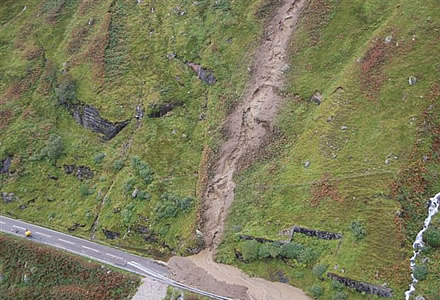
Back to Scotland, where the A83 road and the beautifully named Rest and be Thankful has been the site of repeated landslide problems in recent years, most recently in December 2011:
http://www.dailyrecord.co.uk/news/scottish-news/2011/12/01/motorists-facing-26-mile-diversion-as-landslide-closes-a83-near-rest-and-be-thankful-86908-23602604/
The Scottish Government has announced a £1 million scheme to upgrade a forest road that will allow traffic to still pass, even when the road is closed. At the same time £100,000 is being spent exploring engineering solutions to the problem, focusing either on the construction of a landslide shelter over the road , elevating the road onto a viaduct to cross the landslide zone., or finding a new alignment. Sensibly, addressing the cause of the landslides by better managing the hillslope vegetation is also being considered.
20 February 2012
Attabad landslide – reports indicate that the barrier will be blasted next week (updated)
NB see update at the end of the post
The Express Tribune in Pakistan is reporting that the Attabad landslide (see summary post and Authorstream presentation), which formed two years ago and has caused huge disruption in Gilgit-Baltistan, will be blasted net week:
The spillways need to be blasted which in turn result in flashfloods due to the sudden release of water. The authorities, in an effort to minimise losses for the population living in low-lying areas, have sought time to make adequate preparations.
The district administration of Hunza Nagar made an announcement last week to blast the spillway on February 18, but put off the task till the 27th of this month.
“We have been informed by the home department about a change in date, with instructions to complete the preparations by the revised date,” Deputy Commissioner of Hunza Nagar, Burhan Afindi said.
Explosives will be used to blast the boulders currently obstructing the outflow of water though a spillway dug in 2010.
The article describes the measures that need to be taken downstream to protect the population against a potential flood:
An official said that traffic on the Gilgit-Hunza portion of the Karakoram Highway would be stopped on that day. Authorities also warned residents settled downstream to avoid venturing to the riverside. Pakistan Red Crescent society (PRCS) has deputed a team of volunteers to assist the administration in case of an emergency.
“Assistant Director, Youth, Wajid Ali has been assigned the task of assisting rehabilitation work if something untoward happens,” said Safdar Ali, an official in the PRCS. He added that the team has been trained and equipped to deal with any emergency.
I will provide updates as they become available. It is going to be very important to protect the downstream populations, and I hope that efforts are made to record the ways in which the dam behaves and the flood develops – we can learn a great deal about the ways that landslide dams breach from this event.
Update (22nd Feb): according to a comment below, this is the removal of a coffer (i.e. temporary) dam. This explanation differs from that in the article, which suggests that it is the boulders that are being blasted.
18 February 2012
New landslide video: open cast coal mine failure in Indonesia
Liveleak has just posted this video of a very large open cast coal mine failure in Indonesia. According to the commentary that accompanies the video, it occurred on 4th January 2012 and resulted in one fatality:
Whilst the camerawork is shaky (understandable given that the landslide came over the wall of the pit), the first part of the video shows a very large and very mobile slide. It is worth viewing the first part twice as the second time it is possible to get a better idea of what is going on.
17 February 2012
Context for the Tumbi Quarry landslide – an image gallery for quarry and open cast landslides
Thanks to everyone who has submitted ideas of images of the landslides in and around quarries and open cast mines, in response to the Tumbi Quarry landslide posts. This is a collection of images of landslides caused by mining and quarrying. I will add to it through time, so please do keep suggesting additions.
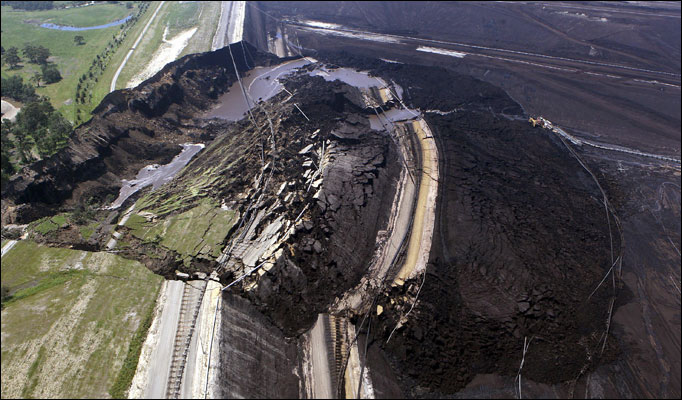
The Yallourn open cast mine landslide in Australia:
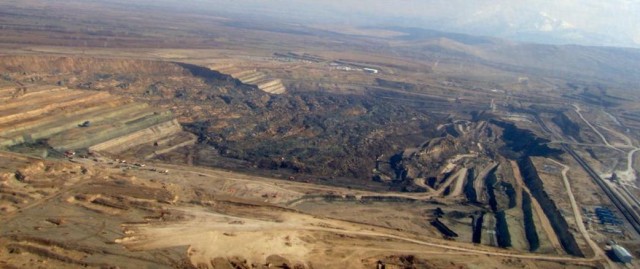
Courtesy of Caner Zanbak, is the Collolar lignite mine landslide in Turkey:
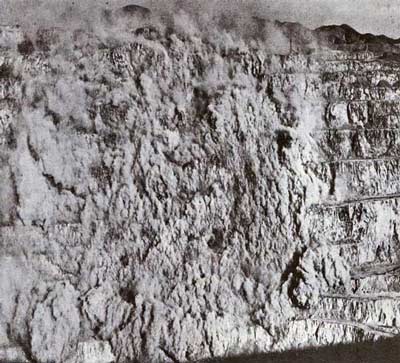
Chuquicamata mine, Chile, pit wall failure in 1969 (see the great resource on mine wall failures here)
http://www.amcconsultants.com.au/2005_june.asp
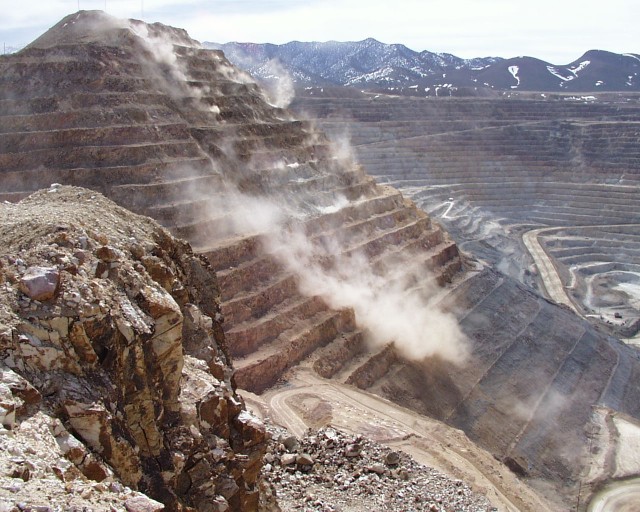
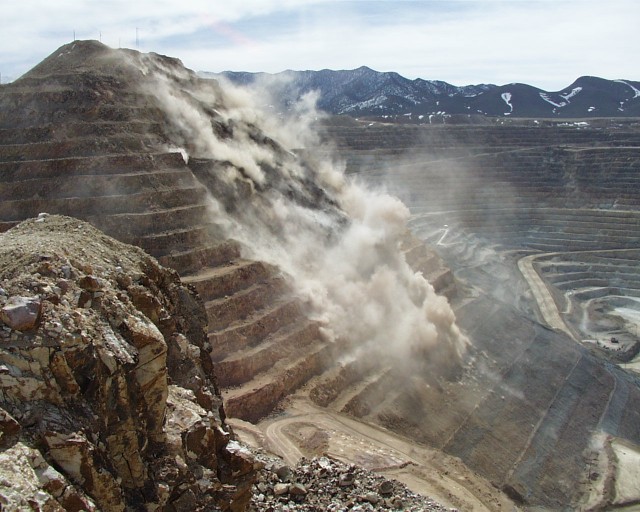
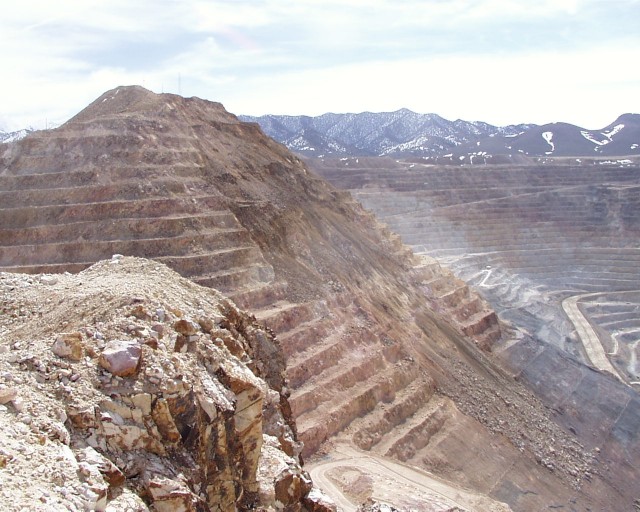
Mine wall failure at Round Mountain in Nevada (courtesy of Dan Bartlett)
Start:
http://www.danbartlett.net/Pictures2.htm
During:
http://www.danbartlett.net/Pictures2.htm
After:
http://www.danbartlett.net/Pictures2.htm
Huckleberry Mine, SE of Smithers BC, Canada, June 2007
Courtesy of Jimmy James: “East Zone Pit north wall failure. (2×10^6 m^3 est volume). No injuries or equipment damage were reported and mine life was nearing conclusion in that pit so there was minimal loss of production. Mining is ongoing in an adjacent pit.”
Bing Aerial View:
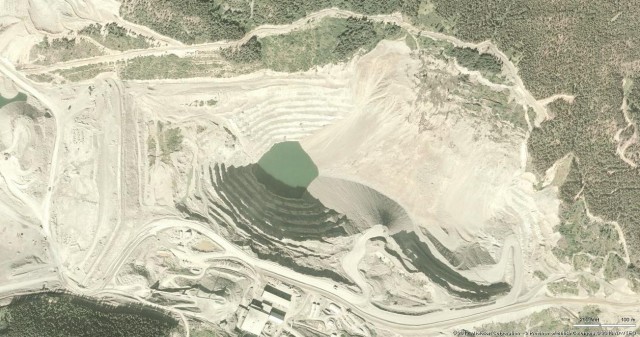
Mine level view looking NE at failure head scarp (http://goo.gl/QRyPo)
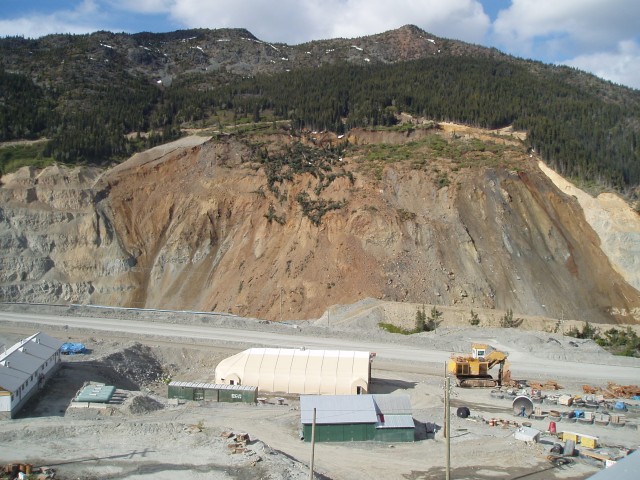
Another mine level view looking slightly east of previous view (http://goo.gl/NfG3J):
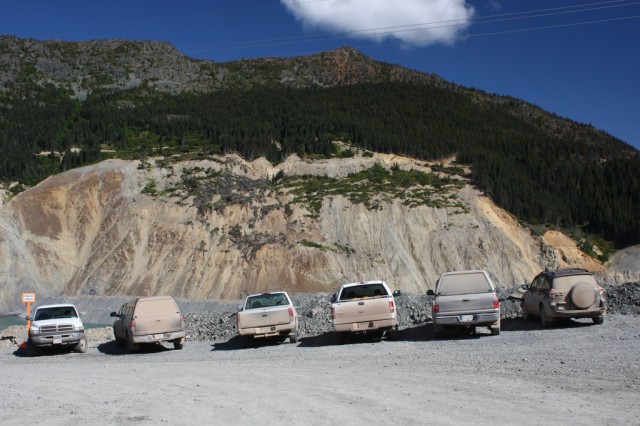
BC EMPR Mines Report 2007 (this includes a view of failure toe and brief discussion of mine geology on page 6)
The 2011 Mine Optimization PDF report discusses the geology of the mine area, including in the completed East Zone Pit. Pages 37, 40 illustrates faulting and slide location. Pages 65, 66 illustrate and describe dyke and faulting along the north wall of the Main pit, just west of the east pit.
The Pantai Remis landslide in Malaysia (the best landslide video of all time):
As noted above, I’d like to add more to this collection, so your suggestions are welcome.
15 February 2012
Background to the Tumbi Quarry landslide – so how can a quarry cause a landslide?
A question that has arisen a few times about the Tumbi Quarry landslide in Papua New Guinea is why it is that a quarry can increase landslide occurrence. The first point to be made is that many quarries, when properly managed, do not cause slope instability. However, some of the most spectacular landslides are caused by mines or quarries. Two come immediately to mind – this is the Yallourn open cast mine landslide in Australia (I have never seen one like this anywhere else!):
And this (courtesy of Caner Zanbak), is the Collolar lignite mine landslide in Turkey two years ago:
So why do quarry walls fail? There are many reasons, but the most important include:
- Almost always the quarry walls are cut more steeply than the existing slope. If this slope is too steep for the rocks in question a slip can develop;
- Cutting the slope sometimes “daylights” (exposes the toe of) an existing discontinuity or plane of weakness, along which sliding can occur. In Collonar above it is likely that sliding occurred on a pre-existing weak layer;
- Cutting the slope can change the groundwater conditions, which can lead to pore pressure build up in weaker areas;
- Blasting the slope can cause fractures to develop that allow the release of a block;
- Cutting the slope can remove layers of strong materials, exposing weaker strata that are prone to failure.
The design of quarry walls, and the maintenance of them, is a highly specialised task into which responsible operators invest a great deal of resource. As a result monitoring of quarry wall movement is a key part of quarry operations, and many quarries operate safety systems to allow them to evacuate is instability develops. As a result, catastrophic quarry wall failures remain rare. Of course it is not clear that any of these are the case at Tumbi Quarry, but these are some of the processes that the investigation should be considering.
It would be good to have some examples of quarry or open cast mine landslides highlighted in the comments. Would anyone like to suggest an example or two?
13 February 2012
The Tumbi Quarry landslide – on the difference between trigger and cause
There continues to be a moderate level of media interest in the Tumbi Quarry landslide in Papua New Guinea, with most of that focusing on the role of the quarry. LNG Watch have examined some of the documents that the project operators themselves have online and have shown that audits of the project last year raised questions about the stewardship of the quarry site. It is not entirely clear as to the nature of these issues, but the possibility that the quarry operations were inadequately overseen are clearly of interest here.
There does seem to be some confusion about the difference between the cause and the trigger in the case of this landslide. It seems that there may be a line of argument developing that because the quarry was not in operation at the time of the landslide it cannot be responsible for it. This is a fallacious case to make, if that is beig argued. The issue here really does come down to the important distinction between the cause of a landslide and the trigger event that initiated it. So let’s take a look at what we mean by these two concepts:
Trigger – the trigger event is the external or internal process that makes a slope to collapse at that particular point in time. In most cases the trigger event is either heavy rainfall or an earthquake, although it can be human activity, snowmelt, etc. We should note that some landslides have no external trigger, but in the majority of cases we can identify one. As an analogy we might think of the demolition of a building – the trigger is someone pushing the button that fires the detonators.
Cause – the causes of a landslide are those processes that have made the slope susceptible to failure. In the case of a natural slope these might be weak rocks, erosion at the toe by a raiver, deforestation, etc. In most cases a combination of causes combine to make a slope unstable, and the trigger event then initiates the failure. Going back to the analogy of the demolition of a building, the causes are the placing of explosives, removal of structural walls, etc.
The key idea here is that both causes and the trigger combine to create the landslide event. Without the causes the triggercould not initiate the failure. So in understanding a landslide event we need to identify not just the trigger, but to find out what caused the slope to be be ready to fail. This is the role of an investigation.
It is also worth noting that in managing landslides, we often focus on both the causes and the trigger – for example we might install rock anchors to strengthen the soil (removing a cause) and drains to reduce pore pressure (blunting the effects of a trigger).
In the case of the Tumbi Quarry landslide, this distinction is important. In investigating the landslide we must not consider just the trigger. It may well be that the quarry was inactive at the time of the landslide, and that exceptionally heavy rainfall had occurred. In this case the trigger might be the rainfall and not the quarry. However, this does not give us information about the causes, and in the context of lives being lost it must be the causes that are important. Here we need to look at the combination of other things that have been occurring to weaken the slope. And in this context a key factor might be the role of the quarry. It may well be that it in fact did not have anything to do with the final collapse, but we cannot say that without a proper forensic investigation. Isolating the trigger does not provide the answers to these deeper questions.
For what it is worth, and from 12,000 km away, I continue to be a little perplexed by the explanation that this is a natural failure triggered by rainfall. First, it just seems to be a remarkable coincidence that the only reported large-scale slope failure was a site that had been recently disturbed by human activity. Coincidences do occur of course, but by definition they are rare, and scientists are rarely happy with an explanation that in effect says that it was an act of god. Second, usually when a trigger event initiates a large, entirely natural failure failure like this it also triggers many, many smaller failures (as described by power law distributions). Maybe the reported rainfall event did trigger many small failures, but as yet I have not seen any reports of this. If it did not, then one would have even more reason to ask what happened on this particular slope to make it susceptible to failure.
I remain absolutely open-minded about the causes of this landslide, and continue to emphasise that it might be an entirely natural event. A proper investigation will ascertain this without great difficulty.
11 February 2012
Continued questions about the role of the quarry in the Tumbi Quarry landslide
Interestingly, over the last few days there appears to have been increased interest in the role of the quarry in the Tumbi Quarry landslide. Regular readers will remember that the National Disaster Center report indicated that the failure developed as subsidence close to the quarry. Triggering of the landslide was associated with heavy rainfall, with no evidence to support this trigger, and no other mention was made of the quarry, even though it is clear from the images that a section of it was removed by the landslide. In an earlier post I questioned both the evidence for rainfall / high groundwater as the trigger and the lack of consideration of the role that the trigger might have played.
Two recent statements have been reported by those associated with the disaster. First, in a Radio Australia interview, Martin Path, who is the Principal Disaster Coordinator for the Southern Highlands province in Papua New Guinea, has given a rather different perspective to that from the official report(LAM is Sen Lam, the interviewer):
LAM: And Martin, at the time of the disaster, the landslide was blamed on blasting at nearby quarries, near the Exxon-Mobil LNG project in the Southern Highlands. Is a clearer picture emerging, of what happened, that early Tuesday morning? Are you getting a clearer picture now?
PATH: Not as yet. We have yet to conduct, er, we are conducting some portion of the independent investigation that the National … Council has endorsed. We believe that an independent investigation unit has been assigned, and we believe that this group would be up here over the weekend. But we also have the geo-hazard technical team on the ground now, since Day One. So they’re still providing the information, so with regards to the quarry that was established some years back, we have yet to establish the actual cause, what actually caused this slide.
There is a strange confusion here – “We have yet to conduct, er, we are conducting some portion of the independent investigation…We believe that an independent investigation unit has been assigned, and we believe that this group would be up here over the weekend.” It is hard to interpret what is going on from that.
Second, my earlier posts have been picked up by the PNG Industry News website, who then have some comments from an ExxonMobil spokesperson:
An ExxonMobil spokesperson previously told PNGIndustryNews.net that PNG LNG contractors did not conduct any blasting at the Tumbi quarry.
She said a project contractor completed work at the Tumbi quarry in August, 2011.
“There was no need for [PNG LNG-related] blasting at this quarry,” she said.
“The Tumbi quarry has been operating for over two decades.”
There are two issues here. First, the spokesperson notes that there had been no blasting at the quarry, which is in contradiction to the reports from local people. I have no way of verifying this either way. Second, she suggests that work associated with the LNG project ceased six or so months ago. The unstated implication is that this means that the Exxon-Mobile work was not responsible for the collapse.
However, unfortunately slope behaviour is not as simple as that. Whilst slope collapses can occur spontaneously during quarrying, there is often a time gap between the processes that lead to failure, and the failure itself occurring. This is a mechanism known as progressive failure, which was first described in the 1960s. There are two elements to this:
1. It may well be that the quarrying operations occurred when groundwater levels were low, or indeed that the quarrying caused an initial drawdown (release) of groundwater. In such circumstances, the groundwater recovers the stability of the slope can reduce, allowing a failure to develop. Seco
2. Failure of the slope occurs when a shear surface is fully formed that allows the landslide to detach from the surrounding rock. This is not a spontaneous process, but requires the formation and growth of planes of weakness. Such a process can take weeks or even years. I have written several papers on this very process, such as this (click on the title to download the paper):
It can be the case that cutting a slope in a process such as quarrying initiates the progressive failure mechanism, and allows the slope to collapse some time later.
None of this inevitably means that the quarry was the cause of the landslide. It may have been the direct cause, it may have been one of several causes, or it may be irrelevant. However, understanding its role is critical. Once again I would emphasise that this can only be uncovered with a proper forensic investigation by a team who understand the complexity of this type of landslide. This is not a trivial task, and will involve detailed field mapping; structural measurements; examining aerial and ground images before and after the landslide; examining the quarry design and operation; looking at rainfall records; etc. The methodology for such an investigation is well-established, but undertaking it requires very specialised skills. Usually this will require an international team.
The loss of a significant number of lives really demands that this landslide is investigated properly. I do hope that this process is now underway.
 Dave Petley is the Vice-Chancellor of the University of Hull in the United Kingdom. His blog provides commentary and analysis of landslide events occurring worldwide, including the landslides themselves, latest research, and conferences and meetings.
Recent Comments