

22 April 2013
Images of landslides from the earthquake in China
It is increasingly clear that the major challenge to the rescue and recovery effort in the aftermath of the earthquake in China is being posed by landslides, which have blocked the communications and transportation network across the earthquake-affected area. So, I have been looking at the international media for some images of the landslides that were triggered by this event.
First the BBC has these two images:
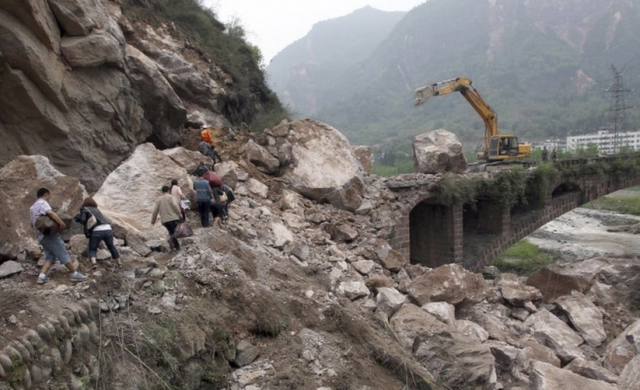
http://www.bbc.co.uk/news/world-asia-china-22233246
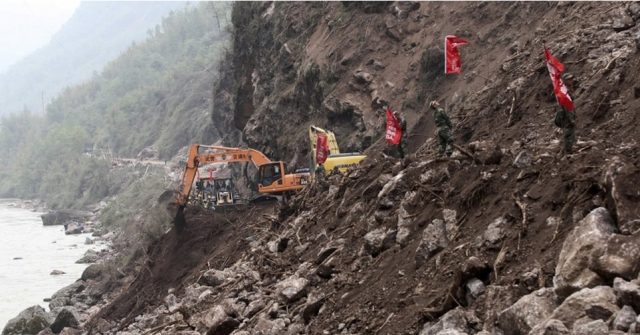
http://www.bbc.co.uk/news/world-asia-china-22233246
Meanwhile USA Today has this image of the landslide damage to a highway:
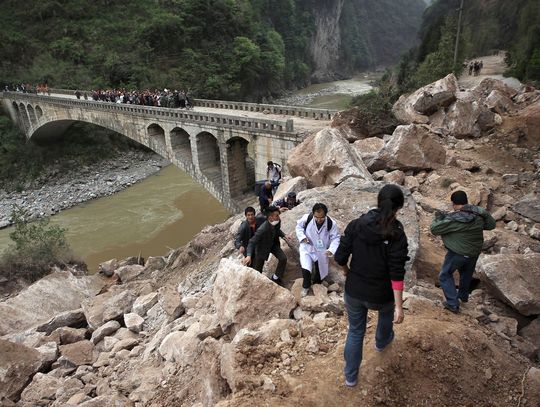
http://www.usatoday.com/story/news/world/2013/04/21/china-sichuan-earthquake-lushan/2100723/
Meanwhile Xinhua has this image of a landslide triggered by the earthquake:
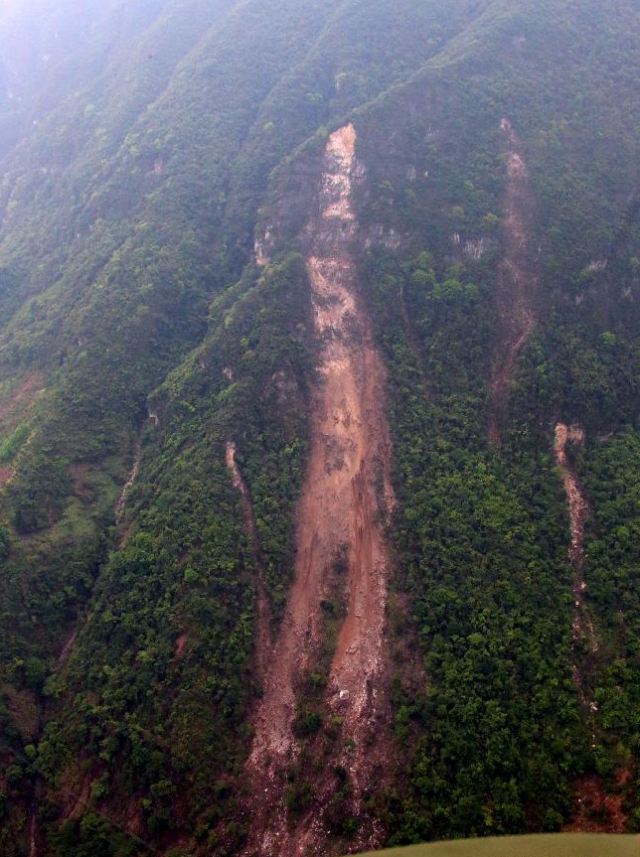
http://news.xinhuanet.com/english/photo/2013-04/21/c_132328151_2.htm
And the challenges associated with the road network is well-illustrated by this Xinhua image:
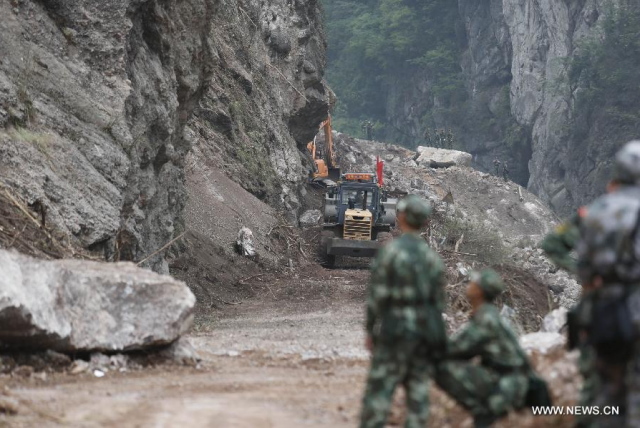
http://news.xinhuanet.com/english/photo/2013-04/21/c_132327966_2.htm
Rain is forecast for the earthquake-affected area this week, which is likely to trigger further landslides.
20 April 2013
Initial reports of landslides from the earthquake in Sichuan this morning
The Magnitude 6.6 earthquake in Sichuan this morning occurred just to the southwest of the area affected by the May 2008. Of course this is not remotely on the scale of that earthquake, but the magnitude and shallow depth will have been sufficient to cause significant damage to the local area. The USGS shakemap suggests that this will be the distribution of the shaking:
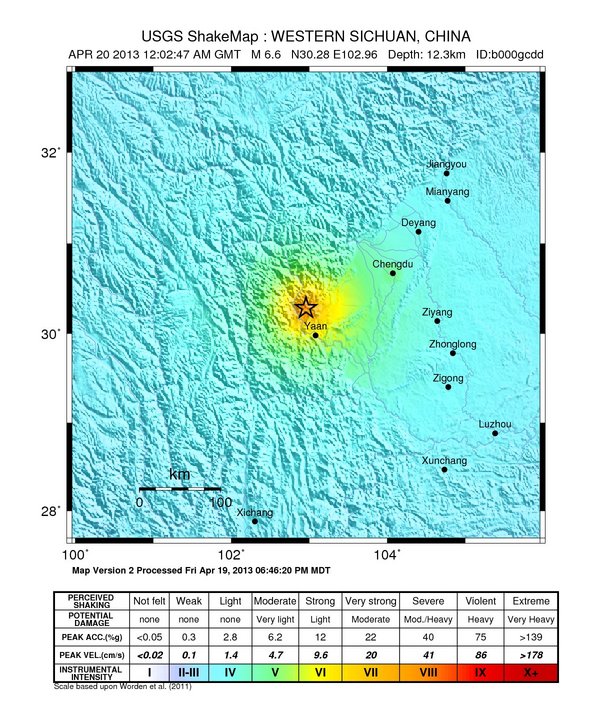
http://earthquake.usgs.gov/earthquakes/eventpage/usb000gcdd#shakemap
..
Putting this into Google Earth suggests that the affected area is mountainous, which will inevitably mean that there have been landslides:
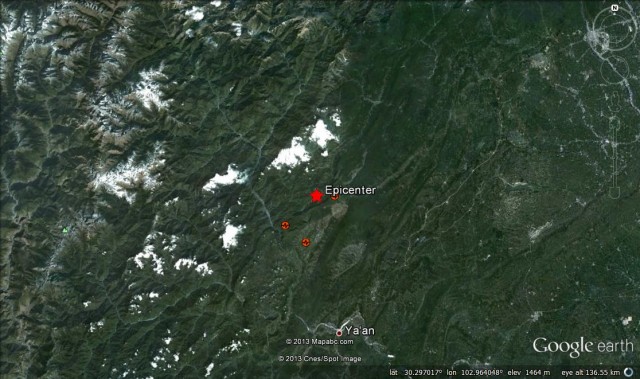 ..
..
The Vancouver Sun has the first landslide image that I have been able to track down, showing a large block that has fallen onto a road:
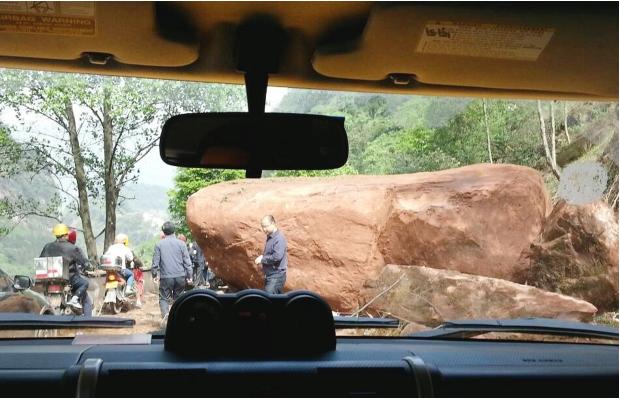
http://www.vancouversun.com/news/Photos+China+Sichuan+province+rocked+powerful+earthquake/8269890/story.html
..
Xinhua is currently reporting two valley-blocking landslides, plus other failures and rockfalls, but with little detail:
Landslides have blocked traffic in many places across the county and two barrier lakes caused by the landslides are posing risks for the rescue efforts, it said…Vehicles damaged by rolling rocks were seen in the county. Houses along a street in the Lushan county seat have also collapsed. Helicopters are hovering, according to Xinhua reporters at the scene.
This Twitter image purportedly shows buildings in Ya’an – if this is correct (and I am uncertain about this at the moment – but the date is correct) then it appears that foundation failure has been a major issue:
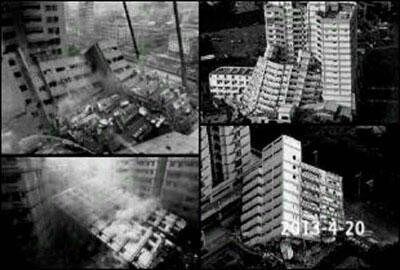
https://twitter.com/AdamNMayer/status/325430226442129408/photo/1
18 April 2013
A first analysis of the potential landslide distribution from the Iran earthquake
By Rob Parker (University of Cardiff) and Dave Petley
The Mw = 7.8 earthquake on Tuesday in Iran was the largest event in that country for about 50 years. Fortunately, the depth of the earthquake (82 km) and the low population density in the affected areas meant that loss of life was low for an event of this size. Indeed, reports suggest that only one person died in Iran, although there are reports of 40 deaths in Pakistan. This single fatality in Iran was the result of a landslide, and one of the images on the BBC reports about the earthquake also seems to show landslides:
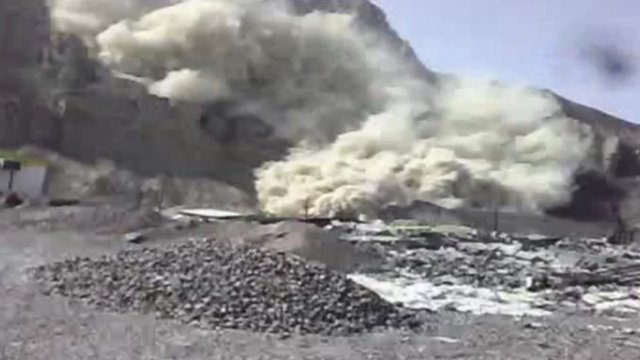
http://www.bbc.co.uk/news/world-middle-east-22168202
Over the last three years or so, we have been working with our colleagues Alex Densmore and Nick Rosser, and funded by the Willis Research Network, to develop a model that will allow us to make an initial assessment of landslide impacts in earthquakes. Rob recently submitted his PhD, and has now moved to a post-doctoral position at Cardiff. However, we thought that this event would be an interesting first application of the model, which has been produced through a statistical (logistic regression) analysis of spatial patterns of landslides (with areas larger than 11,000 square metres) triggered by four large earthquakes in the USA, New Zealand, Taiwan and China. The model provides a first-order prediction of the probability of hillslope failure across the region affected by seismic shaking, based on the strength of ground motions and the gradient of hillslopes. Areas likely to have experienced high levels of landslide activity are shown in red, and while areas we expect to be less affected by landslides are shown in green and then blue. Here, landslide probability has been estimated using preliminary ground motion data published by the USGS and hillslope gradients derived from the ASTER global elevation model.
This is the outcome of the model:
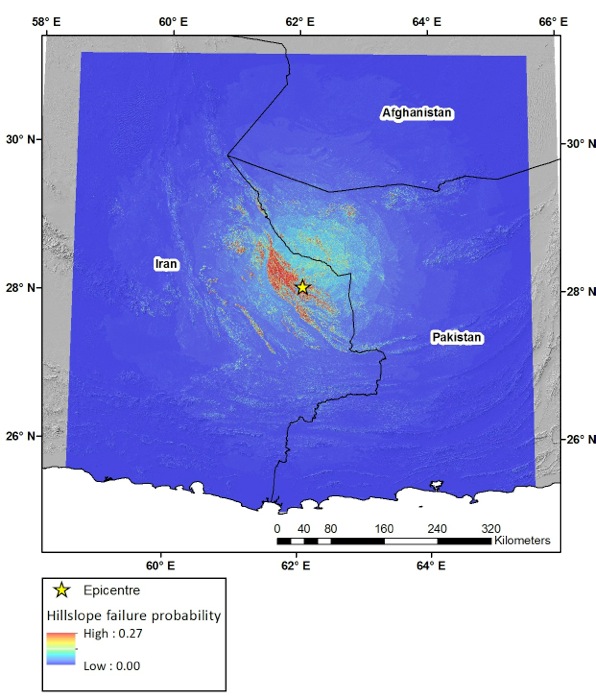
We have a Google Earth kml of this map – you can download it from here.
Some notable features of the predicted landslide distribution are:
- The highest levels of landslide activity are predicted close to the epicentre, where ground accelerations were strongest;
- Higher landslide probabilities are predicted to the south-west of the epicentre, where there are higher levels of relief, and lower probabilities are predicted for lower relief regions to the north-east;
- Despite the high magnitude, the predicted impact of landslides is relatively low. This can be seen through a comparison of predicted landslide activity with that observed in other major earthquakes (see table below). By aggregating predicted probabilities spatially, the percentage of hillslopes that undergo failure can be estimated. Table 1 shows a comparison of the predicted percentage area affected by landslides within 20 km of the epicentre, with that observed in three other earthquakes. Although the Tuesday’s earthquake has a magnitude similar to the Wenchuan earthquake, the predicted density of landslides is lower than that observed in the magnitude 6.7 Northridge earthquake. This is mainly due to the deep focus of Tuesday’s earthquake, which meant that surface ground accelerations were weaker than those produced by shallower earthquakes of this size.
| Earthquake | Magnitude | Depth(km) | Percentage of failed hillslopes within 20 km of epicentre |
| 2008 Wenchuan earthquake (China) | 7.9 | 12.8 | 13.4 % (observed) |
| 2013 Khash earthquake (Iran) | 7.8 | 82 | 0.3 % (predicted) |
| 1999 Chi-Chi earthquake (Taiwan) | 7.6 | 8 | 1.1 % (observed) |
| 1994 Northridge earthquake (USA) | 6.7 | 18 | 0.5 % (observed) |
A notable feature of this earthquake is the relatively low number of reported deaths (41 in the two affected countries). The 2008 Wenchuan earthquake, which had a magnitude of 7.9 (i.e. it was similar to this event), caused around 80,000 fatalities, 20,000 of which were attributed to landslides. Similarly, the 2005 Kashmir earthquake in Northern Pakistan (magnitude 7.6) resulted in over 80,000 fatalities. Underestimates of damage and fatalities are common in the immediate aftermath of large earthquakes, particularly in remote areas, and the death toll may change over the coming days. However, the epicentral region has a relatively low population density compared with areas affected by the Wenchuan and Kashmir earthquakes:
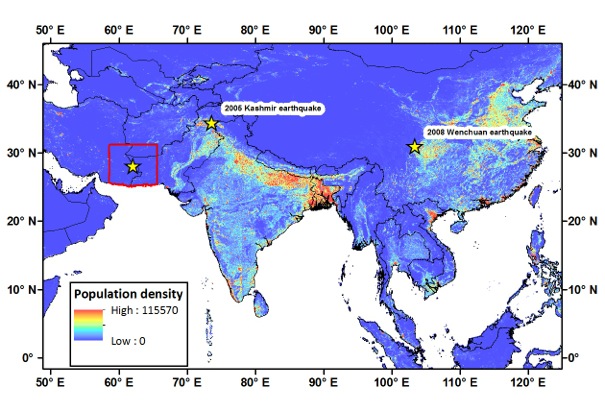 ..
..
Estimates from 2008 suggest a total population of around 4 million within the area covered by our landslide model above. The death toll is therefore unlikely to rise to the levels seen in Wenchuan and Kashmir, where population densities are much higher. It is this low population density, combined with the very large depth of the earthquake, that has meant that the loss of life is so low. A similar, but shallow, earthquake in a more densely populated area would have had very different outcomes.
It is of course vital to say that this is just a first order estimation, and we will need to examine the actual distribution as images become available.
Reference
Bright EA, Coleman PR, King AL, Rose AN, Urban ML. LandScan 2008. 2008 ed. Oak Ridge, TN: Oak Ridge National Laboratory; 2009.
17 April 2013
More information on the disastrous mining-induced landslide in Tibet a fortnight ago
Questions continue to be asked about what I have been calling the Jiama/Gyama Mine landslide in Tibet. First, it should be noted that this is a misnomer – the event should correctly be called the Tseri Mountain landslide I think, so from here-on in this will be how I refer to it. Anyway, I thought I’d highlight three sources of information about the landslide that are all very helpful. Note that all have been compiled independently from my own analysis.
1. An interpretative report about the landslide by Adrian Moon
Adrian Moon, who regularly contributes this blog, has written an analysis of the landslide. This is a very impressive piece of work. He has given me permission to make it available, so I have uploaded it onto Slideshare and have embedded it below. You should be able to read it below, but if not click here. Adrian also asked me to acknowledge the input of his colleagues Robert Barnett, Professor of Contemporary Tibetan Studies, Columbia University and Yeshi Dorje at the Voice of America Tibetan Service.
.
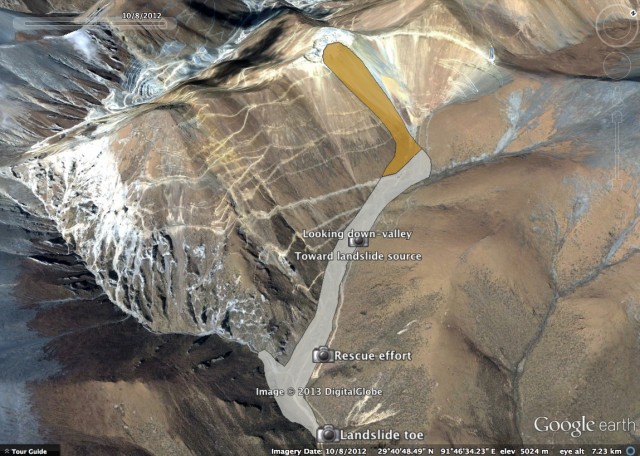
https://sites.google.com/site/kerryleith/home/updates/mappingthegyamajiamaminelandslidefrompressimages
16 April 2013
Is the Bingham Canyon copper mine landslide the most expensive single mass movement in history?
Further news is emerging about the landslide at Bingham Canyon copper mine last week. The transparency of all involved is impressive to behold, and is a remarkable contrast to the much more costly in human terms landslide at the Jiama mine in Tibet. I thoroughly recommend that you visit the Kennecott Utah Copper flickr site, which has some wonderful images of the landslide. I cannot post them here, but do take a look.
In landslide terms this event was a major success, with one substantial caveat, in that detailed monitoring allowed the event to be predicted, which meant that the mining operations were stopped and the mine was evacuated prior to the event. The mine was using slope deformation radar systems provided by the Italian Company IDS, which can detect movement in the walls of the mine. Interpretation of the movement patterns can be used to forecast and even predict a failure event – indeed this is an area that our research group at Durham has worked upon in some depth. The caveat of course is that the size and travel distance of the landslide does not seem to have been anticipated. Indeed Rio Tinto released a market report that said:
The size of the slide was significant,” the company said in an emailed statement. “We don’t have information yet regarding the magnitude or impact. We do know that the flow into the pit extended beyond the scenarios we forecasted, having a greater impact on equipment.
I suspect that we need to undertake more research on the ways that we can extract this sort of information from these datasets – my colleagues and I have also been working on this. It would be fascinating to back analyse the dataset from this event to see if we can develop better techniques. I suspect that if we transfer the techniques we have been developing in New Zealand and Italy to this setting and data type we might be able do this better.
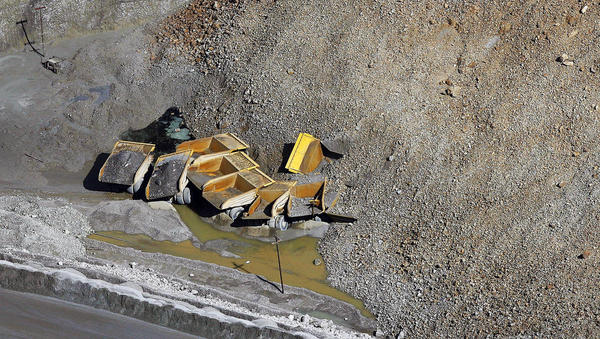
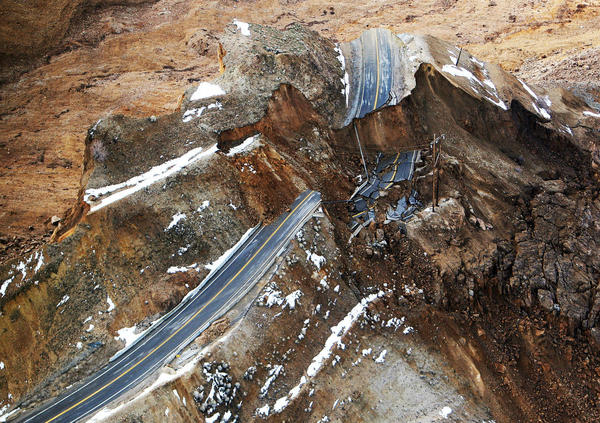
Meanwhile, the implications of this event are becoming apparent. Locally the mine is continuing to produce copper through stockpiled resources (they are reported to have 20 days worth of resources), but the Wall Street Journal is reporting that the mine is asking its workers to take leave. As the images below show, the landslide has caused the loss of a large part of the wall of the pit, filled the mine floor, destroyed buildings and the haul road, and buried equipment. Mining cannot be restarted until the haul road is rebuilt (in itself this is not trivial), and the above article suggests that it will take months rather than weeks to restart production. A key issue will be the stability of the material left on the slipped slope – if further movement occurs then restarting mining will be difficult until it has been stabilised.
http://imgur.com/gallery/Btvfi
http://imgur.com/gallery/Btvfi
The costs of the landslide are interesting. The mine produces 17% of copper in the US and 1% worldwide. One estimate has suggested that the landslide might cost Rio Tinto $1 billion, which would I think make it the most expensive landslide of all time. The Wall Street Journal has an estimate that is hard to read:
Commonwealth Bank said Monday that assuming the Bingham Canyon mine isn’t operational for the rest of the year, the mine likely would report a loss of US$79 million. The bank had previously expected the mine to earn US$701 million this year, about 6% of Rio Tinto’s total earnings.
My interpretation of this is a loss of $770 million, slightly lower but still a huge sum of money. There are also some concerns that the event might cause an increase in global copper prices, but so far this does not seem to have occurred.
I am sure that more information will emerge in the next few days – I will post again if this is the case.
13 April 2013
So was the Tibet landslide, which killed 83 people, really “natural”? You be the judge
In the aftermath of the deadly Gyama (Jiama) mine landslide in Tibet a fortnight ago, the Chinese media reported in some detail the undoubtedly brave efforts of the rescue teams in their quest to recover dead – this has been largely successful, although some victims (about 17 as far as I can tell) remain lost. As is often the case, the last set of reports indicated the results of an initial investigation, which indicated that:
Loose rocks triggered a massive landslide that buried 83 workers in southwest China’s Tibet Autonomous Region last Thursday, a geological expert said Tuesday. About 3.5 millon cubic meters of loose rocks remain on top of the mountain that served as the source of the landslide, posing a threat to the rescuers beneath, said Dorje, an academic with the Chinese Academy of Engineering. Dorje has conducted a field investigation into the cause of the disaster, which occurred around 6 a.m. last Thursday. Dorje said the area that the landslide originated from was previously covered by large glaciers. Rocks hidden under the glaciers broke into smaller, loose rocks over a long period of time due to thermal expansion and contraction stress, as well as rainy and snowy weather. Dorje said smaller rocks near the source of the landslide collected together and snowballed into a massive landslide that was incredibly destructive.
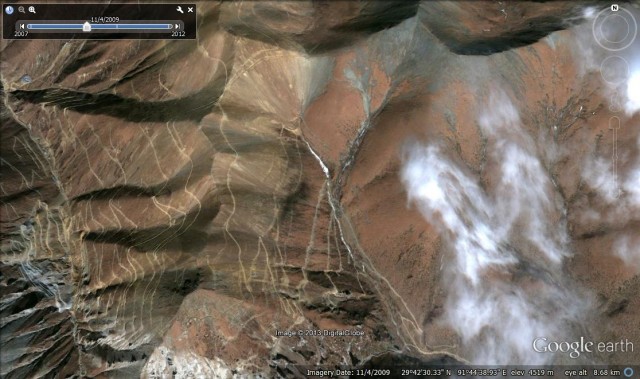
So in essence the landslide was a dreadful tragedy that was natural, according to this expert. Of course even that does not necessarily absolve those responsible for the mine of blame because if the mountains were prone to such events then the camp should not have been in such a dangerous location, but that is a side issue. The key is whether this explanation of the event is credible. So why would we think that it might not be? Well, first up from a technical perspective there is something really odd about the landslide; this is that it has travelled a remarkably long distance. The reported volume is 2 million cubic metres and we know from the photo evidence that it occurred in this particular valley:
 .
.
So we can use Google Earth to get a first order estimate of the height: length ratio of the landslide. The report is that it travelled about 3 km down the valley, which would imply a height change of about 700 metres (according to a crude measurement from the imagery). The ratio between these two parameters gives us a rough indication of the mobility of the landslide – i.e. how far it went given the vertical distance it travelled. We know that big (in terms of volume) landslides tend to be more mobile than are small ones; indeed this relationshop has been extensively explored in the literature. So lets compare the Jiama mine landslide with previous examples. In a paper a few years ago, Li (1983) plotted this up data for large rockfalls and fitted a best fit line. I have added a star to indicate the approximate position of this event:
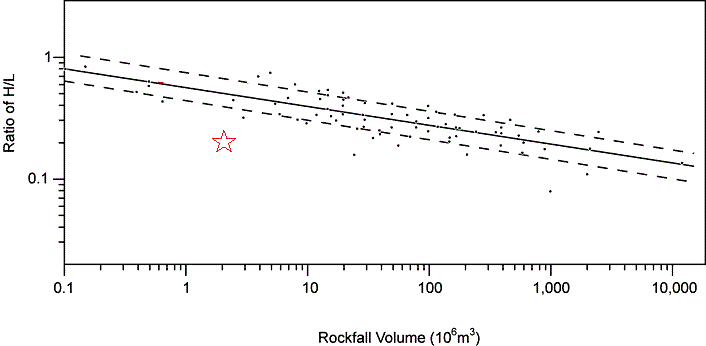
Li 1983
In other words this landslide event seems to have been exceptionally mobile – much more so than were other rockfall type landslides of a similar size. That in itself is surprising, especially as it did not travel across a very low friction surface such as a glacier. Of course Google Earth only gives us a rough estimate of the parameters, so the error bars are large, but even if you take this into account the landslide appears to have been very mobile, indicating that something rather strange has happened here. It could of course be that the very narrow valley played a role in some way, so there could be a natural explanation, but it does suggest we should be looking at this in more detail.
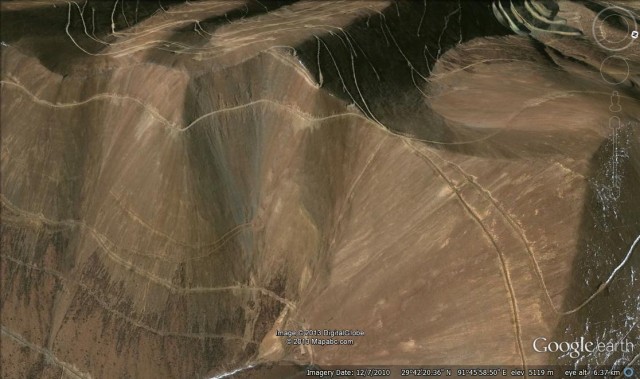
So let’s take a look at the site. This is the slope that failed as shown on the standard Google Earth image, taken with a perspective view:
 .
.
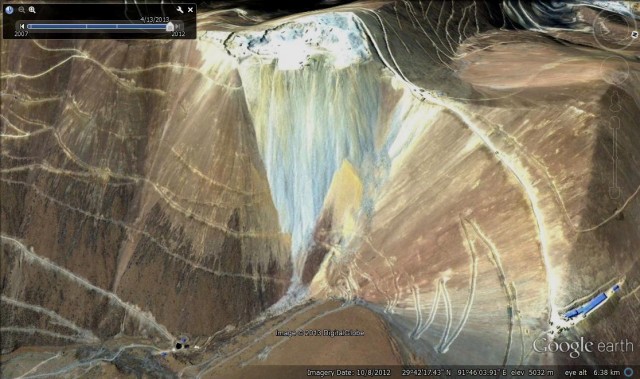
There are clearly a set of mining tracks across the hillside, but otherwise this looks like weathered rock in a reasonably natural state. However, this image was collected in July 2010. Hidden in Google Earth is a more recent, and more interesting image, dated 10th August 2012:
 .
.
To me this is a sensational image. It shows that the slope that failed had been subject to a huge mining operation – basically a mountain-top removal exercise. Perhaps more importantly, the spoil that has been removed has been dumped down the slope that subsequently collapsed. The scale of this operation is very large, and it is notable that the spoil has mostly accumulated on the upper part of the slope, although some has passed to the foot of the slope.
So, how come the Chinese news reports about the event did not mention this huge modification of the slope. Remember that Mr Dorje said:
Rocks hidden under the glaciers broke into smaller, loose rocks over a long period of time due to thermal expansion and contraction stress, as well as rainy and snowy weather. Dorje said smaller rocks near the source of the landslide collected together and snowballed into a massive landslide that was incredibly destructive.
He neglected to point out that a large volume of loose rock had been dumped in the upper portion of the slope due to mining. The idea that a small failure turned into a very large collapse is a good one; it is the source of the material that is the issue. The volumes are interesting too – the excavation is about 300 x 330 metres – i.e. a surface area of about 100,000 square metres. If an average of 20 metres of rock has been removed, which seems reasonable, the volume of spoil is about 2 million cubic metres. This would seem to be a reasonable fit to the reported volume of the landslide.
So, does this answer why the landslide was so mobile? It certainly provides a possible explanation. Most of the landslides in the Li (1983) dataset were natural failures, consisting of rock blocks that had to go through massive fragmentation at the foot of the slope. Breaking rock is very energy intensive, which means that there is less energy available to move the mass. In the Jiama mine landslide case, the rock mass had been fragmented before the failure, which would have allowed a much more efficient run-out process.
Of course I cannot definitely say what happened at this slope in Tibet, and I cannot rule out the possibility that it was a natural event. I will allow you to be the judge of that, and welcome comments and thoughts. If you want to look at the imagery the site is at: 29.703978° N, 91.762919° E
Finally, I am also aware that there are other reports and analyses of this landslide online now. I will link to those in a post in the next day or so. I quite intentionally wrote this post independently of those reports – this is my best analysis of the events at Gyama Mine. It leaves a lot of important questions hanging.
Reference
Li, Tianchi, 1983, A mathematical model for predicting the extent of a major rockfall, Zeitschrift fur Geomorphologie, 27 (4): 473-482.
12 April 2013
The unusually large Bingham Canyon Mine landslide – an impressive example of prediction using monitoring
See also the update to this post here
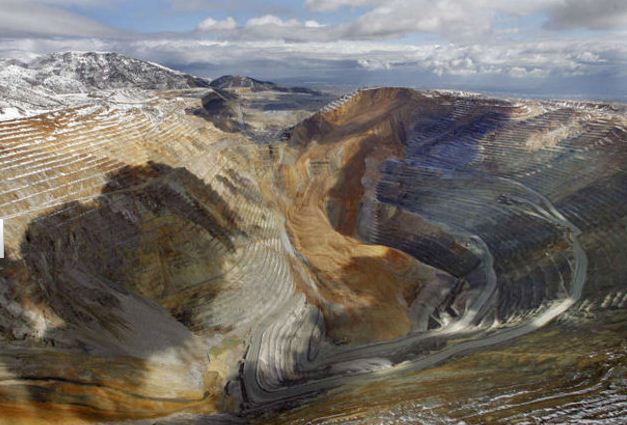
On Wednesday evening an extremely large – and in the case this is no exaggeration – landslide occurred in the Bingham Canyon copper mine in Utah, USA. According to various news reports, the deforming slope was identified some months ago and monitored intensively. An increasing rate of strain in the hours before failure indicated that a collapse was imminent, and the mining company released a warning about the landslide in advance. The upshot is that although it has caused considerable damage to the mine, there are no casualties.
The scale is impressive. There is a fabulous gallery of images of the landslide on the ksl.com website. These are two of them:
http://www.ksl.com/index.php?page=1&sid=24748916&nid=460
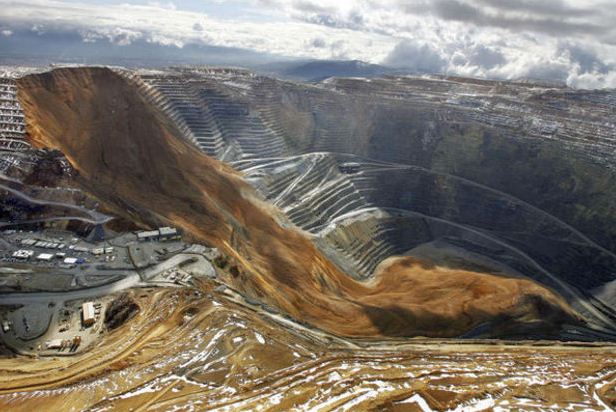
http://www.ksl.com/index.php?page=1&sid=24748916&nid=460
The landslide deserves a separate post interpreting the mechanics – I will do so in the next few days. However, the landslide is sufficiently large that it was detected on seismic networks. Jeff Moore kindly pointed out that the landslide appears on the University of Utah seismic recording station record from Granite Mountain Vault, Salt Lake City:
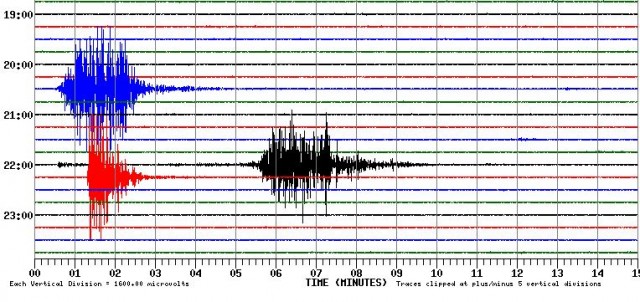
http://www.quake.utah.edu/helicorder/gmu_webi_2d.htm
Meanwhile, Colin Stark noted that the landslide was recorded on the Columbia University global seismic dataset too, which suggests that the volume is in the tens of millions of cubic metres:
2013-04-11	05:05:52	40.75	-111.75	 4.9	UTAH
2013-04-11	03:31:04	40.75	-111.75	 5.1	UTAH
Note that in both cases the seismic record is for two events (in the Utah dataset these are the blue and black records). Landslides have a characteristic form in seismic records, essentially looking like a hairy caterpillar. I am not sure what the red event is – this does not have this characteristic form. Both landslides were sufficiently large to be picked up by these networks, which means that there were two very large landslide events here, one at 9:31 pm local time and the second at 11:06 pm.
Finally, many people have sent links to this – thanks to you all. I will follow this up with another post in the next couple of days about the mechanics. However, this does demonstrate that lanslides in mines are manageable, a lesson that those operating the mine in Tibet (and indeed elsewhere in China) would be sensible to learn. I will also post again on this landslide in the next day or so – there have been some interesting developments with respect to that one.
See also the update to this post here
7 April 2013
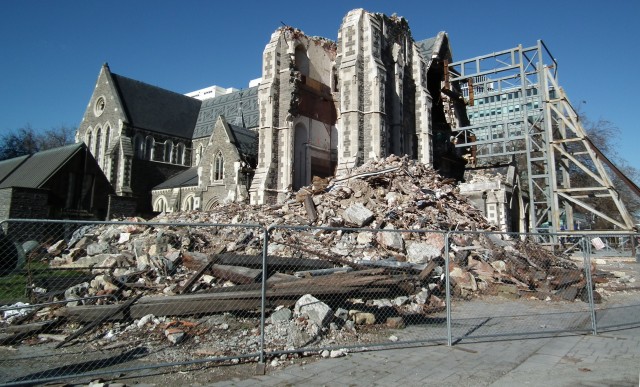
Future trends in natural hazard losses – the Powerpoint file from my Geographical Association 2013 conference talk
 .
.
Yesterday I was deeply honoured to present the AQA Annual Lecture at the Geographical Association annual conference in Derby. I talked on the topic of Future Trends in Natural Hazard Losses – essentially a review of what we expect to see in the next few decades on a global basis. I started the talk by looking at recent trends, and then looked forward to what we might expect. I finished with an example of one of the mega-quakes that we fear – in this case a large earthquake in Western Nepal.
The slides are on Authorstream – you can download the Powerpoint file there – an should also appear below:
[authorSTREAM id=1764439_635008939131252500 pl= player by= Nubiagroup]
5 April 2013
Landslides in Portugal, including a new landslide video
Portugal News reports that heavy rainfall in the last few days across the country has induced landslides and floods, with the district of Santarem being worst hit. The most interesting landslide occurred at Guimarães, where the ring road was severed by a landslide. On Youtube there is a dramatic video that shows the early stages of this failure but not the main landslide event. There are some very good images of the aftermath at the end of the video. It is worth watching:
.
The modern apartment block at the top of the hill is now severely threatened by the landslide. This website has an image that shows that the pile foundations are now exposed:
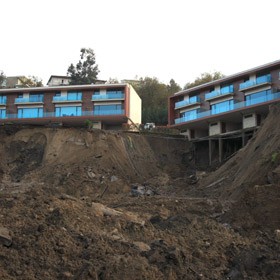
http://www.guimaraesdigital.com/index.php?a=noticias&id=52048
.
Repairing the damage to these buildings is likely to be extremely difficult.
4 April 2013
Caveat Emptor part 2 – the end game
Back in October I highlighted the case of a house in Torquay in Devon that was being affected by landslides. This is rather a sad story in many ways – the house was bought for a knock-down, but not insubstantial, price, apparently unseen, before the most recent problems began. The buyer has now suffered very high levels of loss as the house has been destroyed. The Daily Mail yesterday ran a photo story about the house, which has subsequently suffered a series of landslide events. The result is that it is possible to put together a sequence of photos of the loss of the house:
The house in question (from the Daily Mail):
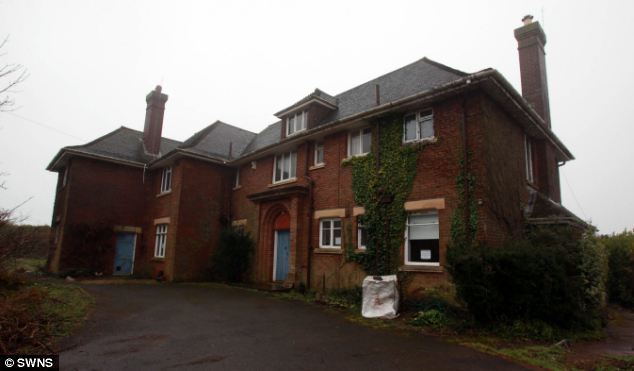
http://www.dailymail.co.uk/news/article-2221965/Torquay-house-left-teetering-cliff-edge-landslide-week-disabled-Sue-Diamond-paid-154k-it.html
After the landslide in October 2012 (from the Daily Mail)
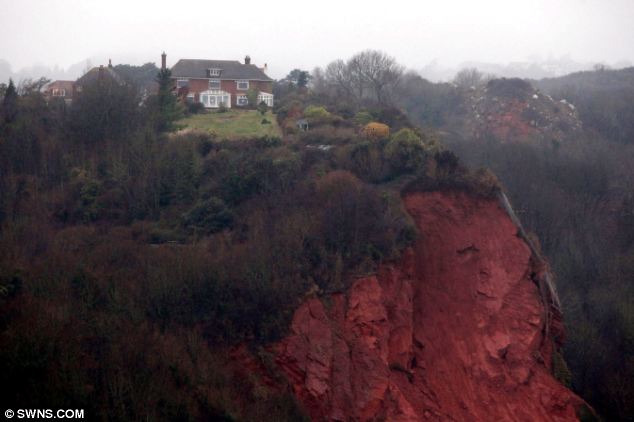
http://www.dailymail.co.uk/news/article-2221965/Torquay-house-left-teetering-cliff-edge-landslide-week-disabled-Sue-Diamond-paid-154k-it.html
By February this year the landslide had retrogressed sufficiently that the house was starting to show severe signs of distress (from the Daily Mail):
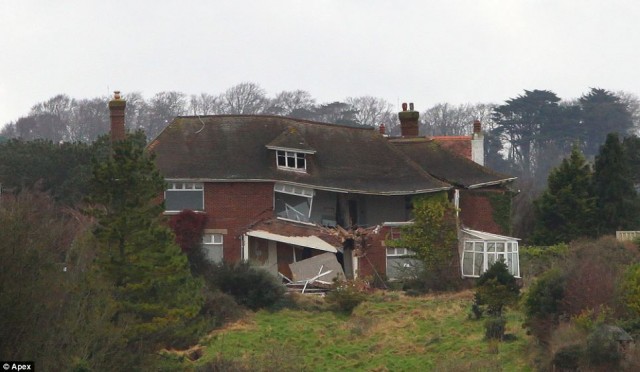
http://www.dailymail.co.uk/news/article-2303412/Sea-red-landslide-claims-Torquay-cliff-face-taking-154-000-house-owned-London-woman-bought-viewing.html
A couple of weeks later and a further collapse had occurred (from the Daily Mail):
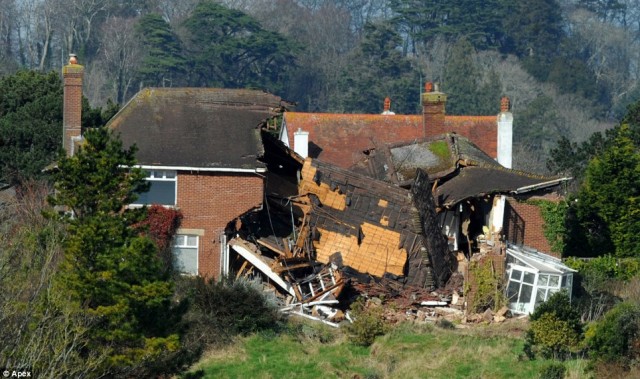 In the last few days a large landslide event occurred, taking a part of the house with it (from the Daily Mail):
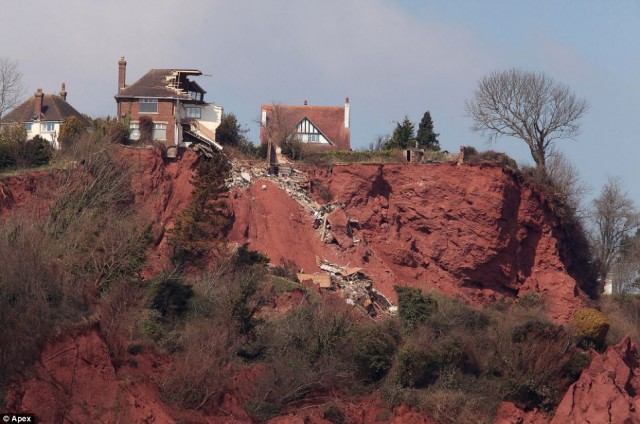
http://www.dailymail.co.uk/news/article-2303412/Sea-red-landslide-claims-Torquay-cliff-face-taking-154-000-house-owned-London-woman-bought-viewing.html
So now the endgame for this house is very close (from the Daily Mail):
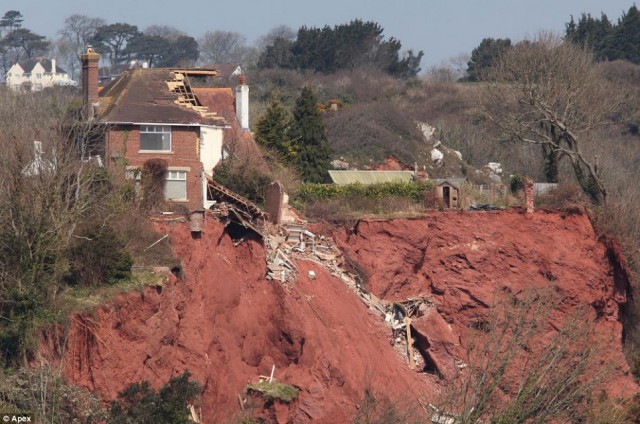
http://www.dailymail.co.uk/news/article-2303412/Sea-red-landslide-claims-Torquay-cliff-face-taking-154-000-house-owned-London-woman-bought-viewing.html
This is clearly a tragedy for the owner. Unfortunately, although the period of very heavy rainfall in the UK appears to have ceased now (at least temporarily), it is likely that water levels deep in the ground are continuing to rise. This means that we are very likely to see some more large landslides in the weeks ahead.
 Dave Petley is the Vice-Chancellor of the University of Hull in the United Kingdom. His blog provides commentary and analysis of landslide events occurring worldwide, including the landslides themselves, latest research, and conferences and meetings.
Recent Comments