

24 April 2012
Landslide Mitigation Housing
Last week Archinect website carried a slightly intriguing design concept for “Landslide Mitigation Housing” by Jared Winchester and Viktor Ramos, which are residential units to be intentionally constructed on a landslide site. The inspiration is a location in California at Rancho de Palos Verdes , near to Los Angeles, where there is a site that is currently impossible to inhabit because of an active earthflow. This is the site, as per a Google Earth perspective view:
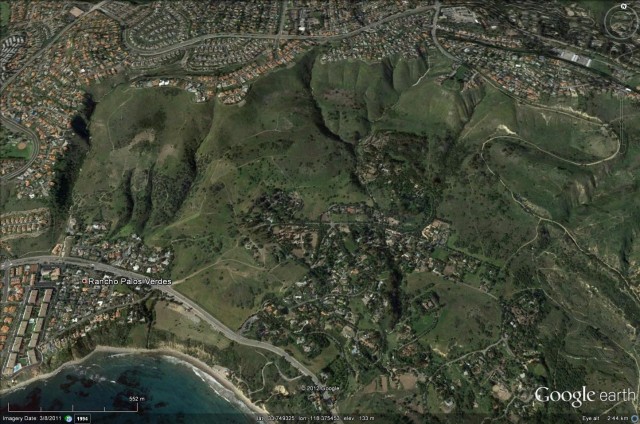
The proposal, which is very conceptual at this stage, is to locate housing units onto the landslide in order to (in the words of the architects):
…mitigate future catastrophic events, salvage currently unbuildable landscape, and to evolve an architectural vernacular of dwelling within tight topographic settings
The idea is to tether a network of houses onto the landslide. The design appears to tie the houses onto the slope using a network of cables linked to ground anchors. The houses themselves are designed to be able to change form as the landslide moves beneath them:
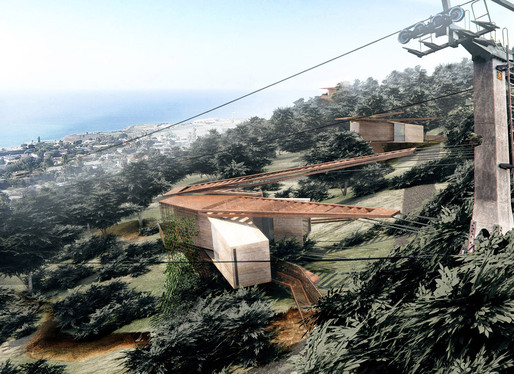
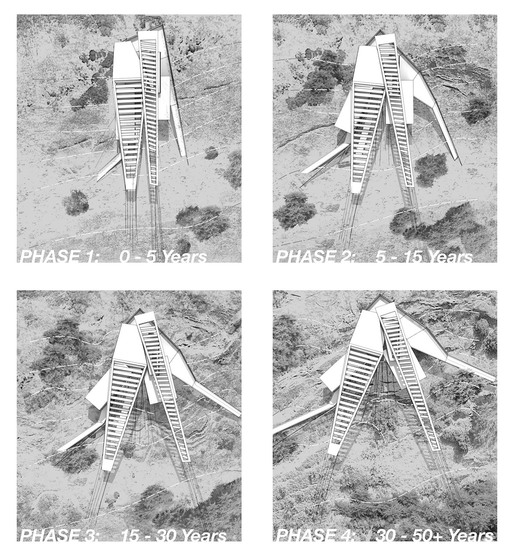 The idea seems to be to slow down the movement of the landslide by using these housing units to provide a drag force. Presumably therefore the cables are tied in below the shear surface and the movement of the landslide then pushes against, and is impeded by, the houses. Thus, the landslide is partially mitigated and the slope is inhabited, but the natural system continues to function.
There is much to be commended in this design, which is both innovative and interesting. I like the way that the structures respond to the landslide and provide an indication as to its behaviour. There are of course several aspects that the designers might need to think rather carefully about though:
- The key is that the anchors at the end of the cables need to be fixed into bedrock. As the landslide moves these anchors (and the cables) will be buried, which means that a protective structure would be needed;
- Generally, we do not use cables in tension to provide support to landslides. Rock anchors are in tension, but they are designed to induce compressive forces in the ground to mobilise frictional forces rather than to resist movement through their tensile strength. Landslide forces are very large, such that the strength of the cables would need to be high. The possibility of a cable under tension snapping is potentially serious for both the landslide and any people in the vicinity;
- A poorly-understood aspect of house viability is the need for the structure (especially the floors) to be level. One reason that houses on landslides quickly become unoccupiable is that levels are lost, which is deeply uncomfortable for the occupants. Keeping these structures level as the landslide moves would be a serious challenge;
- Provision of services would also be interesting – providing in particular water and sewerage across an active landslide is difficult, and needless to say leakage of the pipes on a landslide cannot be tolerated. Presumably they could be designed to minimise the need for electricity, and could generate power locally using wind and solar sources;
- I wonder how an insurance company would view these structures? In most countries landslides are not an insured risk.
I think that all of these problems are solvable with thought, and really welcome the innovation that is being shown here.
12 April 2012
The Siachen Glacier avalanche (138 people killed) was an ice-rock avalanche
Now Updated – see the end of the post
The international media briefly reported that on Saturday there was a devastating event in the high mountains of Pakistani Kashmir. An avalanche was reported to have descended from the Siachen Glacier and overwhelmed an army camp, killing 138 soldiers and civilians. This story always had a slightly strange ring to it as the reports were that no bodies had been recovered, which is unusual in an avalanche. In addition, one or two Pakistan news outlets started to refer to this event as a landslide.
Over the last 24 hours several pictures have emerged of the site. This one is from AP, and shows what one assumes is the site:
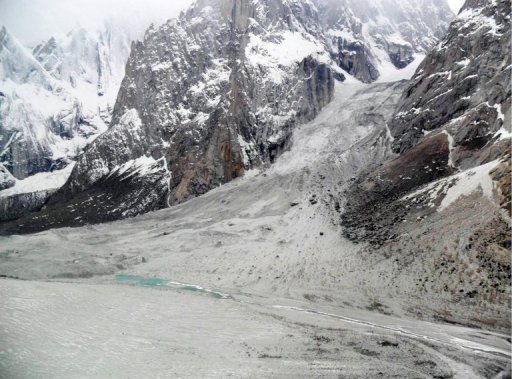
Both the deposit and the morphology of the flow looks like an ice-rock avalanche rather than a simple avalanche, presumably one that has run across the surface of the ice in the side valley, and then plunged into the main valley. Even more conclusive are these two shots of the attempts to recover the bodies. This image is also from AP:
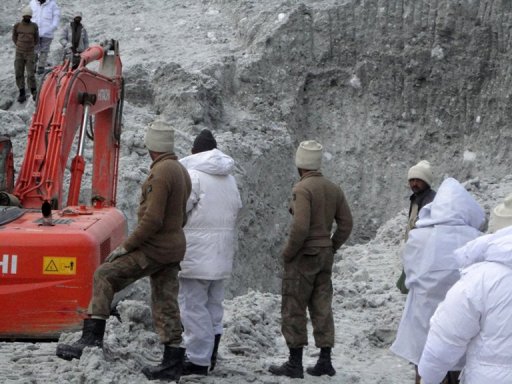
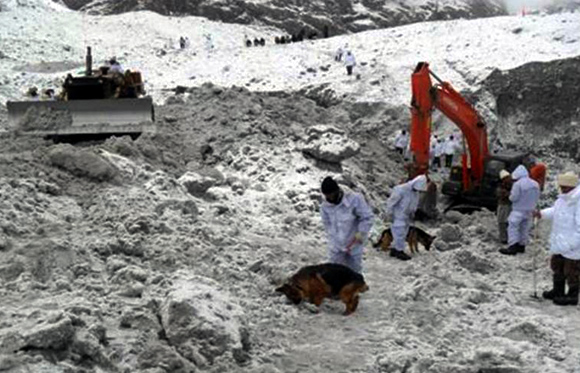
Both images show what is undoubtedly not a simple avalanche deposit. This is undeniably that of something more complex – an ice-rock avalanche type of landslide.
So, it is clear that the Siachen Glacier Avalanche was actually the Siachen Glacier Ice-Rock Aavalanche. It would now be interesting to find out more about what happened – for example how far this landslide travelled, and from where it originated. Someone also needs to update the very impressive Wikipedia article on this event.
Update – further information from an article in Dawn.com:
Col (retd) Sher Khan, a mountaineering expert, suggested the devastation might have been caused by a landslide rather than an avalanche.
“For me it was a huge landslide provoked by a cloud burst, not an avalanche. In this case a huge flood of water is coming down from the sky and creates a lot of mud and loose earth on the mountain. Mostly boulders, mud and water ran down the mountain.”
He said several days of freezing temperatures would have hardened the mass of snow, mud and boulders, making digging more difficult.
So, can anyone explain this?
This is quite extraordinary:
This still is captured from the video:
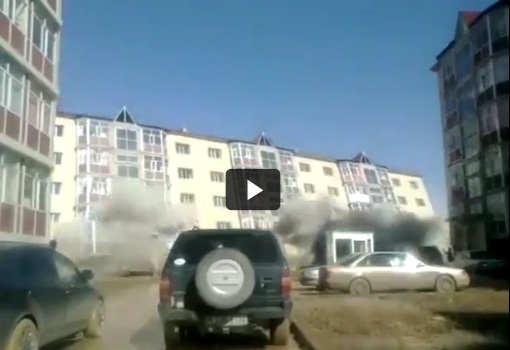
Update – it is the sructural failure of a residential building in Karaganda, Kyrgyzstan earlier this month. Details here.
10 April 2012
The Xintan landslide in the Three Gorges area of China
The Xintan landslide is located on the opposite bank from the Chain Cliff landslide about which I posted yesterday. This catastrophic landslide event occurred on 12th June 1985, destroying the village of Xintan in the process. Fortunately the landslide had been anticipated, and the town evacuated, such that there was no loss of life. The landslide is described in an article by Keqiang et al. 2010 which is available online.
This image shows the landslide site as it is now – of course the lower portions of it are now flooded by the Three Gorges reservoir. unfortunately it was a very hazy day when I was there, so apologies for the quality of the image:
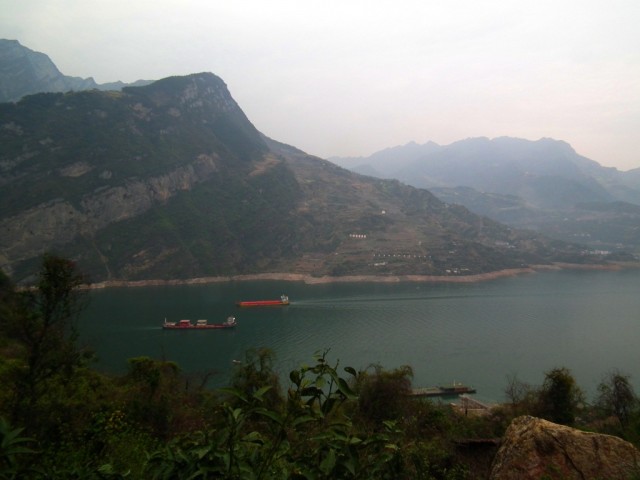
The mechanism of the landslide is quite interesting. The cause was coal mining activity on the lower part of the bluffs above the landslide (located to the left as seen in the photograph above). This destabilised the cliffs, causing repeated rockfalls onto the main slide below. Instability was recognised in the 1970s and the landslide was being monitored as a result. The final failure event does not seem to have been initiated by a rockfall event, but developed progressively over a period of some weeks. Monitoring of the landslide mass detected this development of failure, and on the day before the landslide all 1371 people living in the town were evacuated.
The final failure event was catastrophic, with a mass of about 13 million cubic metres slipping with an average depth of about 45 metres. About 2 million cubic metres entered the main channel of the Yangtze River, generating a wave that was up to 49 m high. The wave killed ten people on the river and destroyed 77 boats.
The landslide is an example of successful monitoring of slope failure – undoubtedly without the evacuation there would have been a substantial loss of life. The slope is now more stable than before, but the potential for further movement remains. Thus, the landslide is still monitored intensively.
Reference
Keqiang, He et al. 2010. Dynamic features and effects of rainfall on landslides in the Three Gorges Reservoir region, China: using the Xintan landslide and the large Huangya landslide as the examples. Environmental Earth Sciences, 2(4), 76-1274.
9 April 2012
Honey, the sunroof seems to be jammed…
Thanks to Greg Springer for putting an amazing album of images of the boulder fall in Athens, Ohio last month on Flickr (see my earlier post on the event). This is my favourite:
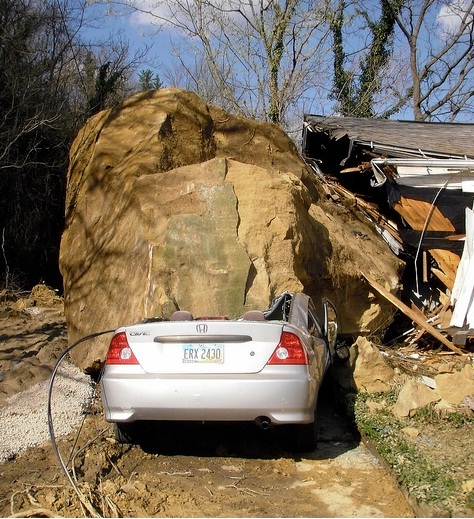
Other captions welcome (please post them in the comments below), but do check out Greg’s photos on Flickr.
Chain Cliff deforming rock mass on the banks of Three Gorges reservoir
As a part of my visit to China Three Gorges University, my hosts took me up the lower reaches of the Three Gorges reservoir to look at some of the large landslides that have occurred in and around the gorge. This is truly a landslide treasure trove, set in quite remarkable scenery. One of the sites that we visited is known as Lianziya, in English as Chain Cliff. As a result of coal mining activity at the toe well before the construction of the dam, this large limestone massif showed signs of active movement, with a big series of tension cracks widening with time. Measurement suggested that a block with a volume of 3.3 million cubic metres was slipping as a resulting of plastic deformation in the thin shale and coal seams beneath the limestone.
There was real concern about the possibility of a catastrophic collapse, which would have been both a hazard in itself and would have potentially blocked the river. Over 30 tension cracks were observed, with widths of up to two metres, and monitoring suggested that creep was continuing to develop. This image shows the limestone blocks and the tension cracks:
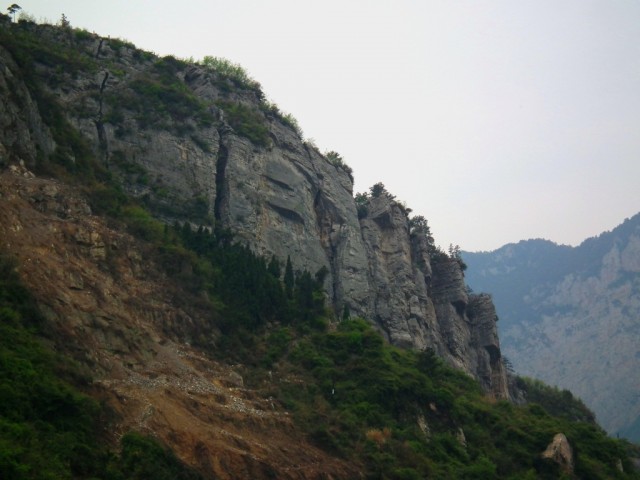
This mass was subsequently stabilised by supporting the toe, primarily by back-filling the old mine workings. The project was apparently successful, with no signs of movement even during impoundment of the reservoir.
In the foreground of the above image you can probably see the debris zone from a much smaller, very recent rockfall from the limestone massif. That will be the subject of my next post in this series.
8 April 2012
Images of the Three Gorges Dam ship lock wall
I am currently in China visiting the Three Gorges University to discuss research collaboration. The university is located within 45 km of the Three Gorges Dam site, and is responsible for monitoring many of the unstable and potentially unstable slopes on the banks of the reservoir. My hosts have been kind enough to take me to a few of the more notable sites over the last couple of days. The first was the cut slope on the walls of the flight of ship locks at the dam site itself. This is an image of the dam from the downstream:
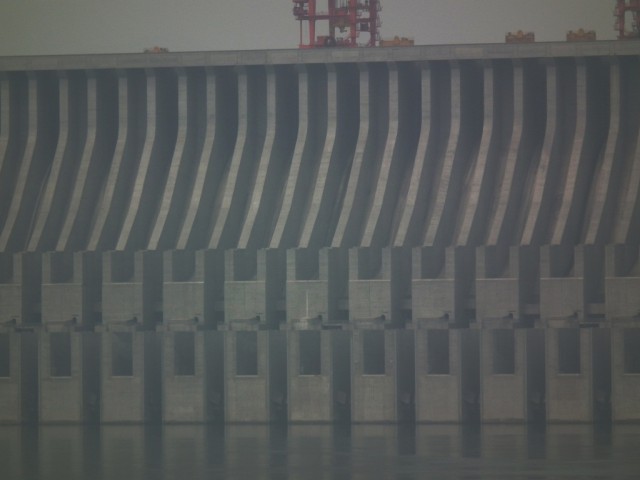
This is the central part of the dam, which provides the spillways. As the flow is low in the spring the spillways are not being used. The dam is a strange structure – not aesthetically pleasing in any way, as many dams are. Indeed, I found it to be surprisingly brutal although, as in the image above, the geometrical shapes in the spillway do create some very strange optical illusions (the image is not altered at all).
From the true left bank of the upstream side the dam looks like this:
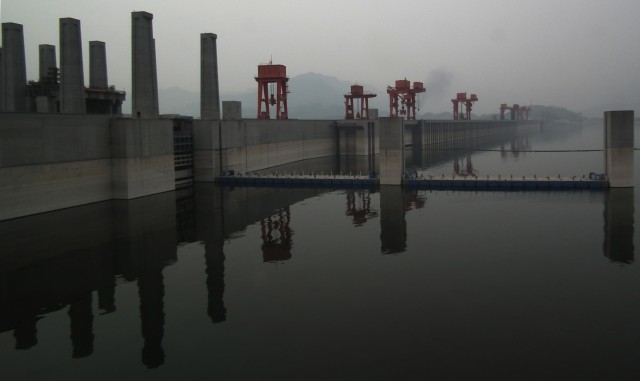
The scheme is truly epic in scale and ambition. The model below shows the layout:
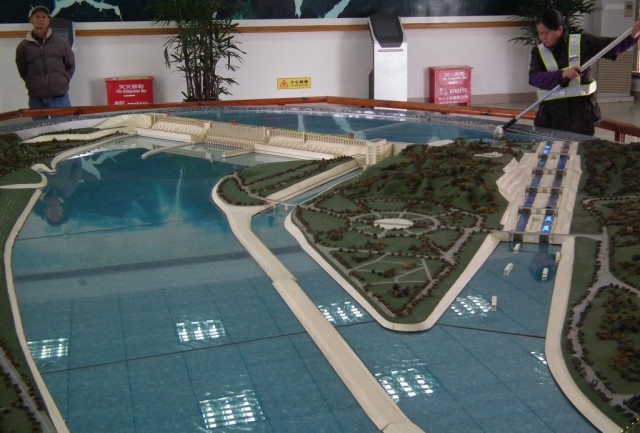
This is the view from downstream (the cleaner is not a part of the actual scheme, in case you were wondering…). In the view the main dam is on the left side. It consists of three sections – a central section comprising the spillways and on either side sections that contain banks of electricity generators. On the right side of the main dam is a narrow channel leading to the ship lift, which is currently under construction. On the right side of the model is the two flights of five ship locks, cut through the hillside. This channel had to be sliced through the granite, which required the construction of an extremely high cut slope wall. This is the ship lock system as from the viewpoint between the locks and the dam. Note the superstructures of the ships just visible in the upper lock on the left side (this is the downstream direction for the ships). Note that you can only see two out of each of the two flights of five locks:
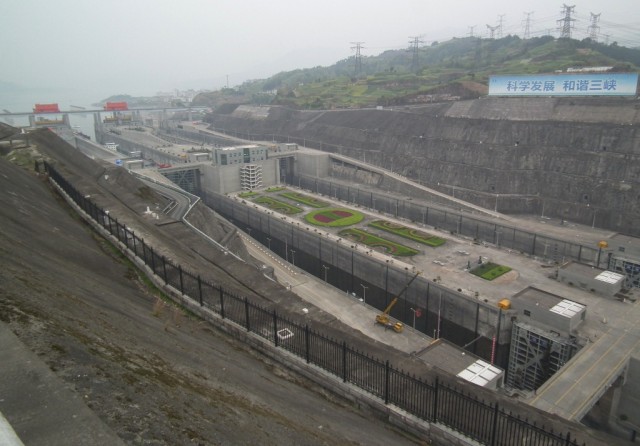
One of the great challenges of building this lock system was the creation of the box-cut that contains it. The total excavation depth is 170 metres, consisting of a lower 68 metre vertical section for the locks themselves (with of course a central island between them that is 57 m wide (note the crane in the above image for scale), and a 102 m benched slope above. The standards required here were very high – the river is an essential communication and freight route to Central China, so the loss of the locks is intolerable. Furthermore, the locks themselves are of course holding back the reservoir, so deformation of for example the lock walls that support the gates must be minimal.
The walls are strengthened with about 2000 pre-stressed cables up to 60 m long and over 100,000 rockbolts before the slope face was sealed with concrete. The slope is drained with a set of tunnels, from which there is a set of boreholes drilled to provide complete coverage through the rock mass. These slope stabilisation measures can be seen in the image below, which shows a drainage tunnel and the heads of the pre-stressed cables:
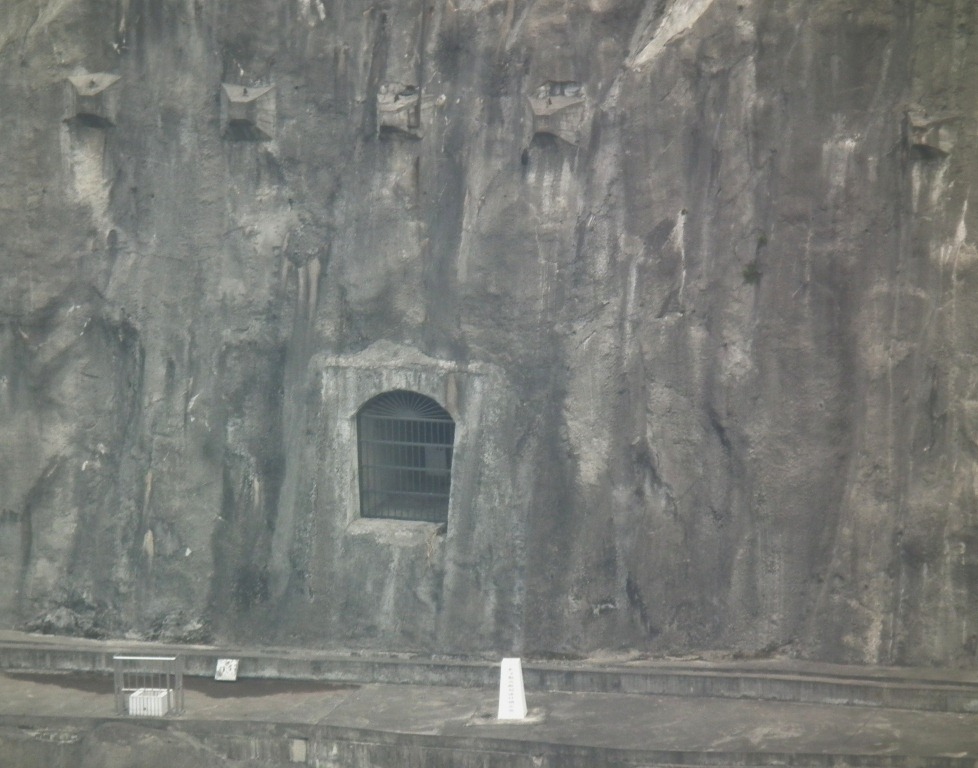
Also visible in this image is the monitoring system now deployed to ensure the stability of the site. This includes both geodetic measurements using standard field techniques and GPS monitoring, plus measurement of the groundwater conditions. It has been reported from the site that the deformation of the slopes is minimal (generally less than 30mm).
3 April 2012
Powerpoint file of my talk to the Hong Kong Royal Geographical Society tonight
Below you should be able to view the Powerpoint file for my talk to the Hong Kong Royal Geographical Society tonight. The title is: The Hazards of Geography: Earthquakes, Floods and Landslides. If you cannot see the file below, it can be viewed here (and you should be able to download the powerpoint file too).
[authorSTREAM id= 1378304_634690114204727500 pl= player by= Dr_Dave]
Thoughts and comments welcome, and it would be great to meet you there.
The need for investment in large-scale natural hazards research programmes
It is an exciting day in the world of physics as the committee meets to decide the location of the Square Kilometre Array, a giant new radio telescope that will improve resolution by 50 times compared with existing instruments. This is a truly epic piece of science – it will for example collect data at a rate that exceeds the capacity of the entire global internet at present! The costs and timescales are also remarkable to observe – the project was first conceived in the early 1990’s, with construction expected to be complete in 2024. The estimated cost is 1.5 billion Euros ($2 billion).
This instrument is designed to address some really interesting scientific questions – for example mapping the large-scale structure of the cosmos. It is a part of a series of very large physics-based science experiments and facilities, including the European Extremely Large Telescope (budget: 1.1 billion Euros) and of course the Large Hadron Collider (budget: 7.5 billion Euros).
Now, natural hazards kill large numbers of people and inflict huge costs on society. This graph for example, which uses EM-DAT data, shows the direct losses associated with natural disasters since 1980. Note that this excludes the multiple indirect costs, which would multiply these totals many times over:
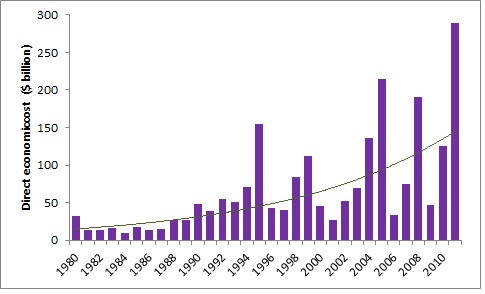
This is a really substantial, and rising cost, to society. There is widespread concern about either the trillion-dollar earthquake (in fact some estimates are that a large event in Tokyo could cost up to $2 trillion) or the million fatality earthquake (for example a very large event in the Himalayas could inflict this level of loss), both of which are statistically entirely possible.
So why is it that natural hazards research does not attract the level of large-scale investment that goes into physics? Allow me to cite an example. Two of the UK Research Councils – NERC and ESRC, are currently funding a major new research programme entitled Increasing Resilience to Natural Hazards, with two strands (earthquake and volcano). This is a genuinely exciting initiative, which has induced the creation of a raft of new consortia across natural hazards research in the UK. It is hoped that it will make a substantial impact in reducing losses from natural hazards over the next decade. But the total cost of the two majors grants that will be awarded is about £6 million ($10 million). Now, this is a large sum of money in anyone’s terms, and this programme is both ambitious and impressive, and it is very welcome. But in comparison with the investment in physics research it is really rather paltry.
If $10 million can make a large impact, one can only imagine the impact that a coordinated investment of $2 billion could have. I believe that such an investment could genuinely induce a step change in both our understanding of natural hazards, and in our management of them. The benefits to society, in particular in less developed countries, would be tremendous.
So surely it is now time for the natural hazard community to take the lead from the physicists. We should create a large-scale investment plan for a comprehensive, international research effort into natural hazards that is properly resourced and managed. The impact of such a programme could be enormous, but to do will require a long-term perspective and high levels of ambition.
No-one should under-estimate the complexity and difficulty of such an initiative, but this should not deter us.The average direct economic cost of natural disasters over the last five years has been $145 billion. Let’s that losses remain at this level (and of course they are in reality rising quickly). If the research programme were to cut these losses by just 10% per annum, the saving would be $14.5 billion per year in direct costs alone, or $290 billion over 20 years. That would make the investment extraordinarily good value for money. Perhaps as a scientific community we need to be a little more self-confident!
1 April 2012
Two interesting recent landslides in the Alps
There has been a number of landslide events in the last few days, one of which I have already reported, but here are two more:
1. A bizarre rock avalanche from Austria
Thanks to Klemens Pürmayr for the heads-up on this one. A little over a week ago a large slab detached from the Meiminger above the Alpbactal Valley in Austria. According to this news report (in German), the slide occurred early on 23rd March. Whilst I have little information about the event the images are dramatic:
Source area and upper track:
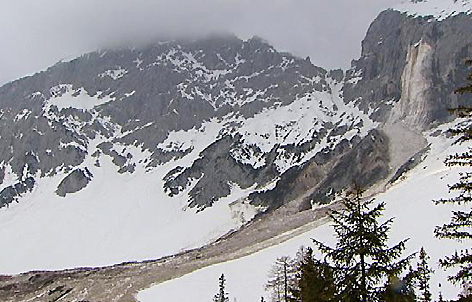
http://tirol.orf.at/news/stories/2527128/
Lower track:
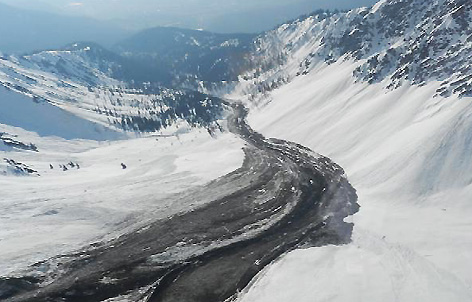
http://tirol.orf.at/news/stories/2527128/
This was clearly a highly mobile landslide, but note that mass has not spread and that very little debris has been left along the path. It is also interesting to see the super-elevation (riding up the valley wall) as the mass has gone around the bend in the lower image.
2. A fatal rockfall in Switzerland
Meanwhile, (and thanks to a small number of people who pointed this out to me), a rockfall in the Engadine Valley of Switzerland between Martina and Vinadi killed a coach driver on Friday (30th March). The ccoach was fortunately empty but for the driver, if this had not been the case then the loss of life would undoubtedly have been much more serious:
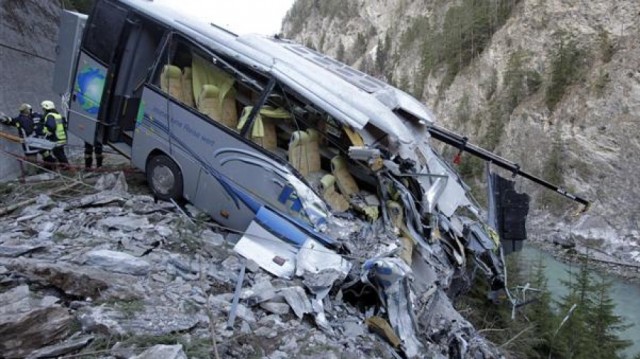
http://www.blick.ch/news/schweiz/chauffeur-57-aus-car-geschleudert-tot-id1829160.html
Does anyone have any more information about either event?
 Dave Petley is the Vice-Chancellor of the University of Hull in the United Kingdom. His blog provides commentary and analysis of landslide events occurring worldwide, including the landslides themselves, latest research, and conferences and meetings.
Recent Comments