

4 December 2012
Mystery mylonite
Posted by Callan Bentley
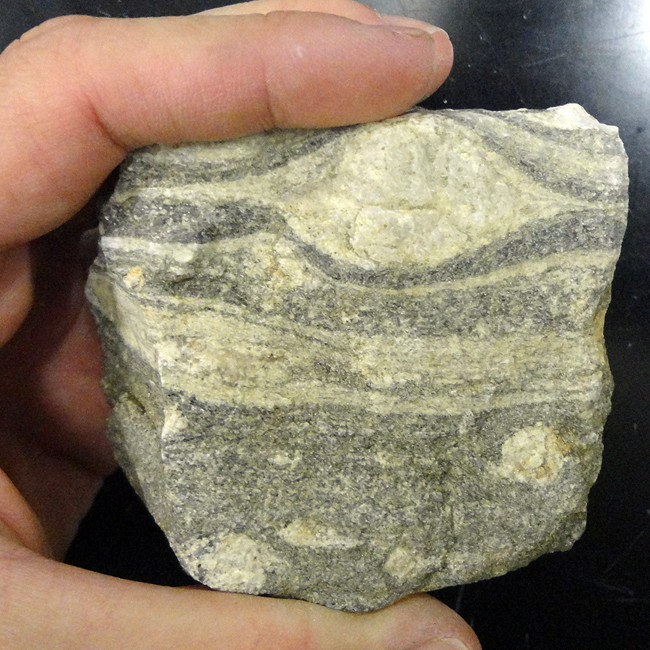
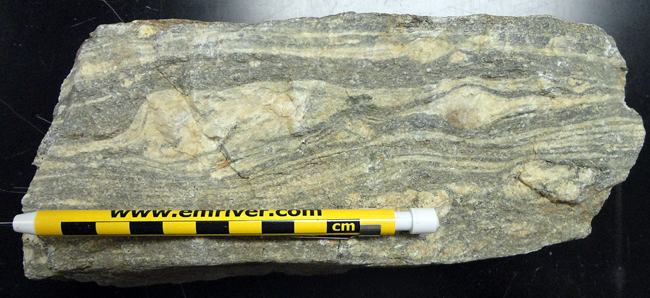
I went into work on the weekend recently, and found two lovely new specimens of mylonite in the lab. Not sure whose they are, or where they came from, but I knew I had to photograph them so I could share them here with you:


 Callan Bentley is Associate Professor of Geology at Piedmont Virginia Community College in Charlottesville, Virginia. He is a Fellow of the Geological Society of America. For his work on this blog, the National Association of Geoscience Teachers recognized him with the James Shea Award. He has also won the Outstanding Faculty Award from the State Council on Higher Education in Virginia, and the Biggs Award for Excellence in Geoscience Teaching from the Geoscience Education Division of the Geological Society of America. In previous years, Callan served as a contributing editor at EARTH magazine, President of the Geological Society of Washington and President the Geo2YC division of NAGT.
I know whose they are! Jim brought them back from California.
Purdy!
Superficially, these things could be mistaken (speaking for myself) for augen gneiss or maybe even migmatite. What are the key features that can be used to distinguish mylonite from these other metamorphic rock types, in hand specimens or outcrop? Thanks!
Good question. “Augen gneiss” is an old word for “protomylonite” in my book. Mylonites aren’t “metamorphic” in the sense of mineral reactions having taken place (at least, not necessarily); they are deformational rocks, like a cataclasite or a fault breccia. In my mind, what characterizes mylonitization is some combination of grain size reduction and evidence of ductile flow of some minerals while others remained rigid. There’s a gradation between protomylonite, proper mylonite, and ultramylonite, depending on the grain size reduction observed. But that depends on the context of seeing the undeformed rock – and I don’t have that luxury here. Quartz ribboning and bookshelfed or tailed feldspars, particularly asymmetric ones (as in the second photo), are characteristics I look for in isolated samples like these.
So I’m using “mylonite” sensu lato, and hope to be forgiven for that sloppiness.
Migmatite is another beast altogether – need to show evidence of partial melting (or, granitic injection) to call a rock a migmatite.
Itz a terrific sample…any clue on where the sample came from?