

20 September 2010
Champlain thrust fault
Posted by Callan Bentley
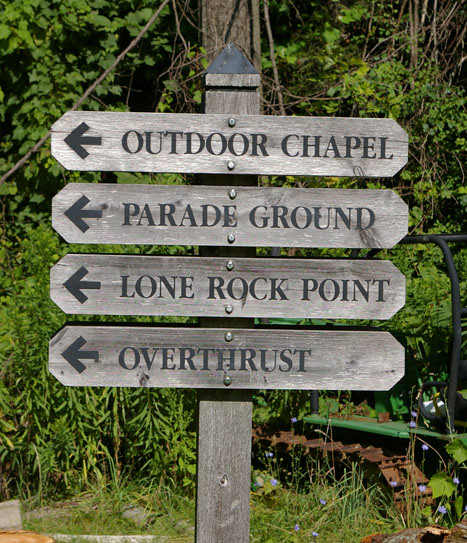
Over the summer, I went up to Vermont to visit my friends the Clearys. Joe Cleary is a college friend and a talented luthier. He and his wife Tree and their children Jasper and Juniper have settled in Burlington, a lively town with a lot of cool stuff going on. Joe took time out one morning to show us a superb example of a thrust fault on the shore of Lake Champlain. It is on private property, but Joe got permission for us to hike there first. Our group that day consisted of Joe, Lily, and me, plus by a stroke of good luck, my pal Pete Berquist was in Burlington at the same time, with his friend Amy. The five us were Team Burlington for the day.
There are two rock units involved in the faulting at this location. Consider the first:
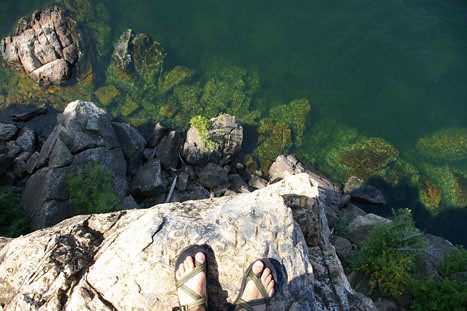
This is the Dunham Dolostone. It’s early Cambrian in age. It’s resistant to erosion, and stands up in cliffs above Lake Champlain. The distance from my ten little piggies down to the water is probably fifty feet. Below the Dunham Dolostone, you can find the Iberville shale. It is actually younger than the overlying dolostone. (We know this from unfaulted stratigraphy elsewhere in the region.) The Iberville shales are Middle Ordovician in age. They are relatively weak (‘incompetent’) rocks, and have been sheared out by the faulting. Here, Team Burlington demonstrates the sense of shear, by leaning over in the direction that foliation has rotated towards:
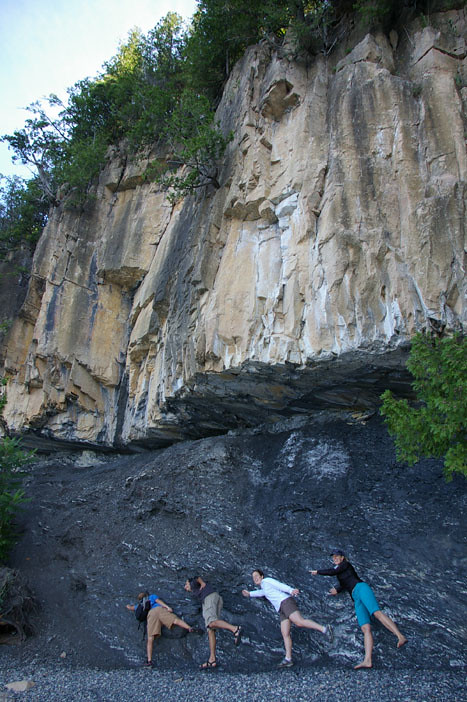
Looking in one direction along the base of the fault to show the differential weathering of the two units:
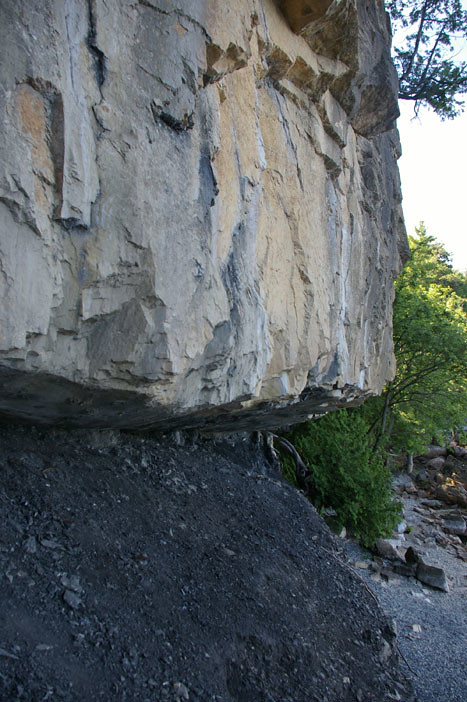
Flip it around 180°, and you see the same thing in the other direction:
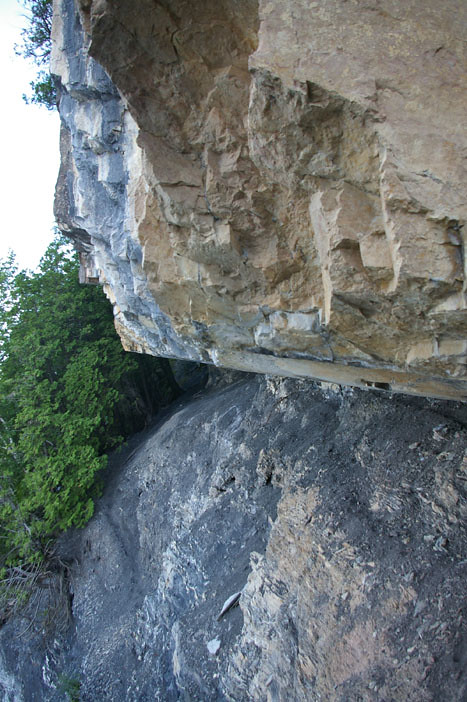
Pete, Joe, and I crawled underneath the ominously overhanging dolostone to check out the detailed structure of the fault. Here’s Pete tickling the sheared out shales, looking for little sigmas…
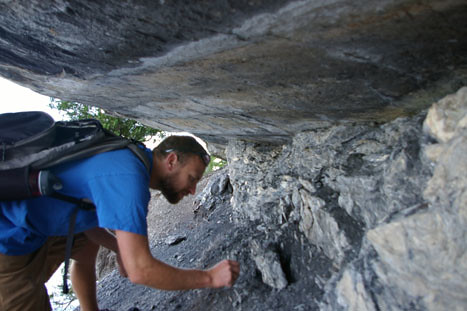
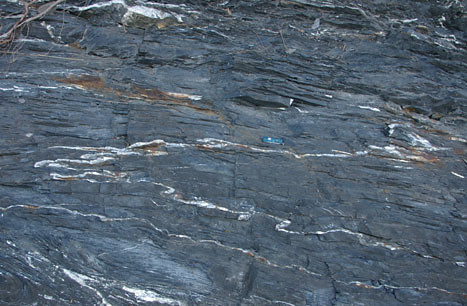
The shales had nice veins of calcite running through them, and the high contrast of light and dark reveals some lovely folds, like this one:
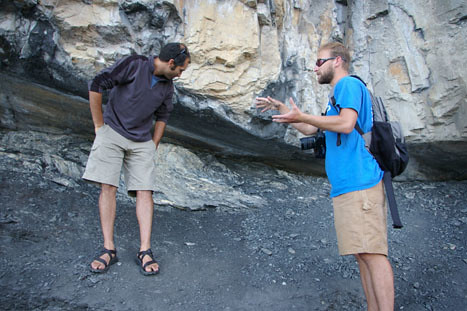
Pete goes into professor mode, gesticulating and using the verb “shmoo” to describe the reaction of the shale to a gazillion tons of dolostone sliding over top of it:
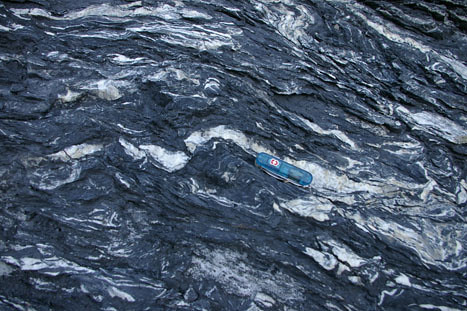
Another nice fold (little tiny blue Swiss Army knife, 5.7 cm in length, for scale):
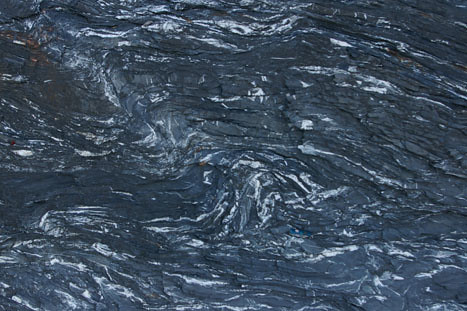
And another nice fold:
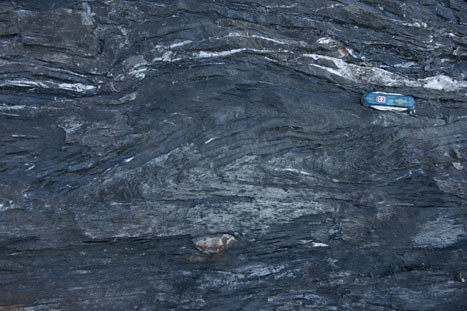
This fold is transitioning into a shear band:
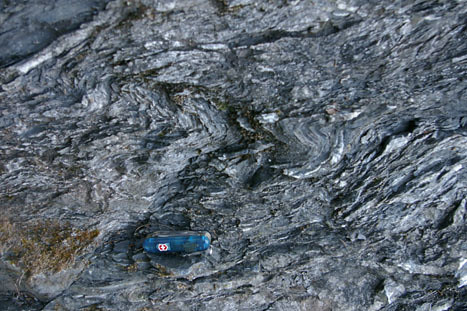
Here’s my favorite part of the outcrop, a big fold with little parasitic folds all over it, showing opposite senses of shear on the opposite limbs of the big fold:
S-folds on the upper limb, Z-folds on the lower limb. Sweet, eh?
Here, a sort of S-C fabric has developed, with foliation tipped over the the left, and then near-horizontal shear bands running along through it:
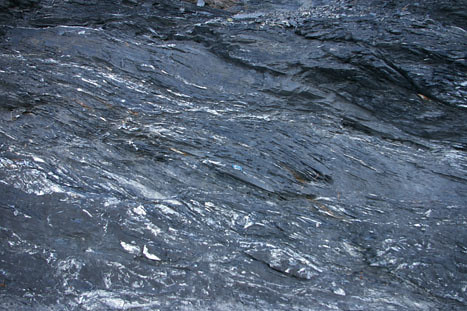
Here’s something weird. Perhaps a reader can explain it. Here’s a shot of some of the veins, with the same 5.7 cm knife for scale:
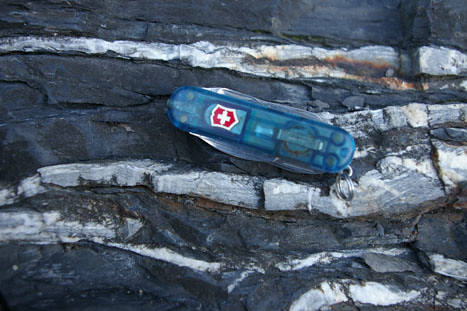
Now we’ve zoomed in, and you can see some detail in the vein:

What are those lines? Is that more “S-C” fabric? I mean, it can’t be cross-bedding in a vein… but I’m having trouble visualizing what process of shearing the vein could yield such a delicate, even distribution of dark material amid the vein fill. What the heck is going on here?
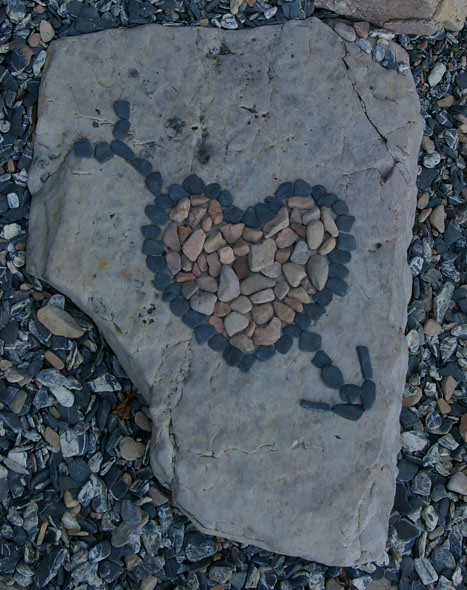
Okay, now that you’ve twisted your brain up thinking about that, you can relax with a structure whose meaning is obvious. Some artistic and romantic previous visitor (not a member of Team Burlington) had arranged pebbles weathered from the two rock units into a bimodal icon of love:
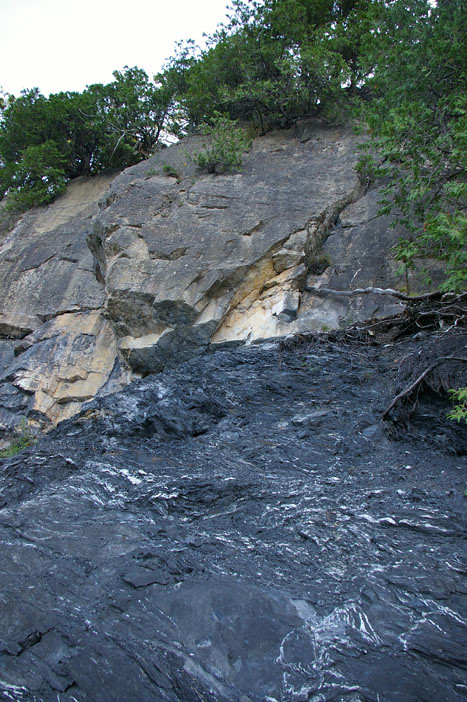
Displacement along the Champlain Thrust is estimated at 30–50 miles (48–80 km). These dolostones started off near the New Hampshire border, then crossed Vermont, almost but not quite making it into the Empire State! The Champlain Thrust is the westernmost thrust fault that has been associated with the Taconian Orogeny, a late Ordovician episode of mountain building associated with the docking of an island arc with ancestral North America. Looking up at the fault trace:
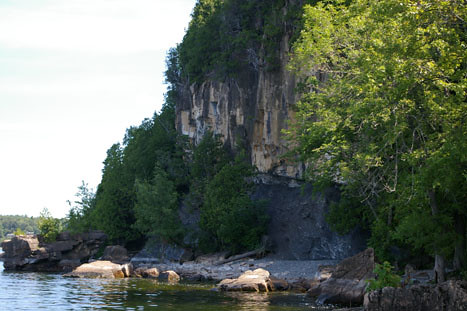
A final glance at the thrust outcrop, looking north and showing the fault’s gently-inclined easterly dip:
Joe, thanks for taking the time to bring us out there!


 Callan Bentley is Associate Professor of Geology at Piedmont Virginia Community College in Charlottesville, Virginia. He is a Fellow of the Geological Society of America. For his work on this blog, the National Association of Geoscience Teachers recognized him with the James Shea Award. He has also won the Outstanding Faculty Award from the State Council on Higher Education in Virginia, and the Biggs Award for Excellence in Geoscience Teaching from the Geoscience Education Division of the Geological Society of America. In previous years, Callan served as a contributing editor at EARTH magazine, President of the Geological Society of Washington and President the Geo2YC division of NAGT.
Gee, Callan, are you going to get me to simply move my Passchier & Trouw permanently onto my desk? I think that if you examine Fig. 6.7 (and if you don’t have the book, I can get the image to you after class) your vein looks like the image of an antitaxial vein undergoing shear strain. Btw, I do love this book 🙂
Yes, let’s see the image!
Gee, Callan, are you going to get me to simply move my Passchier & Trouw permanently onto my desk? I think that if you examine Fig. 6.7 (and if you don’t have the book, I can get the image to you after class) your vein looks like the image of an antitaxial vein undergoing shear strain. Btw, I do love this book 🙂
Yes, let’s see the image!
This “cross-bedding” looks a bit like extensional crenulation cleavage (ECC). If so, this would indicate a dextral movement sense…
That would be weird, considering the rest of the outcrop’s dominant sinistral sense of shear, but I suppose it could be a little local dextral shear, as with the lower side of the fold with the parasitic folds.
That would be weird, considering the rest of the outcrop’s dominant sinistral sense of shear, but I suppose it could be a little local dextral shear, as with the lower side of the fold with the parasitic folds.
I posted the figure over at my blog: http://lifeinplanelight.wordpress.com/2010/09/20/vein-microstructure/
Your picture shows parallel S-shapes, but the line striking through all those S-shapes seems to cut them at a 90 degrees angle, which I can’t see in the outcrop photo. I’ve never heard of this kind of vein deformation, so I don’t know if this is crucial. Just my observations
I posted the figure over at my blog: http://lifeinplanelight.wordpress.com/2010/09/20/vein-microstructure/
I think that would be S-C mylonite deformation of the quartz vein, which was possibly originally banded or maybe fractured in early deformation. Looks sinistral, eh? Mylonitized quartz vein.
I think that would be S-C mylonite deformation of the quartz vein, which was possibly originally banded or maybe fractured in early deformation. Looks sinistral, eh? Mylonitized quartz vein.
Callan, here is a gigapan taken around the corner to the north from where you were: http://gigapan.org/gigapans/30397/
Looking forward to meeting you in November.
Very cool. Thanks for sharing. See you in Pittsburgh!
Callan, here is a gigapan taken around the corner to the north from where you were: http://gigapan.org/gigapans/30397/
Looking forward to meeting you in November.
Very cool. Thanks for sharing. See you in Pittsburgh!
That’s a pretty impressive contact–is there any corresponding deformation on the base of the overlying dolostone?
Not nearly so much — some weakly developed slickenlines, but the dolostone is much tougher (“competent”), while the shale is essentially a big black banana peel…
Great post. That is a rare exposure to see.
[…] Originally posted in September 2010 as part of this missive on the Champlain Thrust Fault. […]
[…] folds which “decorate” the main fold. Like we saw in the gooily-deformed shales below the Champlain Thrust Fault, parasitic folds are higher-order folds whose asymmetry can be used to infer shearing kinematics on […]
More details on the area (and the big picture of Appalachian geology):
http://written-in-stone-seen-through-my-lens.blogspot.com/2011/10/champlain-thrust-fault-at-lone-rock.html
Thank you for your recent comment! I’ve been a big fan of your blog for some time now. Your photos, explanations and diagrams are great. Thanks for visiting once again. Jack
[…] stuff looks very much like a lighter-colored version of the sheared-up shale underneath the Champlain Thrust Fault in Vermont. I’ve seen similar sigmoidal domains bounded by highly-cleaved rock in Cretaceous […]