

29 February 2012
Survival geology for the space traveler
Posted by Jessica Ball
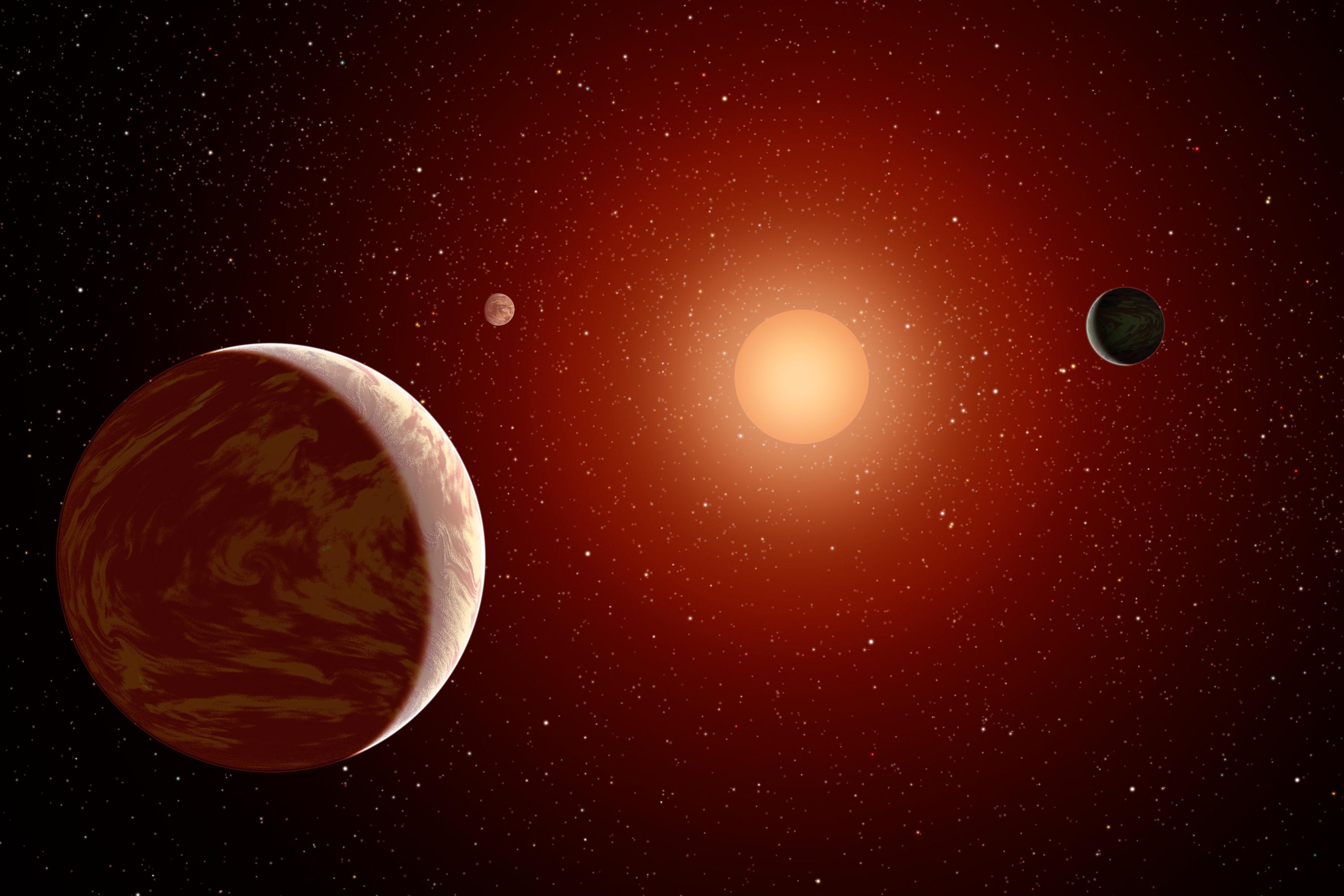
Image from NASA/JPL-Caltech
For your reading pleasure: a totally frivolous post based off musing I’ve been doing when I actually have time to sit down and watch TV.
Recently I’ve been on a scifi kick (and got sucked into watching episodes of Stargate: Universe online, which is a great way to see a whole series but a massive free-time sink). Interpersonal issues aside, the characters on SGU, who are stuck on an alien spaceship on the other side of the universe, spend a lot of time visiting new planets, looking for resources like food and water. Sometimes the main barrier to this is an alien critter that doesn’t like them much, but often they end up on deserted planets with little more than a “well, you can breathe and it’s not too cold” from the probes they send through first.
This seems like an awfully dangerous way to go about things, even if you have a remote control camera to send through your alien transportation device of choice. Wouldn’t it make a lot more sense to do some kind of triage before you go traipsing around a new planet, hoping to stumble across the resource you’re looking for?
This got me thinking about how I would handle things if I were the ship’s geologist. (It would be really cool if that was an attainable job description, but we can’t all be astronauts, I guess.) In a situation where making a mistake might lead to unpleasant consequences, it would be a good idea to do the same methodical check each time you’re thinking of visiting a new planet. So here are a few things I would pay attention to after my initial “Holy crap I’m going to another planet!” moment, assuming I had the sensors to pick up data like this:
- What does the atmospheric composition look like? Does it have a lot of greenhouse gases (probably a hot climate below) or is it pretty thin (cold, unbreatheable or both)? Does it protect the planet from bombardment or space weather? It’s great to find a planet with useful resources, but not if you’re going to be crisped by radiation before you get to them.
- What’s the planet’s composition? This is going to affect important things like gravity. Just because your planet is the same size as Earth doesn’t mean it will have the same composition and density – so you might be learning to moon-walk faster than you thought.
- Does the planet have active tectonics (and can you tell from a visual analysis)? This makes a big, big difference. Not only would this mean a higher potential for natural disasters of all types, but it will also result in a much more diverse planetary surface, and possibly different climate zones as well. (A planet without tectonics can still have volcanic activity, though.)
- Does the planet have liquid water? This also requires you to pay attention to the surface temperatures. An icy planet could still have water, or it could have methane snow (not very palatable). There are also a lot of other liquids that look like water but aren’t going to do you much good. (I will give the SGU crowd credit on this one – they do a lot of chemical testing when they’re looking for potable water.)
- What resources are you looking for? Carbonate rock might be good for fixing your air filters, for example, and could also contain useful things like flint nodules. Heavy metals can be used to fixing electronics, and are more likely to show up in mineral veins in plutonic settings. Clays are more likely to show up in tropical or volcanic settings. Knowing where you’re likely to find springs (like in karst topography) will save you time if you need water.
- What are the hazards? Are you parking your shuttle near an unstable edifice, or on a river floodplain, or next to a volcano with recent eruptive deposits? Are there visible fault scarps? Do you see evidence of flooding or tsunamis?
- What’s the likelihood that you’ll find something edible? Chemistry aside, most plants (and the animals that eat them) want to live in settings with nutrients available, which usually means you need soil of some sort. Extremophiles do exist, but they’re also likely to be unattractive, inedible or downright poisonous, depending on how they’ve adapted to living in their environment. Don’t take the chance that you might actually find arsenic-based life.
Assuming the landing party makes it down to the planet in decent shape, doesn’t get eaten immediately by an alien dinosaur or attacked by carnivorous plants, and has a little time to look around, here are a few other tips:
- Some clay can be used as a filler in food, so if you need to stretch your rations, tell your geologist to look for kaolinite. Makes a great face mask and sunscreen, too.
- If you’re near a volcano and there are fumaroles around, sticking your face in them and commenting on how much they stink is probably a bad idea. Hydrogen sulfide is detectable at very low concentrations, but if it gets a little more concentrated it will likely kill you. Also, carbon dioxide likes to hang out in those places too – and you can’t smell it.
- Try and carry some dilute HCl around with you – it’s really handy for finding those air-scrubber-worthy carbonates.
- Rocks don’t care that you’re down to one shuttle that’s held together with spit and duct tape. If you crash it in a quarry (or other similarly rocky place with steep sides), rocks are going to fall on it.
- No, you cannot create a cannon with coal, sulfur and diamonds. (To start with, you need charcoal, not coal. Also, potassium nitrate
doesn’t occur naturallytakes a little effort – you’ll need to go find a big pile of animal manure and do some processing, or stumble across a mining operation.) If you’re about to be attacked by something, just throw the diamonds at it – it will be much more effective in the short term. (Okay, this one is from Star Trek, but it’s just as applicable.) - Please boil your water. Or throw some iodine in it. It might save you trouble later on.
All right, wannabe space travelers, what geological advice would you have for someone about to set foot on an alien planet?


 Jessica Ball is a volcanologist at the U.S. Geological Survey, researching volcanic hydrothermal systems and stability, and doing science communication for the California Volcano Observatory. She previously worked at the Geological Society of America's Washington DC Policy Office, learning about the intersection of Earth science and legislative affairs. Her Mendenhall postdoc and PhD focused on how water affects the stability of volcanoes, and involved both field investigations and numerical modeling applications. Her blogging covers a range of topics, from her experiences in academic geosciences to science outreach and communication to her field and lab work in volcanology.
As Stargate’s scientist and a geophysicist, it absolutely broke my heart when we killed off the project geologist in the very first episode…
I have to say, I’m madly in love with the concept of a field astrophysicist: like a geophysicist, but in space! Space stations are small, isolated communities with concentrations of unusual characters, just like exploration camps! No idea what the parallel of a space-driller is, though, unless we count the ones who took on the planet-killing asteroid in Armageddon.
Oh — although the site is currently experiencing a hiccup & is down (sigh…), I did chat about our chemical alternate to HCl for carbonate-detection in SGU: Air.
I was definitely thinking of that post – “Air” got me thinking about the whole topic, and I was practically squealing with delight at the geologist taking center stage.
Field astrophysicist would be an excellent job. I think we need to convince NASA to start sending folks out to check out a few asteroids! I put in an application for the latest round of astronaut selection, but I’d be thrilled if we get any more geoscience folks up there.
So volcanism without tectonics? Would that be something like Tidal friction?
Yes, I was thinking Io on that one. Although we’re pretty sure that Venus has volcanoes and not so sure if it had tectonics, so there could be other things going on there. I’ll have to get the planetary volcanology folks at UB to remind me what the alternative mechanisms are, though.
I can’t think of any thing to add to your list, but just want to say… AWESOME!
I love this thought process. The subject could make a great college course for non-science majors. What better way to deliver the info about how geology works than through sci-fi?
A side thought here from a biologist’s perspective: are you sure boiling the water would suffice on an alien planet? We’d want to be sure that the microbial life is similar to Earth’s. Otherwise, you could be accidentally killed by an extremophile that can withstand boiling. Same with iodide… maybe they eat that stuff for breakfast.
I’d love to do this as a course, if I ever got the chance to teach one. My undergrad profs used to use movies in our geology classes once in a while, and those lessons were always fun.
Good point about the water. Maybe irradiating it…either that or they need to go out and harvest it from some asteroids instead. Although even that might get them into trouble.
Distillation would probably be the safest bet… perhaps alongside some reverse osmosis system.
I had the chance to teach a Practical Science Fiction course at UC Santa Barbara for a few years. It was a total blast doing different themes each week, and bringing in guest speakers. My favourite even years later was having a parasitologist come in to talk about the lifecycle and energy-mass conversion rates of parasites and predators in the movie Alien.
Funny that you mention SGU as your motivation for this article. The pilot episode had an interesting premise revolving around calcium carbonate.
Here’s a cool geological perspective on it:
http://spacemika.com/blog/2010/02/28/the-geology-of-sgu-air/
damn, maybe I should read your comments first 😉
Nah, you just did it to make me gleeful that someone, somewhere read my SGU geo-post! 😉
Saltpeter was mined for centuries. Start with:
http://en.wikipedia.org/wiki/Humberstone_and_Santa_Laura_Saltpeter_Works
and waste your time link jumping.
Ah! Didn’t know that – I took a class on historical gunpowder production once and they only talked about the biological sources. I think my main problem with Kirk was that he just randomly found the stuff laying around in that particular episode.
I absolutely loved this post, it is a really cool way to think about geology. I can’t wait for geologist to be doing this type of work on brand new worlds.
“Don’t be the one on the Away Team who’s wearing the red shirt! You’re doomed. Seriously, this was a great post, and would make an excellent exercise for non-science majors.
So I’ve known both you and your blog for however long now, but I never replied until today. Although with a post like this, how can I not? (it’s kind of exactly my thing).
To answer the question, aside from the lone outlandish character traipsing around on the surface (which is most likely Tim Curry), and even though it’s not exactly geologic, knowing the triple point of various substances and whether or not that planetary body could support it would be rather helpful. Water of course being the most obvious and important. Other substances would be good as well though too, mercury or hydrogen maybe? Basically anything that could somehow be utilized in more than one of its various states with minimal effort to convert it from one to another. Be it for consumption, fuel source, etc.
Obviously knowing this requires at least a basic understanding of the temperature and pressure of the atmosphere, so sending a probe to the surface would be the only way to know definitively. Although, an aerial probe could at least tell the composition and give the pressure I suppose. Additionally and most importantly, even if the planet could support the triple point of a substance, one would have to be smart enough to be able to control that substance in its various states to use it to its fullest without a Hollywood style accident occurring.
You covered just about everything geologically, so that’s what I would look out for afterwards. Great post! And don’t worry, some day we’re all going to be lead geologists on a spaceship crew! (see these are the kinds of things I think about when I move to a new city and don’t know anyone :P)
Good thoughts! Things to keep in mind for Mars for sure.
[…] to post lately. (Plus I had to do my taxes this weekend…) But I did get great comments on the “Survival Geology” post, especially about using movies and TV to teach science, and I thought I’d run with some […]
Interesting post!! I haven’t watched Stargate: Universe, but I do remember the Star Trek episode where Kirk injures a Gorn captain with a homemade bamboo cannon. It isn’t very likely that you’d just find the stuff needed to make a cannon scattered on an alien planet, but don’t forget that the diamonds, charcoal, and saltpeter were intentionally planted by advanced aliens, not naturally available. They could have left battle-axes lying around if they had wanted too.
In-situ resource utilization will be very important for starship crews. We will want to find fuel for fusion reactors, various metals, potable water, and so on. We could refuel by mining hydrogen for comets and asteroids, or maybe even skimming hydrogen from the atmosphere of gas giants. For water, I would recommend mining comets and icy moons. Planetoids and planets could offer supplies of rocks, metal ores, and so on- this is where the field geologist comes in. For food, I would rely on hydroponics. Even if we find life-bearing planets, the local ecosystem probably won’t offer anything edible to humans. The aliens may be full of toxic substances or even based on a completely different biochemistry. I haven’t even touched on the hostile aliens that invariably populate unexplored planets in SF…
I wonder exactly how many planets in the universe are actually suitable for human colonization. Obviously atmospheric pressure, composition, temperature, and so on are important here- but what about the possibility of an asteroid or comet impact? Is the star the prospective colony planet orbits prone to dangerous flares? What about planetary natural disasters like earthquakes, volcanoes, and tsunamis? You don’t want to land on a new planet only to find that you’ll be crisped by a stellar flare or that a super-volcano is about to fill the atmosphere with ash.
I have a question- would a planet without plate tectonics have rich ore deposits? Ore deposits form through many geological processes, but a planet with no plate tectonics won’t have nearly so many of these processes occurring as a planet with plate tectonics does. Look at this- science fiction is going to make me want to take a geology course…
Christopher – Good point about the Gorn! I’d forgotten that detail. Sounds like you’ve done a lot of thinking about this. I suspect that there are probably few planets outside of our solar system that could be considered ‘ideal’ for colonization – if I’m remembering correctly, many of the exoplanets that we do know about are quite a bit larger than Earth and probably much more likely to be gas giants than rocky planets. Potential natural disasters (and the presence of an adequately insulating atmosphere) would definitely limit your choices among the rocky ones, too.
I suspect that a planet without plate tectonics wouldn’t have much in the way of large, accessible ore deposits, but those things can form at lower temperatures (so you wouldn’t necessarily need volcanism, just a heat source to circulate fluids and dissolved ions), so you might still have some. I’m always glad to get people thinking about stuff like this, though – you should definitely go try out a geology course!
Thanks!! It is likely that the smaller exoplanets we have found recently are more like mini-Neptunes than large Earths. Even if Earth-like planets with oxygen rich atmospheres and life turn out to be common, there will be many other kinds of strange planets- and possibly even strange life-forms adapted to such environments. Some SF stories show humans settling the mountain tops and high plateaus of mini-Neptune planets. Even though the lowlands are covered in slush and dense, foggy atmosphere, the high mountains may be pleasant. You might say the problem with such planets is not that the atmosphere is too dense but that sea level is too high off the ground!!
I have done a lot of thinking about interstellar colonization. I’ve noticed that researchers have done some thinking about how to build and launch a starship, but rarely has anyone discussed exactly how or where we might build a settlement on an exoplanet. Nonetheless, this is a vital aspect of any interstellar colonization mission.
What if you are among the last generation born on an STL generation ship, the ones to actually make planet-fall, and you find that the only two planets in the star system your ship has reached are a mini-Neptune and a scorched, desert planet with a poisonous atmosphere? Or perhaps someone back on Terra discovers how to build a tachyon-shunt hyperdrive. Will we find Earth-like worlds ripe for colonization, or will we have to send in Weyland-Yutani planetary engineers first to give prospective colony planets breathable atmospheres?
So- could Mars have ore deposits? There was volcanism on Mars, so adequate heat sources were available. Something to keep in mind for a Mars colonization effort. It may not be rare elements that attract attention when we establish space colonies, though- even lunar regolith may be invaluable both as radiation protection and a source of common elements and building materials. Yep- sometime I’ll have to try out a good geology course!!