

25 January 2011
(Edible) rheomorphic tuff: Accretionary Wedge #30
Posted by Jessica Ball
Following up from my post on rheomorphic flow in volcanic tuffs, it’s geology bake sale time! For my submission to this month’s Accretionary Wedge, hosted at Mountain Beltway, I’m trying to draw a few parallels between a confection more commonly known as “zebra cake” and deformation in pyroclastic deposits. To do a quick recap, rheomorphic flow occurs when parts of a pyroclastic deposit – either during or after deposition – become viscous enough to flow like a syrup. If there is flow banding in the deposit, it can become deformed and folded back on itself to form some visually striking patterns (such as in this piece of rhyolite from Mono-Inyo craters in California). So let’s bake a flow-banded pyroclastic deposit!
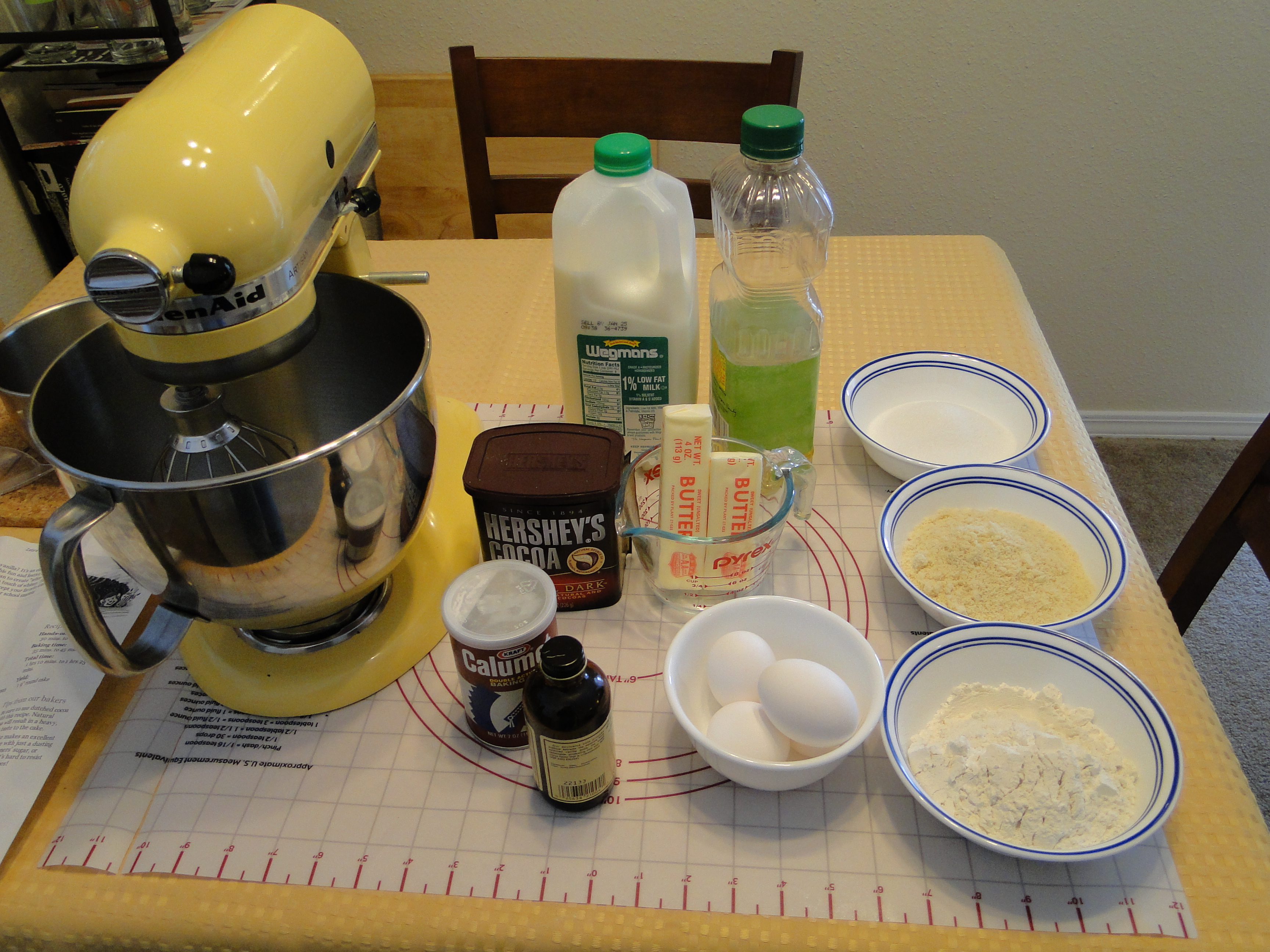
Not how you make your average pyroclastic rock...
Zebra cake is similar in that it consists of alternating layers of vanilla and chocolate cake batter, poured in such a way that they form a “sideways” pattern in the cake pan rather than being layered vertically. In this cake, the alternating layers of vanilla and chocolate batter will represent flow banding that is compositionally different – the cocoa powder is ash that’s richer in some dark component (mafic minerals like pyroxene, hornblende or biotite), perhaps. In this particular version of the recipe in that link, I’ve substituted almond flour for some of the regular flour (think of it as throwing pumice pyroclasts in with the volcanic ash).
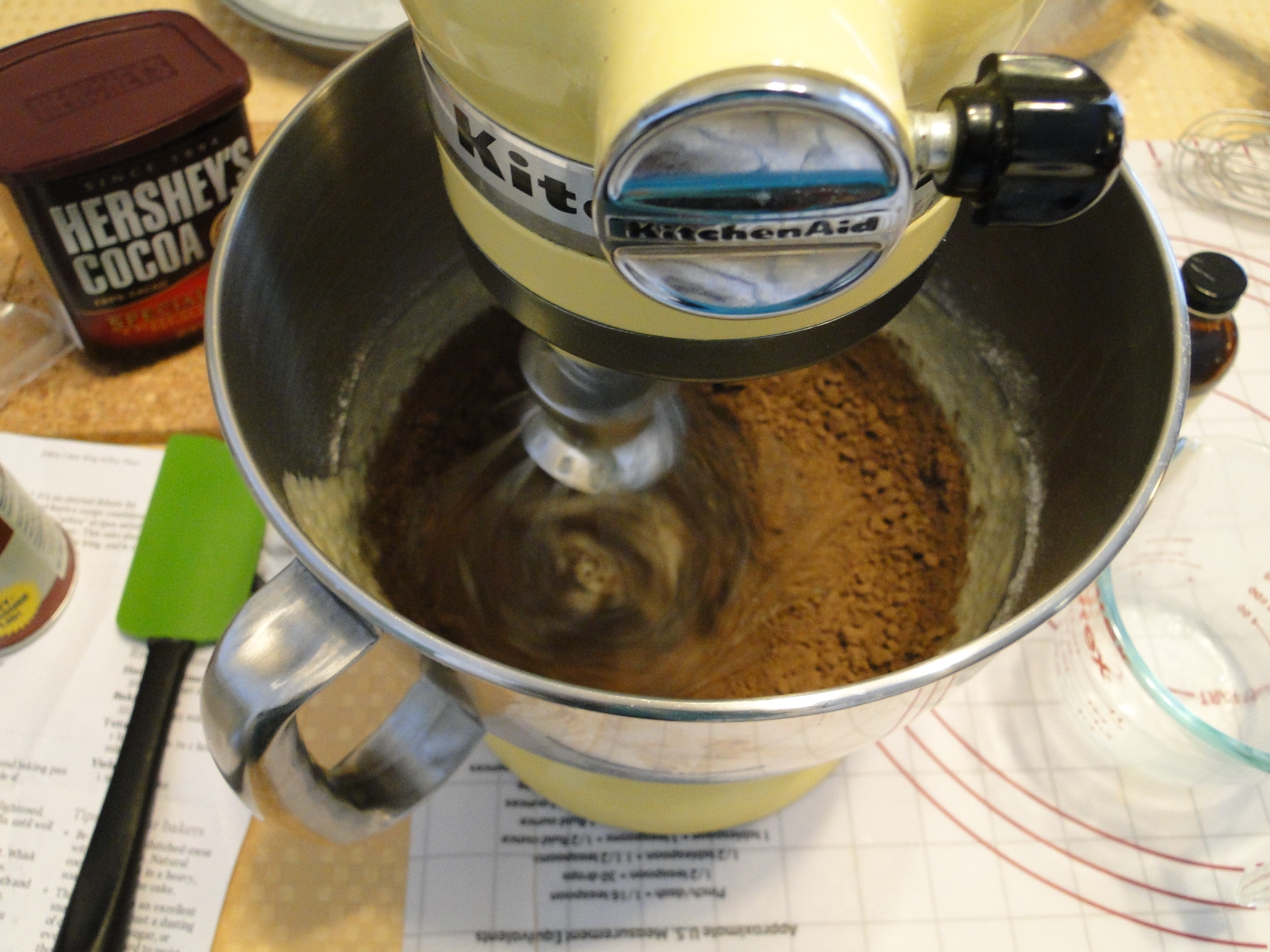
Mixing in the mafic minerals
As I pour the cake, deformation is being introduced as different layers are being added to the deposit (since one flavor pushes the other out of the way, and so on. This could be an analogy for different pulses of a pyroclastic flow being deposited, or even different eruption pulses, which could vary the composition of a deposit. This is syn-depositional deformation.
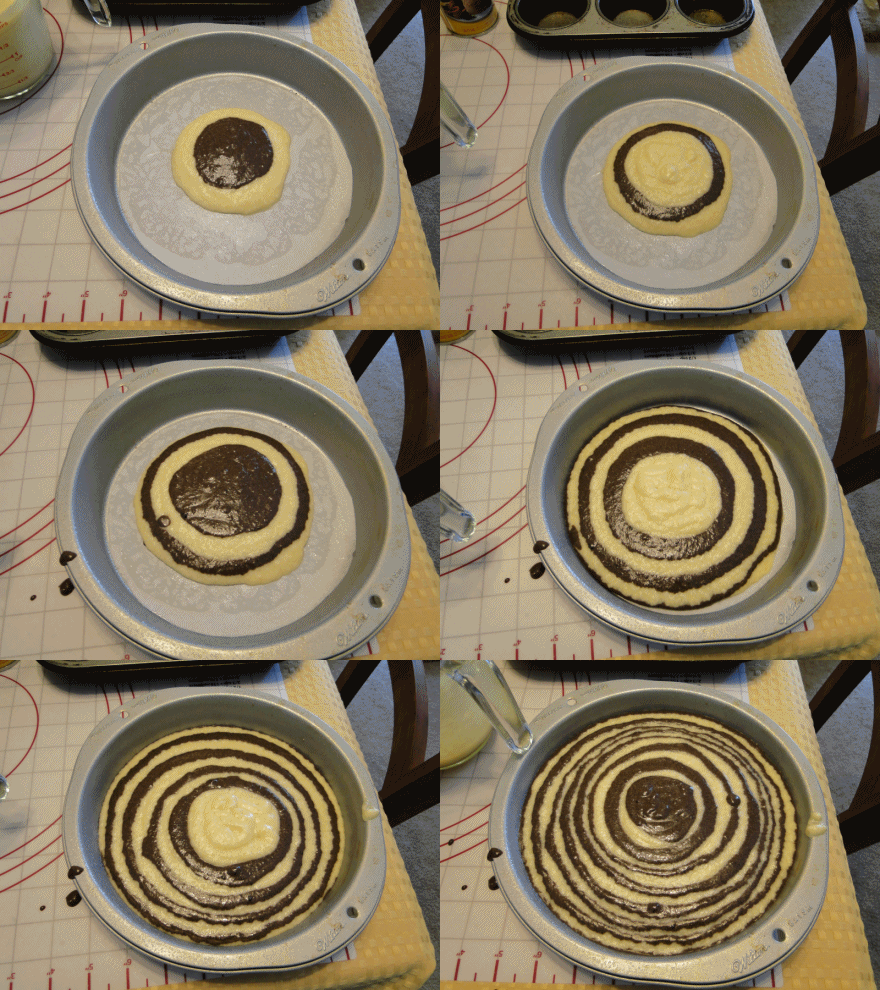
However, if I tilt the cake pan a little bit and allow for some more flow, this could be considered post-depositional deformation.

The pyroclastic deposit sliding "downhill"
The baking process is going to be an analog for welding, in which the heat retained in the pyroclastic material fuses it together into a dense rock. Since this is a high-grade (very hot) pyroclastic deposit, we’re not going to see any other features like gas-escape pipes – just the results of rheomorphic flow.
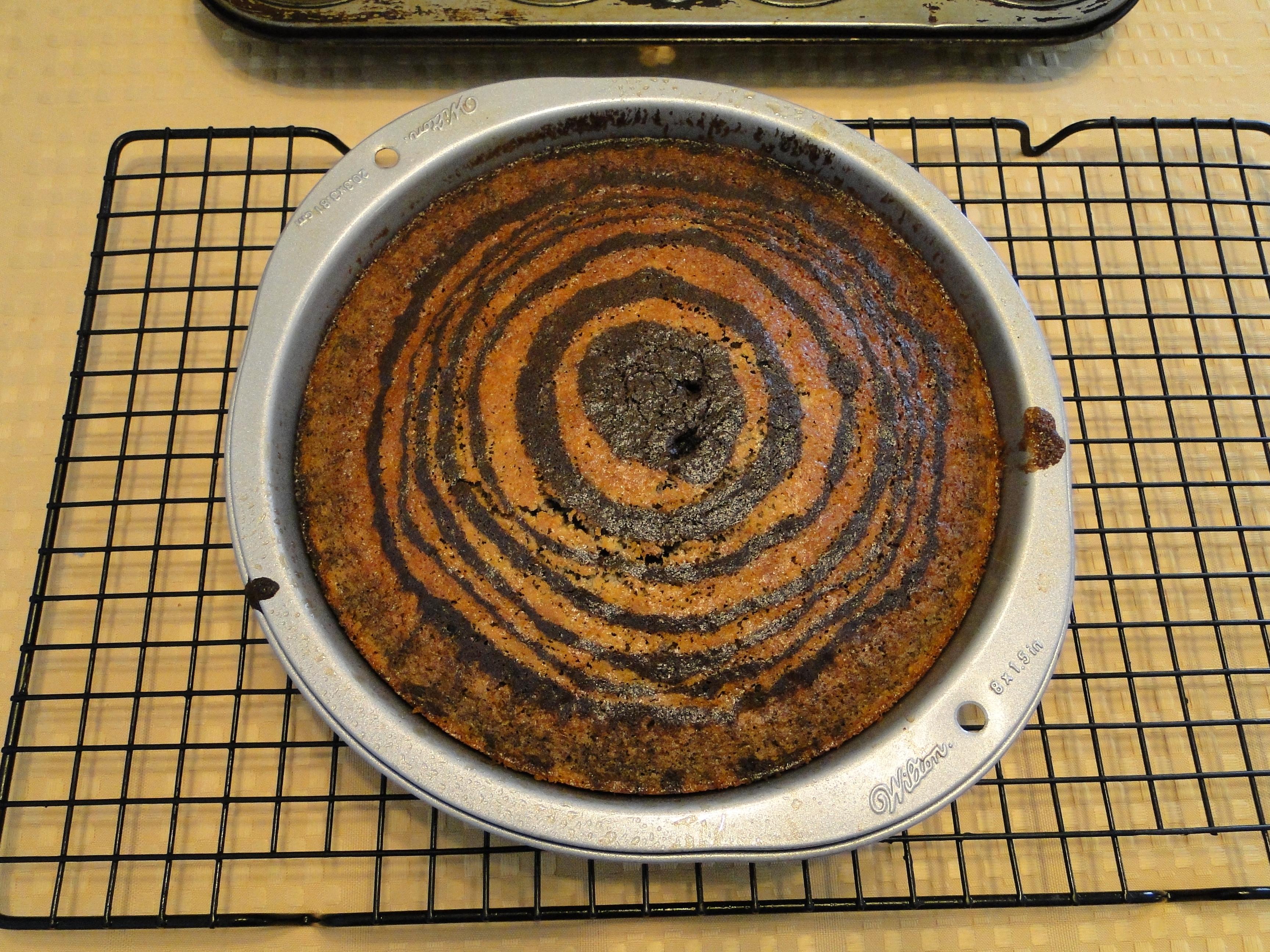
Welded 'pyroclastic deposit', with a few surficial cooling fractures
Beautiful! A nicely welded “deposit” with clear compositional variations – at least in map view. Let’s add a sugary co-ignimbrite ash fall deposit:
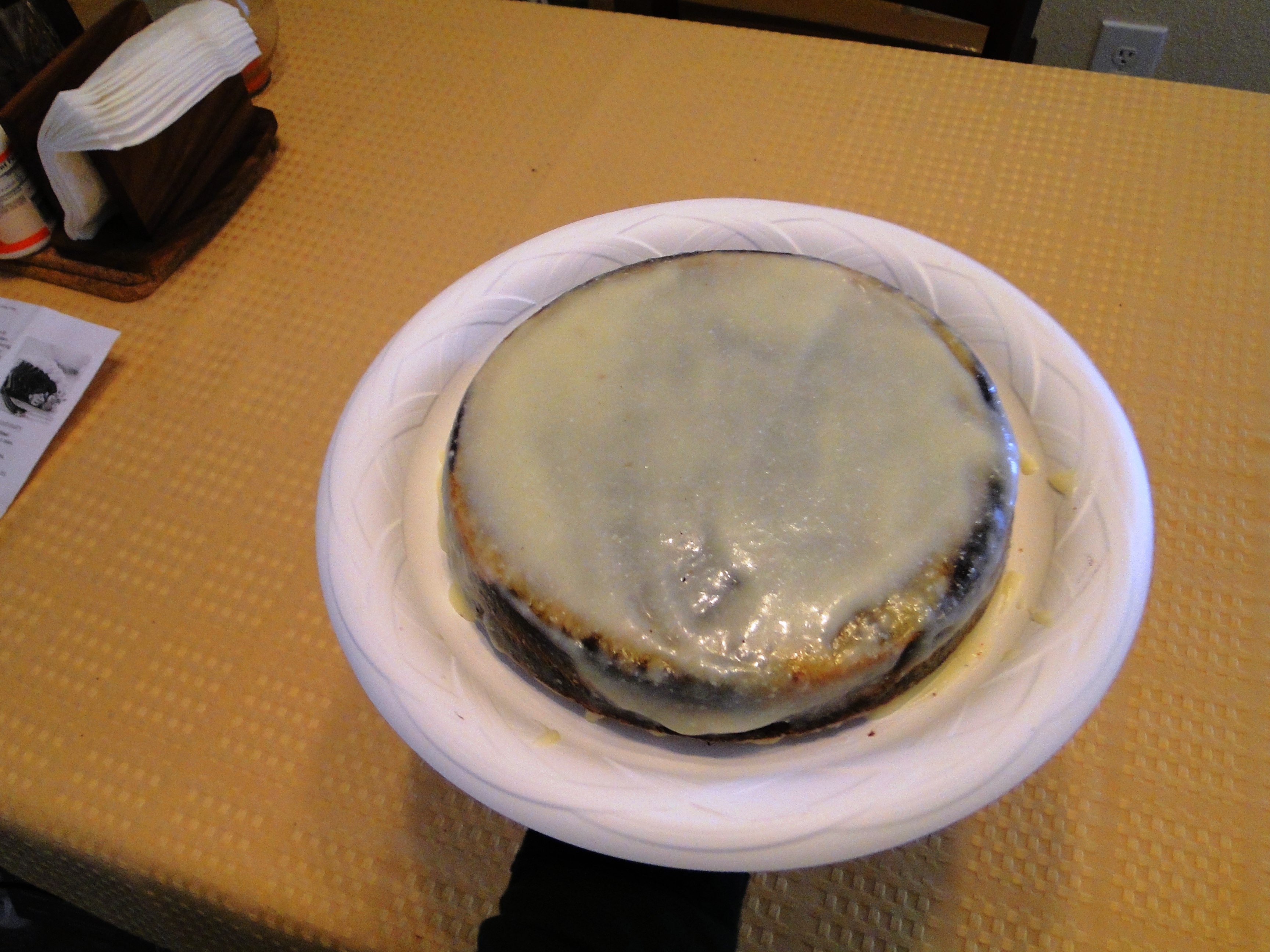
Orange-lemon-cream cheese 'ash'
Then take a look at a cross-section:

Really chaotic flow banding
Well, that didn’t turn out quite as beautiful as this. But if you think about it, this is a good analog for how things actually happen in natural systems – not neatly. This, then, is a pyroclastic deposit that has been very welded (and mixed a bit, post-deposition), to the point where it’s almost obliterated the flow banding that ideally would have shown up in cross-section. I’ve tried to annotate the remaining deposit to show the banding:
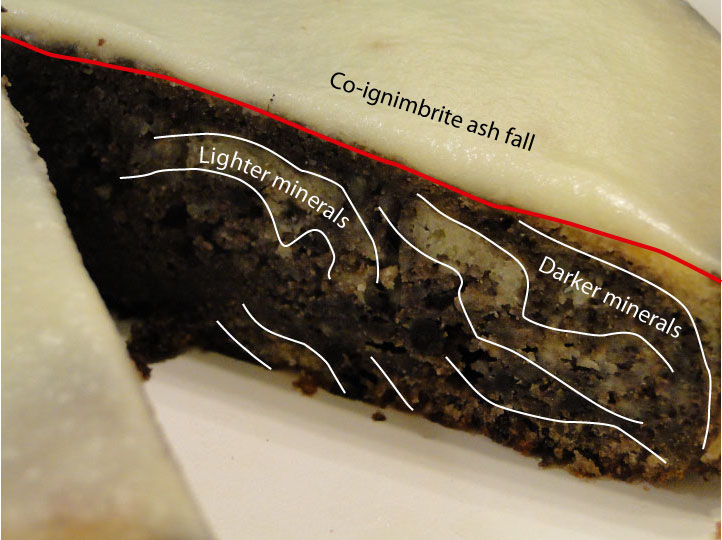
Of course, this is open to interpretation, but it looks like (in some places) the layers have overridden each other rather than pushing each other out of the way. (I suspect it had something to do with the almond flour; next time I’ll try it with just the regular kind.) Still, it’s the most delicious pyroclastic deposit I’ve ever tasted. (In geology, odds are you’ll get around to tasting a lot of rocks, even pyroclastic ones.)
And, as in any volcanic eruption, there’s usually a little cleanup afterward:


 Jessica Ball is a volcanologist at the U.S. Geological Survey, researching volcanic hydrothermal systems and stability, and doing science communication for the California Volcano Observatory. She previously worked at the Geological Society of America's Washington DC Policy Office, learning about the intersection of Earth science and legislative affairs. Her Mendenhall postdoc and PhD focused on how water affects the stability of volcanoes, and involved both field investigations and numerical modeling applications. Her blogging covers a range of topics, from her experiences in academic geosciences to science outreach and communication to her field and lab work in volcanology.
Looks very yummy! And rheomorphic.
This is great! I love the detail and the documentation of the process. I’m planning on doing something similar for part of mine, but I’m not varying the composition (just the color). I wonder if the addition of the cocoa has either enough of a density difference or cooking time difference relative to the yellow cake to promote more mixing, or if it has to do with initial layer thickness. Any of these are appropriate for a geo cake!
Love your cake,and the explanation of deformation! Your cake is a good analogy for us non-geologists.
Really bad idea to visit this blog late in the evening, with dinner long behind me and not a single sweet thing in the house…not even a chocolate chip. Next time please post a suitable warning on the intro to such posts. Man does your geological demo look yummy!
You’ve inspired me to go out and taste some pyroclastic deposits! Although they probably won’t taste quite as good….
[…] that she wanted to bake something relevant to her own volcanologic research, and so she made up a batch of rheomorphic tuff. As with the real-life inspiration, her cake has layers of mafic and felsic minerals that make a […]
[…] (**For the how-to on creating the folds, check out Magma Cum Laude’s great post on (edible) rheomorphic tuff.) […]
muy interesante!